Best Seat Covers for Jeep Wrangler JK: Ultimate Protection Guide
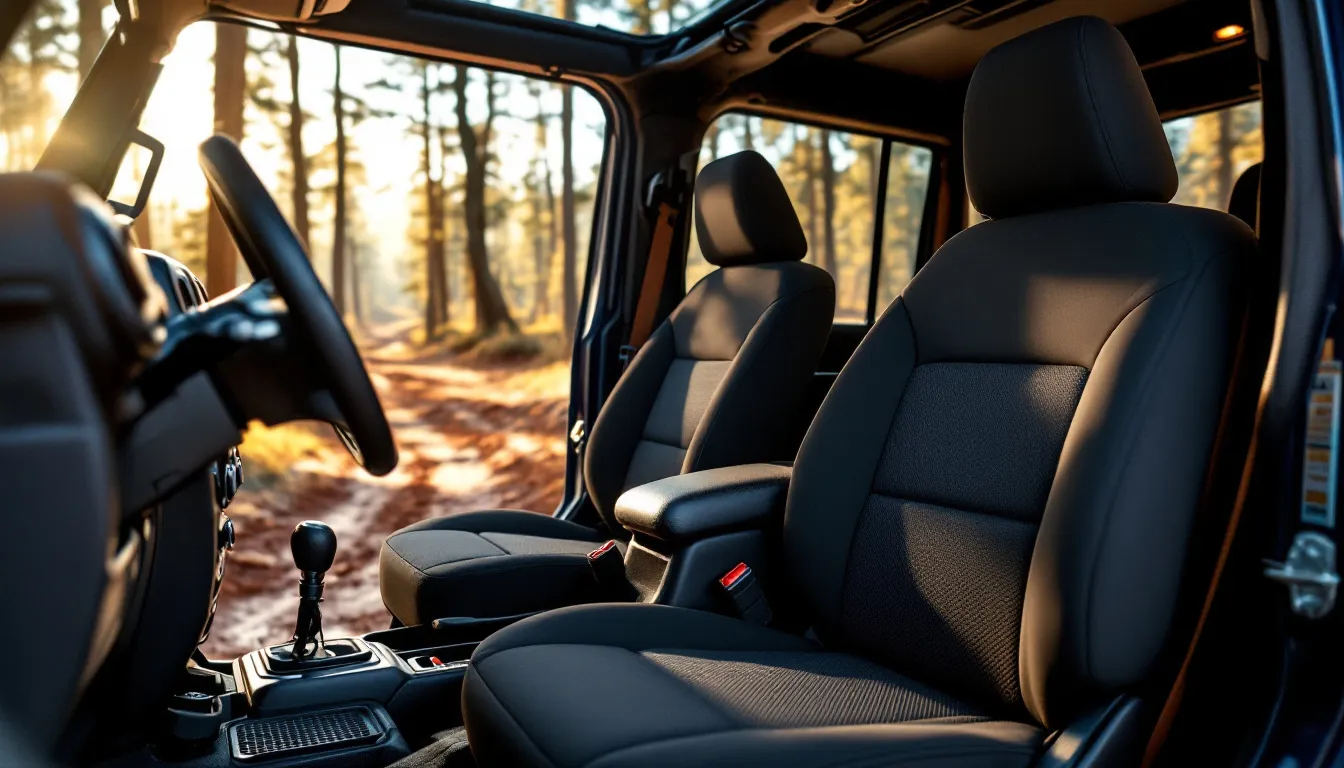
Best Seat Covers for Jeep Wrangler JK: Ultimate Protection Guide
Most owners go through three sets before settling. Cheap universal-fit neoprene from an accessories shop looks fine for about two weeks, then shifts and bunches like a bad sofa cover. Custom-fit covers last longer, but the stitching commonly fails at the seams after about six months of sliding in and out in dirty clothes. With how often I’m coming back from trails caked in dust, the seats take serious abuse.
The third set is what I’m running now: proper marine-grade neoprene with reinforced seams and seat heater compatibility. They’ve survived a full winter, multiple muddy weekends, and my toddler’s best efforts to destroy everything he touches. Still look new.
The lesson: buy once, cry once. The cheap covers cost me more in total than if I’d just bought the good ones upfront.
This guide covers all JK model year differences (2007-2018), both 2-door and 4-door JKU configurations. You’ll get individual product reviews, a material comparison, fitment tips, installation guidance, and a full FAQ — everything you need to pick the right cover the first time.
Best Seat Covers for Jeep JK: Quick Picks at a Glance
Here’s your at-a-glance comparison before we go deep. Whether you’re after waterproof neoprene, upscale faux leather, or a tactical MOLLE organizer, there’s a purpose-built option for your JK.
| Product | Material | Fit Type | Price | Best For |
|---|---|---|---|---|
| Diver Down Neoprene Set ⭐ Best Overall | Neoprene | Custom (JK-specific) | $199.99 | All-weather trail use |
| Coverking Neoprene Black/Red | Neoprene | Custom (2011-2018 only) | $241.99 | Premium daily driver |
| Generic Neoprene Set SB472122 | Neoprene | Semi-custom | $149.99 | Budget neoprene |
| Wrangler Full Set Leather (JK/JL) | Faux Leather | Custom (4DR) | $139.99 | Upscale interior look |
| GIANT PANDA Faux Leather | Faux Leather | Custom (2013-2017) | $129.99 | Front seat upgrade |
| SUNPIE MOLLE Organizer | Polyester/Tactical | Universal | $49.96 | Gear organization |
Footnote: 2-door JK and 4-door JKU require different cover sets — never assume a single listing covers both. Always confirm door count before purchasing. The Diver Down set shown is spec’d for 2DR 2007-2010; 2011-2018 and JKU variants are sold separately.
Get new guides by email
One email when we publish something worth reading. Unsubscribe anytime.
Best Overall: Diver Down Neoprene Seat Cover Set (2007-2018 JK)
When people ask me for a single recommendation without needing much backstory, this is the one I send them. The Diver Down Neoprene Seat Cover Set is purpose-built for the Jeep JK — not retrofitted from a generic template.
The waterproof custom fit is what sets this apart. The cover follows every contour of your JK’s factory seat rather than bunching at the bolsters or gaping at the headrest channels. That matters enormously once you’ve wheeled through a creek crossing or left the doors off in a rainstorm.
This is exactly the kind of cover that ended my annual seat cover replacement cycle. After two failed cheaper attempts, the Diver Down set locked in clean and stayed put. No more repositioning covers mid-trail. No more blown-out seams. Just seats that actually looked like they belonged in the rig.
The neoprene construction handles temperature extremes well — it won’t scorch your legs in summer sun or feel like sitting on a frozen slab in January the way some synthetics do. The padded cushion layer underneath adds noticeable comfort over long drives, which matters if your JK doubles as a daily driver.
Compatibility note: This specific listing fits the 2-door JK, 2007-2010 seat configuration. Jeep revised the seat design for 2011+, so verify your model year before ordering. The Diver Down line offers separate SKUs for 2011-2018 and for the 4-door JKU — worth double-checking your build date on the door jamb sticker.
Pros:
- True custom fit for JK seat contours
- Fully waterproof neoprene material
- Thermal-resistant — comfortable across seasons
- Covers front and rear seat set
- Available for Rubicon, Sport, and Sahara trim levels
Cons:
- Premium price point
- Year/door-count variants sold separately — easy to order the wrong one
- Black-only colorway in this listing
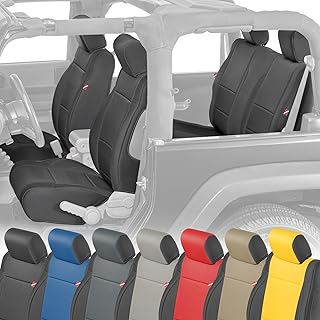
Diver Down Neoprene Seat Cover Set - Fits Jeep JK 2007-2018 Wrangler - Front and Back Seat Set
Check Price on Amazon →Best Premium Pick: Coverking Neoprene Black/Red (2011-2018 JK)
Important fitment warning: This cover fits 2011-2018 JK only. Do not order this for a pre-facelift JK.
Here’s why that year split actually matters: Jeep didn’t just reskin the interior in 2011. They changed the seat structure itself. The seat back geometry shifted. The side bolster profile got deeper. The headrest post spacing moved. A cover engineered for 2007-2010 geometry will gap at the bolsters and bunch at the headrests on a 2011-2018 JK — it’s not just a cosmetic misfit.
The Coverking Black/Red neoprene set is the premium choice for 2011-2018 owners who want a sharp-looking, hard-wearing interior that actually fits. The two-tone colorway is clean — black base with red accents — and Coverking’s reputation for tight custom patterns is well-deserved. These covers hug the seat without loose fabric at the edges.
Pros:
- Precise custom fit for 2011-2018 JK seat design
- Sharp Black/Red two-tone colorway
- High-quality neoprene construction
- Resists water, mud, and UV degradation
- Front seat kit with strong side bolster coverage
Cons:
- Highest price in this roundup at $241.99
- Front seat only — rear seat sold separately
- Strictly 2011-2018; incompatible with 2007-2010 seats
- Red accent may not suit all interior styles
If you have a 2011-2018 JK and want the best-fitting neoprene money can buy for the front seats, Coverking earns its price. Budget for the rear kit separately to complete the look.
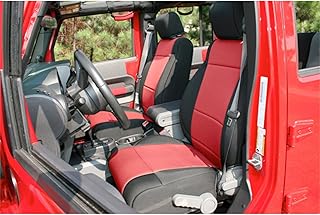
Seat Cover Kit, Front, Neoprene, Black/Red | 13215.53 | Fits 2011-2018 Jeep Wrangler JK
Check Price on Amazon →Best Budget Neoprene: Generic Neoprene Set & Universal Options
Not every JK needs a $200 seat cover. If your rig takes occasional weekend trail duty rather than daily abuse, a budget neoprene option can do the job — with some important caveats.
The SB472122 neoprene set delivers solid waterproof protection at $149.99. It uses a semi-custom pattern rather than a fully JK-specific template, which means fitment is decent but not perfect. You’ll likely deal with minor bunching at the lower seat bolsters, and the rear fold-down sections may need some coaxing to lie flat.
Here’s the real issue with loose-fitting covers: on rough trails, they shift. A generic or semi-custom cover that doesn’t lock tightly to the seat foam will creep and bunch, and eventually expose the seat underneath at the worst possible moment — like mid-rock-crawl when you’re relying on your seat to hold you in position. Custom-fit neoprene doesn’t have this problem. Budget options might.
The Front Set Universal Neoprene cover (Blue, $89.99) is the most affordable option here. It covers low-back front seats with removable headrests and carries an airbag compatibility claim. This is a reasonable choice for a street-driven JK where you want splash and spill protection on the cheap. For trail rigs, step up to a custom-fit option.
Pros (SB472122):
- Strong price-to-protection ratio
- Waterproof neoprene material
- Available for front and rear
Cons (SB472122):
- Semi-custom fit — not perfectly JK-specific
- May shift under aggressive off-road use
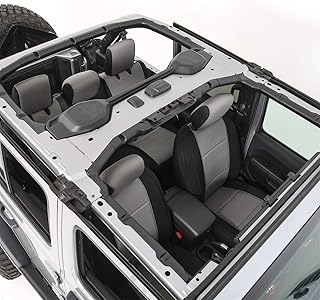
NEOPRENE SEAT COVER SET - SB472122
Check Price on Amazon →
Front Set Neoprene Car Seat Cover for Low Back Seats with Removable Headrest, Universal Fit, Airbag Compatible
Check Price on Amazon →Best Leather & Faux Leather: Upscale Interior Look for Your JK
Leather-style covers serve a different customer than neoprene does. If your JK spends more time as a daily driver or family hauler than a trail rig, faux leather gives you a clean, upscale interior look with easier wipe-down maintenance than fabric.
Always confirm airbag compatibility before purchasing any seat cover. The JK’s front seats have side-impact airbags integrated into the seat structure on many trim levels. A cover that isn’t airbag-compatible can obstruct deployment — that’s a safety issue, not just a fitment inconvenience. Both leather options listed here include airbag compatibility claims, but verify this against your specific JK’s airbag configuration.
The Wrangler Full Set Leather ($139.99) is the more versatile option. It’s listed as compatible with JK and JL 4-door configurations, which is convenient if you’re upgrading and plan to keep covers across models. However, JK and JL interiors are meaningfully different — review JK vs JL interior differences before assuming a shared-fit cover will land perfectly on your JK seats. It also includes lumbar support cushions, which many JK owners appreciate on longer drives.
The GIANT PANDA Faux Leather set ($129.99) is more tightly scoped: 2-door and 4-door JK, 2013-2017 only, front seats. If your JK falls in that window and you want front seat covers in a refined black faux leather, this is a well-regarded option with a genuinely custom cut.
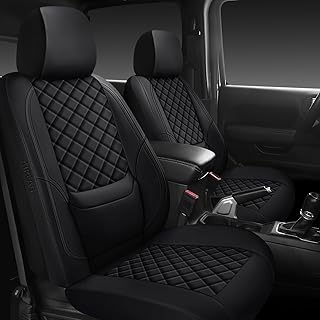
Wrangler Seat Covers 2007-2026 Full Set, Waterproof Leather Interior Sets with Lumbar Support Custom
Check Price on Amazon →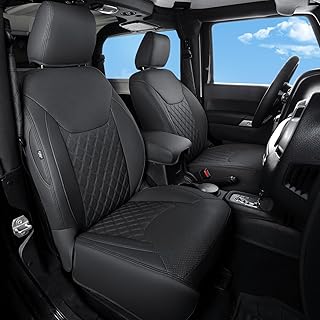
GIANT PANDA Front Jeep Wrangler 2/4 Door JK 2013-2017 Car Seat Covers for Sahara Sport Rubicon Unlimited
Check Price on Amazon →Best Tactical Pick: SUNPIE MOLLE Seat Back Organizer Cover
Let’s be direct: the SUNPIE MOLLE Seat Protector is not a full seat cover. It mounts to the seat back and provides a flat protective surface behind the front seats while adding MOLLE webbing for gear attachment. It does not cover seat cushions, seat bottoms, or side bolsters.
Many buyers discover this only after unboxing. If you’re expecting full waterproof seat coverage, look at the neoprene options reviewed earlier. The SUNPIE fills a different need entirely.
What it does brilliantly: rear passenger protection against muddy boots, gear, and kids. The MOLLE panel lets you attach pouches, tool rolls, recovery gear, first aid kits, and hydration accessories — a genuinely useful setup for JK owners who run open-air trail setups and need organized gear access without a dedicated storage setup.
At $49.96, it’s the lowest-cost item in this roundup and represents solid value for what it does. It’s compatible with JK, JL, JT, and even non-Jeep platforms like the F-150, which reflects its universal-ish design. Install is simple: straps secure around the seat headrest posts.
The best use case: Pair the SUNPIE with one of the front neoprene covers reviewed above. Neoprene up front for waterproof protection where you sit; SUNPIE in the rear for gear organization and seat back protection. It’s a $250 combined solution that covers most real-world JK needs.
Pros:
- Excellent MOLLE gear organization
- Protects rear seat backs from boots and cargo
- Easy install and removal
- Very affordable at under $50
Cons:
- Does NOT cover seat cushions or seat bottoms
- Universal fit — not JK-specific
- No waterproof coverage for rear seat surfaces
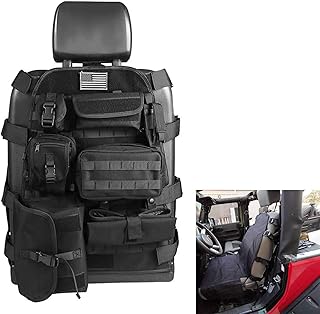
SUNPIE Black Upgrade Larger Seat Protector Tactical Seat Cover Universal Fit for Trucks Pickup SUV
Check Price on Amazon →How to Choose JK Seat Covers: Material, Fit, and What Actually Matters
Choosing the best seat covers for Jeep JK means matching material and fit type to how you actually use the truck — not just buying whatever has the highest review count.
Neoprene vs Leather vs Canvas
Neoprene is the gold standard for trail-focused JKs. It’s waterproof, UV-resistant, soft to the touch, and holds up well to the repeated wet-dry cycles that come with creek crossings and rainstorms. The thermal properties help in both heat and cold. The real downside: it traps odors over time if not cleaned, and it’s the priciest material category.
Faux leather suits daily drivers and show rigs. It wipes clean quickly, looks sharp, and won’t absorb mud odors. The tradeoff is that leather-style materials can become slippery when wet — not ideal if you’re scrambling in and out of a rig that’s missing its doors. Most JK owners treating their rig as a street vehicle will be happy here.
Canvas (ballistic nylon, heavy-duty poly blends) sits between the two. It’s tough, relatively water-resistant, and breathes better than neoprene. Less common in JK-specific applications, but worth considering for high-UV desert environments where neoprene heat buildup is a concern.
| Material | Waterproof | UV Resistant | Trail Use | Street/Daily | Price Range | |---|---|---|---|---| | Neoprene | ✅ Excellent | ✅ Good | ✅ Best | ✅ Good | $$ – $$$ | | Faux Leather | ✅ Good | ⚠️ Fair | ⚠️ Slippery wet | ✅ Best | $ – $$ | | Canvas | ⚠️ Moderate | ✅ Excellent | ✅ Good | ✅ Good | $ – $$ |
Custom Fit vs Universal Fit
Custom-fit covers are engineered for a specific seat pattern. They hug bolsters, route cleanly around headrest posts, and don’t shift under load. Universal covers use elastic edges and Velcro to approximate a fit — passable for casual use, problematic on trails.
For Jeep JK seat protection, custom fit is always the better call if budget allows. The seat shapes in 2007-2018 JKs are distinctive enough that a well-made custom cover looks and functions dramatically better than a stretchy universal version.
JK Year Compatibility (2007-2010 vs 2011-2018)
This split trips up more buyers than any other spec. Jeep revised the JK’s seat design in 2011 — seat back geometry, bolster depth, and headrest post positioning all changed. A cover made for 2007-2010 will not fit a 2011-2018 JK cleanly, and vice versa.
Always check the door jamb sticker for your exact build date. When in doubt, cross-reference with the complete JK model year changes (2007-2018) or ask in JK owner communities. Real-world fitment feedback from other owners — the kind you find in forum threads and owner groups — is far more reliable than product spec sheets. The JK buyer’s guide for new owners is another solid starting point if you’re still sorting out your build specs.
JK Seat Cover Installation Tips: Get a Clean Fit the First Time
Installing seat covers on a JK isn’t complicated, but skipping steps leads to a sloppy result that shifts on the trail.
- Remove the headrests completely. Pull them straight up and set them aside. Threading cover straps around installed headrests guarantees uneven tension and a lumpy finish.
- Drape the cover over the seat back first, centering it left-to-right before tucking anything. Rushing straight to the edges without centering is the single most common mistake.
- Tuck the seat back cover down into the seat-back/cushion gap, using a blunt tool (a plastic trim pry bar works well) to push the tuck strap deep enough to stay put.
- Route the seat bottom cover, starting from the front edge, pulling the material toward the rear and securing the elastic or strap underneath the seat rail.
- Reinstall the headrests through the designated cover openings last, then adjust for even tension across all surfaces.
The most common mistake: skipping the initial centering step. Covers installed off-center will pull to one side under seat movement and never quite look right.
For JKs with integrated side-impact airbags, ensure your cover’s side seam is airbag-compatible. The seam needs to split cleanly during deployment. Most quality JK-specific covers account for this, but verify before you consider the job done.
Soft-top JKs see significantly more water intrusion than hard tops — doors off, top down, caught in weather — so consider that when choosing your material. If you run a soft top regularly, waterproof neoprene is not optional. Check out JK soft-top vs hard-top differences for more context on interior exposure.
Frequently Asked Questions: JK Seat Covers
What are the best seat covers for a Jeep Wrangler JK?
The best seat covers for a Jeep Wrangler JK are custom-fit neoprene sets designed specifically for the 2007-2018 JK seat geometry. The Diver Down Neoprene Set (2007-2010 2DR) and the Coverking Neoprene Black/Red (2011-2018) are the top picks for trail-ready, waterproof coverage. For daily drivers seeking a refined look, faux leather options like the GIANT PANDA set offer a clean custom fit for 2013-2017 JKs.
Are Jeep JK seat covers waterproof?
Not all of them — material makes all the difference. Neoprene seat covers are fully waterproof and the best choice for JKs exposed to rain, trail water, or doors-off operation. Faux leather provides good spill resistance but isn’t truly waterproof at seams. Canvas and fabric covers offer only moderate moisture resistance. If your JK runs a soft top or frequently goes topless, prioritize neoprene.
Do seat covers affect airbags in a Jeep JK?
They can, if you choose the wrong cover. Many JK trim levels have side-impact airbags built into the front seat structure. A cover that isn’t explicitly designed to be airbag-compatible can block or redirect airbag deployment. Always buy covers labeled airbag-compatible and ensure the side seam is designed to split on impact. This is a safety-critical spec, not a marketing checkbox.
What’s the difference between 2007-2010 and 2011-2018 JK seat covers?
Jeep revised the JK’s front seat design for the 2011 model year, changing the seat back geometry, side bolster profile, and headrest post spacing. Covers made for 2007-2010 JKs will not fit 2011-2018 seats cleanly — they’ll gap at the bolsters and bunch at the headrests. Always confirm your exact build year from the door jamb sticker, then match the cover to the correct generation. The complete JK buyer’s guide covers these generation differences in detail.
Do I need different seat covers for a 2-door JK vs 4-door JKU?
Yes. The 2-door JK and 4-door JKU (Unlimited) have different rear seat configurations, and many product listings only cover one variant. Front seat covers are typically shared between 2DR and 4DR, but rear seat covers differ meaningfully — the JKU has a larger rear bench with a different fold-down pattern. Always confirm door count compatibility in the product listing before purchasing, and never assume a single SKU covers both configurations.
How do I install seat covers on a Jeep JK without bunching or shifting?
Start by removing the headrests completely and setting them aside. Center the cover left-to-right over the seat back before tucking anything — this step prevents the off-center bunching that ruins most DIY installs. Tuck the seat back cover deep into the gap between the seat back and cushion using a blunt tool like a plastic trim pry bar. Route the bottom cover from the front edge toward the rear, securing the strap underneath the seat rail. Reinstall the headrests through the designated openings last and adjust for even tension across all surfaces.
Final Verdict: Which JK Seat Cover Should You Buy?
After cycling through three sets of seat covers — from stretchy universal covers that shifted mid-trail to marine-grade neoprene that finally stayed put — the lesson is clear: buy custom-fit, buy waterproof, buy once.
For most JK owners, the Diver Down Neoprene Set is the right answer. It’s purpose-built for JK seat shapes, fully waterproof, and built to last beyond a single season. If you have a 2011-2018 JK and want premium two-tone styling, Coverking’s Black/Red set is worth the extra spend.
Match your cover to your use case, confirm your year and door count, and check airbag compatibility. That’s the entire decision.
While you’re protecting your interior, protect the rest of your JK too — check out the best soft tops for Jeep JK and best JK hardtop options to complete your weather protection setup.
Free: JK Fluids at a Glance
Every fluid, spec and capacity for the 2007-2018 Wrangler JK on one page, plus a cut-out glovebox card. Checked against the owner's manuals. From the JK Service Kit.
Email me the download and new guides when they are published. Unsubscribe anytime. Privacy Policy.
Allan
I'm Allan. I own a 2014 Jeep Wrangler JKU and I research the hell out of every mod before I touch it. When I've fitted something to my own Jeep, I say so. Everything else is researched from manufacturer specs and other owners' reports. No sponsored fluff.
Learn more about me →Free: JK Fluids at a Glance
Every fluid, spec and capacity for the 2007-2018 JK on one page, plus a glovebox card.
Email me the download and new guides when they are published. Unsubscribe anytime. Privacy Policy.
Related Articles
Jeep JK Interior Upgrades: The 12 Mods That Actually Improve Daily Comfort
The Jeep Wrangler JK interior is a purpose-built, trail-focused cabin that trades luxury for capability — and a handful of affordable upgrades can...
Best Floor Mats for Jeep Jk All Weather Protection
All-weather floor mats for Jeep JK are custom-fit or universal protective liners made from rubber or thermoplastic materials designed to contain mud,...
Roof Rack vs Cargo Basket Jeep Jk Weight Capacity
A roof rack bolts to your JK's hard top (or roll bar) and spreads lighter gear across the roofline. A cargo basket hangs off your hitch receiver and...