JK Fluid Specifications: Complete Reference Guide

JK Fluid Specifications: Complete Reference Guide
The 2007-2018 Jeep Wrangler JK uses a short list of fluids, but the details change with the model year, the engine, the transmission and the axles. Coolant switched chemistry in 2013. The 3.6L oil filter changed in 2014. Rubicons and non-Rubicons use different front axles. Most of the fluid mistakes JK owners make come from charts that ignore those splits.
Everything below comes from the fluids and capacities sections of the Wrangler owner’s manuals (2008, 2010, 2011, 2012, 2013, 2015, 2016 and 2018), cross-checked against the published JK capacity charts of Morris 4x4 Center and ExtremeTerrain. Where sources disagree, the owner’s manual wins and we say what to check.
Quick reference: every JK fluid at a glance
| System | Fluid | Capacity | Notes |
|---|---|---|---|
| Engine oil, 3.8L (2007-2011) | SAE 5W-20, Chrysler MS-6395 | 6 qt with filter | Spin-on filter, Mopar 04105409AE |
| Engine oil, 3.6L (2012-2018) | SAE 5W-20, Chrysler MS-6395 | 6 qt with filter | 2012 manual lists 5W-30; read your oil filler cap |
| Coolant, 2007-2012 | HOAT, 5 yr / 100,000 mi formula, 50/50 | 13 qt | 3.8L and the 2012 3.6L |
| Coolant, 2013-2018 3.6L | OAT, 10 yr / 150,000 mi formula, 50/50 | 10.5 qt | Don’t mix with HOAT |
| Automatic, 42RLE (2007-2011) | ATF+4 | 4 qt service fill | 8.8 qt dry |
| Automatic, W5A580 (2012-2018) | ATF+4 | 5.3 qt service fill | 8.1 qt dry |
| Manual, NSG370 | Mopar Manual Transmission Lubricant (MS-9224) | 1.6 qt | Not gear oil |
| Transfer case, NV241J / NV241OR | ATF+4 | 2.1 qt | Fill to the fill hole |
| Front axle, Dana 30 (Sport, Sahara) | SAE 80W-90, API GL-5 | 2.1 pt | Fill to the fill hole |
| Front axle, Dana 44 (Rubicon) | SAE 80W-90, API GL-5 | 2.7 pt | Fill to the fill hole |
| Rear axle, Dana 44 | SAE 80W-90, API GL-5 | 4.75 pt | Trac-Lok: add 4 oz limited-slip additive; towing: synthetic 75W-140 |
| Brake and clutch hydraulics | DOT 3 (SAE J1703) | To the FULL mark | DOT 4 acceptable if DOT 3 isn’t available; never DOT 5 |
| Power steering | Mopar Power Steering Fluid +4, or licensed ATF+4 | To the FULL mark |
Capacities are approximate and depend on how completely a system drains. Gear housings (both axles, the transfer case and the manual transmission) are filled until the fluid reaches the bottom edge of the fill hole, on level ground. The capacity tells you how much to buy, not how much to pour.
Get new guides by email
One email when we publish something worth reading. Unsubscribe anytime.
Which JK do you have?
| Model years | Engine | Transmissions | Coolant | Oil filter (Mopar) |
|---|---|---|---|---|
| 2007-2011 | 3.8L V6 | 42RLE 4-speed auto or NSG370 6-speed manual | HOAT | 04105409AE |
| 2012 | 3.6L Pentastar | W5A580 5-speed auto or NSG370 | HOAT | 68079744AD |
| 2013 | 3.6L Pentastar | W5A580 or NSG370 | OAT | 68079744AD |
| 2014-2018 | 3.6L Pentastar | W5A580 or NSG370 | OAT | 68191349AC |
Axles depend on the trim, not the year. Rubicons have Dana 44 axles front and rear with electric lockers and the NV241OR “Rock-Trac” transfer case (4:1 low range). Sport and Sahara models have a Dana 30 front, a Dana 44 rear, and the NV241J “Command-Trac” transfer case (2.72:1). Some non-Rubicons have the optional Trac-Lok limited-slip rear. If you aren’t sure, check the axle tag or your VIN’s build sheet.
Engine oil
Both JK engines take 6 quarts of oil that meets Chrysler material standard MS-6395, including the filter. The viscosity is SAE 5W-20 in the 2008, 2010, 2013, 2015, 2016 and 2018 manuals. The 2012 manual lists SAE 5W-30 for the 3.6L. If you own a 2012, go by the viscosity printed on your oil filler cap. The 2016 manual also allows 5W-30 when 5W-20 isn’t available.
The number that matters on the bottle is MS-6395, not the brand. The 2016 manual itself names Pennzoil as an example of an approved oil. Mobil 1 5W-20 and Valvoline Advanced Full Synthetic 5W-20 also list MS-6395 on their data sheets.
Oil filters are not interchangeable across the JK years. The 3.8L uses a spin-on filter (Mopar 04105409AE). The 3.6L uses a cartridge in a housing on top of the engine: 68079744AD for 2012-2013, then 68191349AC from 2014. Tighten the 3.6L housing cap to 18 ft-lb (it’s plastic) and the drain plug to 20 ft-lb on either engine.
Change interval. On 2012-2018 Jeeps the oil-change indicator decides, up to a maximum of 10,000 miles or 12 months. For severe duty (dusty or off-road driving, or mostly idling) the 2015 and 2018 manuals say 4,000 miles. The 2008 manual caps the 3.8L at 6,000 miles or 6 months, and the 2011 manual at 8,000 miles or 6 months.
The 3.8L is widely reported to use some oil between changes. Check the dipstick regularly rather than waiting for the next change.
If you buy online, these match the spec above: a 5W-20 that states MS-6395, and the Mopar filter for a 2014-2018 3.6L (check the year split before ordering).

Mobil 1 Advanced Full Synthetic Motor Oil 5W-20, 5 Quart (Pack of 2)
Check Price on Amazon →
Mopar Engine Oil Filter Kit 68191349AC (3.6L Pentastar)
Check Price on Amazon →Automatic transmission: ATF+4 only
Both JK automatics take ATF+4 (Chrysler MS-9602):
| Transmission | Years | Service fill | Overhaul (dry) fill |
|---|---|---|---|
| 42RLE 4-speed | 2007-2011 | about 4 qt | about 8.8 qt |
| W5A580 5-speed (also called NAG1) | 2012-2018 | about 5.3 qt | about 8.1 qt |
A service fill (drain and refill) is much less than the total because fluid stays in the torque converter and cooler. The W5A580 has no conventional dipstick; its level is checked with a tool at a specified temperature, which is a job many owners leave to a shop.
Use a bottle that states it is licensed or approved for ATF+4. Valvoline ATF+4, Castrol Transmax ATF+4 and Pennzoil Platinum ATF+4 all say so on their makers’ data sheets. “Multi-vehicle” fluids that say “suitable for” or “recommended where ATF+4 is specified” are not the same thing. Valvoline’s own data sheet for MaxLife Multi-Vehicle ATF says it “is not an OEM licensed product” and points ATF+4 users to Valvoline ATF+4.
The factory schedule changes the automatic fluid and filter at 120,000 miles, or 60,000 miles for severe use (towing, police, taxi or fleet).
A licensed ATF+4 covers the automatic, the transfer case and power steering top-ups:

Valvoline ATF+4 Full Synthetic Automatic Transmission Fluid, 1 Quart (Pack of 2)
Check Price on Amazon →Manual transmission: NSG370
The six-speed NSG370 takes about 1.6 quarts of Mopar Manual Transmission Lubricant (MS-9224, Mopar part 04874464AC). It is a light synchromesh fluid, not gear oil. Pennzoil Synchromesh states on its data sheet that it meets MS-9224 for applications “requiring Part No. 04874464”. Heavy 75W-90 gear oil in an NSG370 usually shows up first as notchy, hard shifts when the gearbox is cold.
The manual schedules no routine change for normal use. It lists one under severe conditions: towing, plowing, heavy loads, off-road, or sustained high-speed driving in heat.
Transfer case: NV241J and NV241OR
Both JK transfer cases use ATF+4, about 2.1 quarts, filled to the bottom of the fill hole. The manual schedules an inspection at 30,000-mile steps and a change at 60,000-mile steps for towing and fleet use. The 2008 manual also lists off-road use. If the transfer case has been underwater, check the fluid for a milky appearance and change it if you see one.
Axles: Dana 30 and Dana 44
Every JK owner’s manual we read lists SAE 80W-90, API GL-5 gear lubricant for both front and rear axles, and synthetic SAE 75W-140 for trailer towing. Some online charts list 75W-85. That is not what the JK manual says.
| Axle | Where | Capacity |
|---|---|---|
| Dana 30 front | Sport, Sahara | about 2.1 pt |
| Dana 44 front | Rubicon | about 2.7 pt |
| Dana 44 rear | All JK | about 4.75 pt |
Limited-slip additive is for Trac-Lok axles only. The manual says models equipped with Trac-Lok need the additive: 4 oz of Mopar limited-slip additive (04318060AE). Rubicon electric lockers are not Trac-Lok. Adding friction modifier “because it’s a Rubicon” is a common mistake.
The factory schedule inspects axle fluid at 20,000-mile steps (2012-2018) and changes it at 40,000-mile steps for severe use: off-road, frequent towing, or fleet. Water in an axle turns the fluid milky and destroys gears and bearings quickly. Change it after any crossing deep enough to reach the axle vents.
Any SAE 80W-90 labelled API GL-5 meets the axle spec; for example:

Valvoline Daily Protection SAE 80W-90 GL-5 Gear Oil, 1 Quart
Check Price on Amazon →Coolant: HOAT before 2013, OAT from 2013
This is the split most charts get wrong.
- 2007-2012 (all 3.8L Jeeps, and the 2012 3.6L): HOAT, the 5 year / 100,000 mile formula, 50/50 with distilled water. About 13 quarts.
- 2013-2018 3.6L: OAT, the 10 year / 150,000 mile formula (the 2013 manual cites MS-12106), 50/50. About 10.5 quarts.
The problem is mixing the two chemistries. If you don’t know what’s in your system, drain and flush it completely before switching. Don’t just top up with whatever the shelf has. Zerex G-05 is approved for Chrysler’s HOAT standard, according to its maker. For OAT, the Mopar coolant from a dealer is the safest choice. Many shelf “universal” coolants make no Chrysler claim at all.
The factory flush interval is about 102,000 to 104,000 miles or 60 months on the HOAT years, and 10 years or 150,000 miles on the OAT years.
For a 2007-2012 JK (HOAT), Zerex G-05 is approved for Chrysler MS-9769. It is not for 2013-2018 OAT systems.

Zerex G05 Phosphate-Free 50/50 Antifreeze/Coolant, 1 Gallon (Pack of 2)
Check Price on Amazon →Brake and clutch fluid
The brakes and the manual transmission’s hydraulic clutch both use DOT 3 (SAE J1703). The manual allows DOT 4 if DOT 3 isn’t available. Never use DOT 5, which is silicone-based and not compatible. Brake fluid absorbs moisture once opened, so buy small sealed bottles and keep the reservoir cap closed.
Power steering
The JK manuals specify Mopar Power Steering Fluid +4. They also accept a licensed ATF+4 (the 2010 and 2012 manuals say “equivalent licensed ATF+4”). Mopar Power Steering Fluid +4 can be hard to find, so a licensed ATF+4 is the practical choice. Healthy fluid is red and clear. Dark, burnt-smelling or foamy fluid points to overheating or air in the system.
Read the old fluid when you drain it
| What you see | What it usually means |
|---|---|
| Milky, light brown | Water. Change again after a short drive, and check vents and seals |
| Glitter or flakes | Wear metal. If it comes back, inspect gears and bearings |
| Burnt smell, dark ATF | Overheating. Look at towing, tire size and gearing |
| Gritty | Dirt got in. Check seals and the fill-plug gasket |
A fine grey paste on the drain-plug magnet is normal wear. Chunks are not.
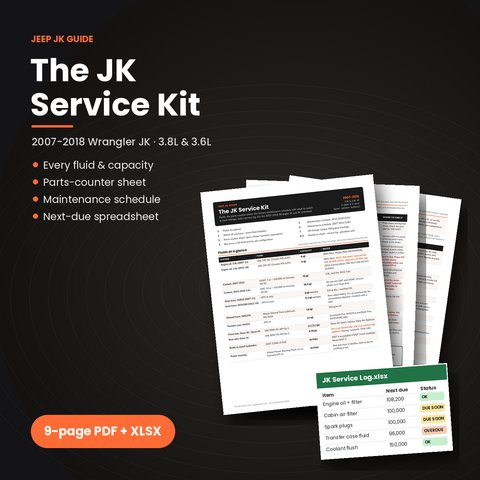
Printable: The JK Service Kit
Every fluid and spec by year and engine, a parts-counter sheet showing which brands actually meet each spec, the factory maintenance schedule with what to check at each mileage, and a spreadsheet that tells you what is due next. 9-page PDF plus Excel/Google Sheets tracker, $12.
Get the JK Service KitFrequently asked questions
Can I use 5W-30 instead of 5W-20 in my JK?
The 2016 manual allows 5W-30 when 5W-20 isn’t available, and the 2012 manual lists 5W-30 for that year’s 3.6L. Otherwise the factory viscosity is 5W-20. Whatever the viscosity, the oil should meet Chrysler MS-6395.
Does my Rubicon need limited-slip additive?
No. The additive is for Trac-Lok limited-slip axles. Rubicon axles use electric lockers, which aren’t Trac-Lok.
What gear oil goes in JK axles, 75W-85 or 80W-90?
The JK owner’s manuals list SAE 80W-90 API GL-5 front and rear, with synthetic 75W-140 recommended for towing.
Which coolant does my JK take?
HOAT if it’s a 2007-2012 (including the 2012 3.6L). OAT if it’s a 2013-2018. Don’t mix them.
Is “multi-vehicle” ATF OK in a JK automatic?
Use a fluid that is licensed or approved for ATF+4. At least one major multi-vehicle ATF maker states that its product is not OEM licensed and recommends its ATF+4 product instead.
How much gear oil should I buy for both axles?
About 3.4 quarts for a Sport or Sahara (2.1 pt front plus 4.75 pt rear) and 3.7 quarts for a Rubicon (2.7 pt plus 4.75 pt). Buy 4 quarts either way, and fill each axle to the bottom of its fill hole.
Related guides
- JK Oil Change Interval Guide
- Jeep Wrangler JK Maintenance Schedule
- JK Common Problems by Year
- JK Model Year Differences
Reference information compiled from the Jeep Wrangler owner’s manuals and the fluid makers’ own data sheets, checked September 2026. It doesn’t replace the owner’s manual for your VIN. Jeep JK Guide is an independent publication, not affiliated with Stellantis N.V.
Free: JK Fluids at a Glance
Every fluid, spec and capacity for the 2007-2018 Wrangler JK on one page, plus a cut-out glovebox card. Checked against the owner's manuals. From the JK Service Kit.
Email me the download and new guides when they are published. Unsubscribe anytime. Privacy Policy.
Allan
I'm Allan. I own a 2014 Jeep Wrangler JKU and I research the hell out of every mod before I touch it. When I've fitted something to my own Jeep, I say so. Everything else is researched from manufacturer specs and other owners' reports. No sponsored fluff.
Learn more about me →Free: JK Fluids at a Glance
Every fluid, spec and capacity for the 2007-2018 JK on one page, plus a glovebox card.
Email me the download and new guides when they are published. Unsubscribe anytime. Privacy Policy.
Related Articles
Jeep JK Fall Trail Prep: 10-Point Checklist Before the Last Runs of the Year
Fall is when your JK needs attention most. Cooler temps, shorter daylight, and slicker trails expose what summer's heat masked. A Jeep JK fall trail...
Jeep JK Death Wobble: Every Cause, How to Diagnose It, and the Permanent Fix
Imagine this: you're cruising the highway at a steady clip when your front tire catches a seam in the pavement. Suddenly, your steering wheel is trying...
How to Winterize Your Jeep JK: Complete Fall Prep & Storage Guide
Winterizing your Jeep JK isn't complicated — it's just preparing your 2007–2018 Wrangler (2-door or 4-door JK Unlimited) to handle the cold months...