Jeep JK Seat Cover Materials: Leather vs Neoprene Durability
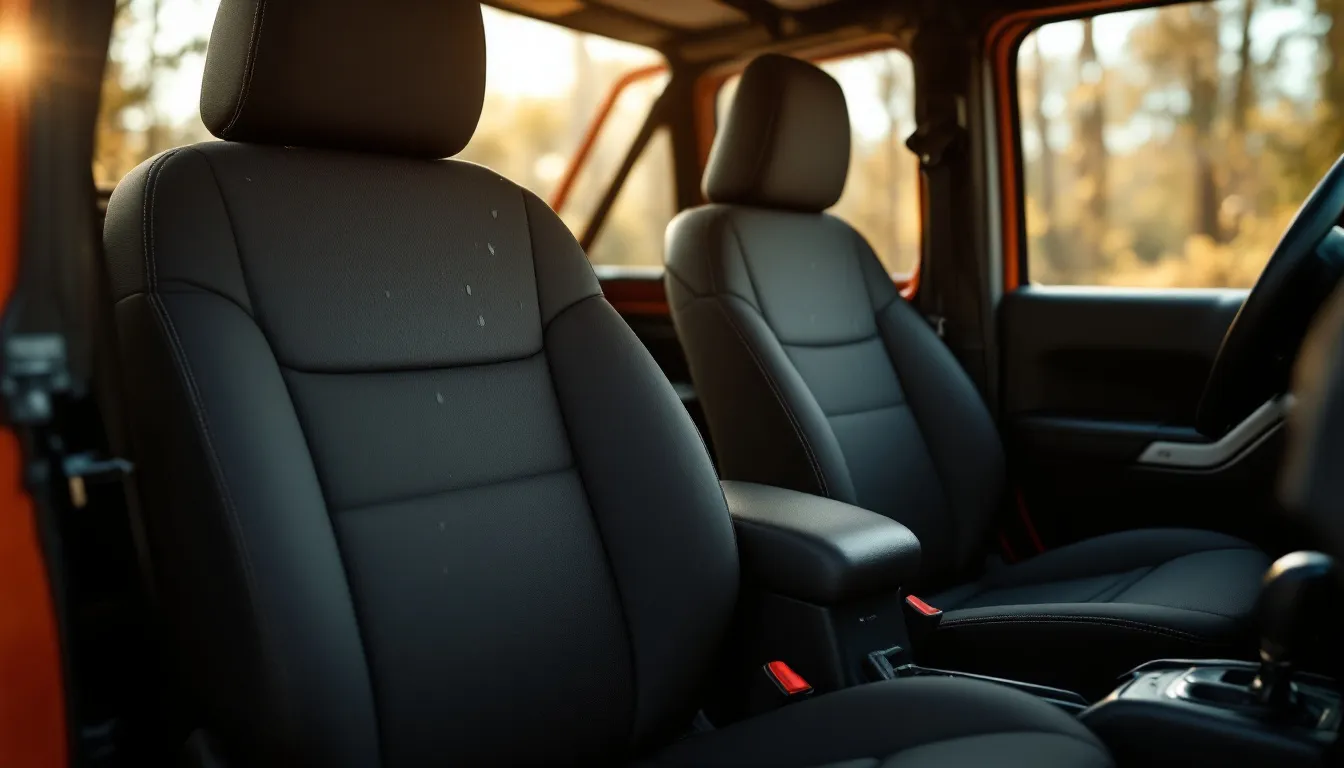
Jeep JK Seat Cover Materials: Leather vs Neoprene Durability
The Short Answer: Which Material Wins for a Jeep JK?
Jeep JK seat cover materials are the protective fabrics fitted over OEM seats to guard against moisture, UV exposure, mud, and daily wear — and for the 2007–2018 Wrangler JK, the choice between leather and neoprene has real consequences on the trail and in the driveway.
Neoprene wins for active trail use. It’s waterproof, mold-resistant, and handles wet-dog-and-muddy-boot abuse without cracking or absorbing odors. Leather (genuine or faux) wins for daily drivers who prioritize a cleaner look and easier wipe-downs on paved roads. Faux leather sits in the budget middle ground — decent looks, moderate durability, but it won’t survive repeated river crossings. Genuine leather is premium but demands regular conditioning and hates prolonged sun exposure in a doorless, topless JK.
This guide covers all 2007–2018 Jeep Wrangler JK and JKU variants — 2-door and 4-door — across all trim levels including Sport, Sahara, and Rubicon.
For a broader look at your options, see the best seat covers for Jeep JK roundup, or jump straight to the JK buyers guide if you’re still configuring your build.
Get new guides by email
One email when we publish something worth reading. Unsubscribe anytime.
What Are Neoprene and Leather Seat Covers?
Neoprene and leather seat covers are the two dominant material categories for Jeep JK interiors — and understanding what each is actually made of tells you immediately how it will perform when things get messy.
Neoprene started out as a wetsuit material, which tells you something useful right away: it’s designed to keep water out while staying flexible. Automotive neoprene uses that same closed-cell foam structure that makes it inherently waterproof, stretchy enough to conform to seat contours, and resistant to UV degradation. The stretch factor matters more than most buyers realize — it makes installation forgiving and fitment consistent even across the slight seat variations between JK model years.
Leather is where the real distinction matters. Genuine leather is a natural hide product that requires regular conditioning to stay supple — faux (synthetic) leather is a PVC or PU-coated fabric that mimics the look for a fraction of the cost but trades breathability and lifespan for that price break. Both can look sharp in a stock JK interior, but they behave completely differently when things get wet.
For the JK specifically, material choice cuts deeper than it does in most vehicles. Every time you pull the doors off or drop the top, your seats face direct sun, rain, wind, and whatever you track in from the trail. A closed crossover might get away with a mediocre seat cover — a JK will expose its weaknesses within weeks.
Faux leather cracks under prolonged UV exposure and becomes brittle in winter cold if it isn’t UV-protected. Genuine leather, left unconditioned, does the same. Neoprene doesn’t crack, but it can trap heat in summer and feel clammy in wet conditions.
If water protection is your top priority, the waterproof seat covers for Jeep JK guide goes deeper on that specific need.
Durability Deep Dive: Neoprene vs Leather on the Trail
On the trail, neoprene outlasts both genuine and faux leather in almost every meaningful scenario — and the community experience with JK owners consistently backs this up.
I’ve been through three sets of seat covers on my JKU over two seasons. The first ones were cheap universal-fit neoprene covers from a local accessories shop. They looked fine for about two weeks, then started shifting and bunching until they looked like a bad sofa cover. The second set were better — custom-fit for JK front seats — but the stitching started failing at the seams after six months of sliding in and out in dirty clothes. With how often I’m coming back from trails caked in red dust, the seats take serious abuse.
The third set is what I’m running now: proper marine-grade neoprene with reinforced seams and seat heater compatibility. They’ve survived a full winter, multiple muddy weekends, and my toddler’s best efforts to destroy everything he touches. Still look new. The lesson hit hard: buy once, cry once. The cheap covers cost me more in total than if I’d just invested properly from the start.
Key failure modes by material:
- Faux leather: Cracking along seat bolster edges (the stress points where you mount and dismount), delamination where the PVC coating separates from its backing after sun exposure, and color fading within one full season of doorless driving.
- Genuine leather: Surface cracking when conditioning gets skipped even for a few months in dry or hot climates; water absorption through stitching leads to mildew smell if the interior gets rained on frequently.
- Neoprene: Heat retention in direct summer sun (the real trade-off); surface pilling on high-friction areas after extended use; some lower-grade neoprene develops a slight odor when continuously wet, though marine-grade versions handle this well.
For 2007–2010 JK owners, the Diver Down Neoprene Seat Cover Set is built specifically for your seat geometry:
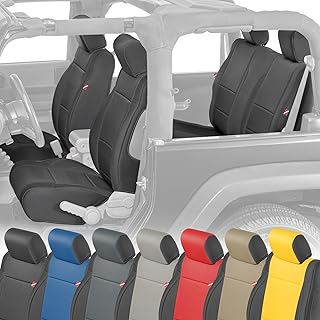
Diver Down Neoprene Seat Cover Set - Fits Jeep JK 2007-2018 Wrangler - Front and Back Seat Set - Waterproof
Check Price on Amazon →If your JK is a 2011–2018 model, the Rugged Ridge front neoprene kit in black/red is purpose-built for your updated seat profile:
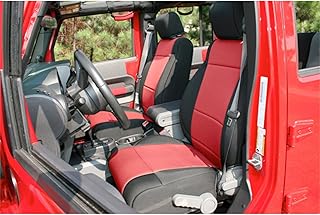
Seat Cover Kit, Front, Neoprene, Black/Red | 13215.53 | Fits 2011-2018 Jeep Wrangler JK
Check Price on Amazon →Leather vs Neoprene: Head-to-Head Comparison
When you put both materials side by side across the factors that actually matter to a JK owner, the trade-offs become obvious — and the right choice depends almost entirely on how you use your Jeep.
| Factor | Neoprene | Leather (Genuine / Faux) |
|---|---|---|
| Waterproofing | Excellent — inherently waterproof | Poor to moderate — genuine absorbs moisture; faux resists briefly |
| UV Resistance | Good — resistant to fading and cracking | Poor without treatment — cracks and fades under prolonged direct sun |
| Trail Durability | Excellent — handles mud, water, abrasion | Moderate (genuine) / Low (faux) — cracks at stress points |
| Comfort | Good — padded feel; warm in winter, hot in summer | Good — breathable (genuine); can feel stiff in cold (faux) |
| Maintenance | Low — wipe clean, machine wash some covers | High (genuine requires conditioning) / Low (faux wipe-clean) |
| Install Ease | Easy — stretches to fit, forgiving | Moderate — stiffer material; less give during install |
| Price Range | $149–$250 for custom-fit JK sets | $90–$200 for faux; genuine custom sets run higher |
| Best For | Trail driving, wet climates, families with dogs/kids | Daily drivers, pavement-focused, appearance-first builds |
Trail and off-road drivers: go neoprene without hesitation. Daily drivers who prioritize the showroom look and don’t do serious water crossings have real options, including quality faux leather.
For appearance-focused 2013–2017 JK owners, the GIANT PANDA faux leather set offers custom fitment without the premium price:
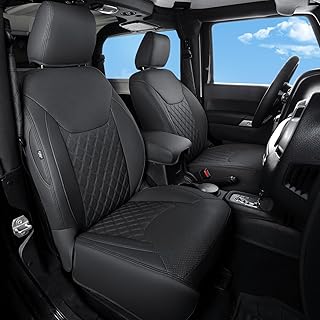
GIANT PANDA Front Jeep Wrangler 2/4 Door JK 2013-2017 Car Seat Covers for Sahara Sport Rubicon Unlimited
Check Price on Amazon →For 4-door JKU owners who want leather aesthetics with waterproof backing across the full seat set:
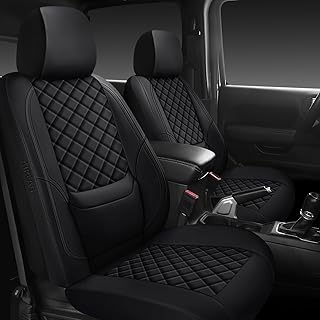
Wrangler Seat Covers 2007-2026 Full Set, Waterproof Leather Interior Sets with Lumbar Support Custom
Check Price on Amazon →For a deeper look at protection-focused options, the ultimate seat cover protection guide for Jeep JK covers additional scenarios and layered protection strategies.
Comfort and Climate Performance in the JK
Comfort in a Jeep JK seat cover comes down to how each material handles temperature — and the JK’s open-air design means your seats experience more climate extremes than almost any other vehicle on the road.
Neoprene’s biggest comfort trade-off: it retains heat. On a summer day with the top off, neoprene seats bake in direct sun and can be genuinely uncomfortable to sit on after the Jeep has been parked. In winter, that insulating property flips to an advantage — neoprene holds body heat better than bare leather or cloth. The padding built into quality neoprene covers also adds a noticeable cushioning layer, which many JK owners appreciate on longer runs.
Leather’s biggest comfort trade-off: temperature extremes at both ends. Genuine leather gets scorching hot in summer sun and bitterly cold in winter — the JK’s lack of a traditional headliner and significant sun exposure make this more pronounced than in a standard SUV. Faux leather behaves similarly.
For 2-door JK owners, the front seats take the most punishment from sun exposure, so the heat-retention difference between materials is most noticeable up front. 4-door JKU rear passengers are more shielded but still benefit from neoprene’s moisture-handling in wet conditions.
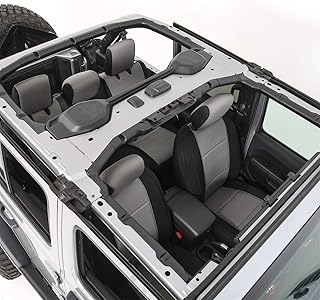
NEOPRENE SEAT COVER SET - SB472122
Check Price on Amazon →If you’re weighing how your top choice affects seat exposure — and therefore which material makes more sense — the guide on soft top vs hard top decisions for Jeep JK is a useful companion read.
Installation, Fit, and JK Compatibility Notes
Most quality seat covers fit a Jeep JK in 30–60 minutes per seat — but the 2007–2010 vs 2011–2018 split is a genuine compatibility trap that catches many buyers off guard.
Jeep revised the JK seat design for the 2011 model year. The seat bolster shape, headrest configuration, and mounting hook positions differ enough that a cover built for a 2007–2010 will not fit cleanly on a 2011–2018, and vice versa. Always confirm the model year range listed on any cover before ordering — and check the door count, since 2-door JK rear seats have a different fold-and-tumble geometry than the JKU’s 60/40 rear bench.
⚠️ Critical airbag warning: If your JK has side-curtain or seat-mounted airbags, you must verify that any seat cover you install is explicitly airbag-compatible. A cover that blocks an airbag deployment seam is a serious safety hazard — this is non-negotiable.
Most custom-fit covers from reputable brands note airbag compatibility explicitly. The Ballistic series front bucket cover is built with custom patterns for specific JK seats and notes compatibility with OEM safety systems:
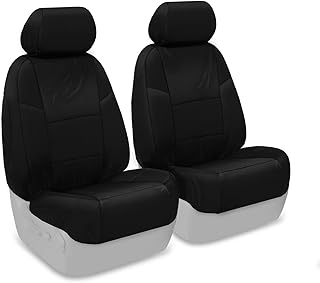
Front 50/50 Bucket Custom Fit Seat Cover for Select Jeep Wrangler Models - Ballistic (Black)
Check Price on Amazon →If you want a budget-friendly tactical option that fits across JK, JL, and TJ models without precise year matching, the SUNPIE organizer-style cover works as a seat-back protector rather than a form-fitted cover — useful to know the distinction:
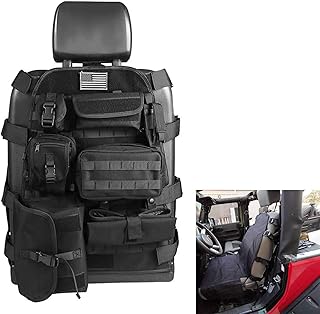
SUNPIE Black Upgrade Larger Seat Protector Tactical Seat Cover Universal Fit for Trucks Pickup SUV
Check Price on Amazon →For trim-level-specific fitment questions — particularly around Rubicon seat features vs Sport — the Rubicon vs Sport vs Sahara trim comparison breaks down what differs at the seat level across trims.
Best Neoprene and Leather Seat Covers for Jeep JK
The buy-once-cry-once lesson stands out for a reason. Cheap universal-fit covers that shift and bunch, then failing stitching after six months, then finally pulling the trigger on marine-grade neoprene that actually lasts — it’s a pattern I’ve watched play out multiple times in the community. That trajectory shapes every recommendation here. The right product saves you money, frustration, and the distinctive smell of mildew baked into a faux leather cover that was never meant to get wet.
Here are the top picks for 2007–2018 JK and JKU owners, ordered from best overall to most budget-friendly.
Best Overall — Trail-Ready Neoprene (2007–2010 JK)
Diver Down Neoprene Seat Cover Set - Fits Jeep JK 2007-2018 Wrangler - Front and Back Seat Set - Waterproof
Check Price on Amazon →- Best For: Trail drivers and off-road enthusiasts with 2007–2010 JK 2-door
- Key specs: Full front and rear set, marine-grade neoprene, custom fit for 2007–2010 2-door JK, waterproof, thermally resistant padding
- Pros:
- Purpose-built for 2007–2010 seat geometry — no bunching or slippage
- Waterproof and resistant to mud, sweat, and wet-dog smell
- Padded construction adds noticeable cushioning
- Con: Runs warm in direct summer sun; color options limited
- Price: $199.99
Premium Pick — Neoprene for 2011–2018 JK
Seat Cover Kit, Front, Neoprene, Black/Red | 13215.53 | Fits 2011-2018 Jeep Wrangler JK
Check Price on Amazon →- Best For: 2011–2018 JK owners who want a premium two-tone neoprene set
- Key specs: Front set, neoprene construction, black/red colorway, custom fit for 2011–2018 JK, Rugged Ridge fitment
- Pros:
- Built for post-2011 seat revision — correct hook positions and bolster shape
- Bold black/red color adds a sport aesthetic
- Rugged Ridge is a well-established JK accessories brand
- Con: Front-only set; rear cover sold separately
- Price: $241.99
Best Faux Leather — Appearance-First JK
GIANT PANDA Front Jeep Wrangler 2/4 Door JK 2013-2017 Car Seat Covers for Sahara Sport Rubicon Unlimited
Check Price on Amazon →- Best For: 2013–2017 JK/JKU owners prioritizing look over trail durability
- Key specs: Front set, customized faux leather, fits 2/4 door JK 2013–2017, compatible with Sahara, Sport, Rubicon, Unlimited, Altitude
- Pros:
- Clean, OEM-adjacent look at a reasonable price
- Broad trim-level compatibility including Unlimited (JKU)
- Easy to wipe clean for everyday dirt
- Con: Faux leather will crack over time with sun exposure — not suited for doorless/topless use
- Price: $129.99
Best Leather Full Set — JKU 4-Door
Wrangler Seat Covers 2007-2026 Full Set, Waterproof Leather Interior Sets with Lumbar Support Custom
Check Price on Amazon →- Best For: 4-door JKU daily drivers who want leather aesthetics with added water resistance
- Key specs: Full set including rear, waterproof leather construction, lumbar support, fits JK and JL 4-door, covers Sahara/Sport/Rubicon/X/392/Willys
- Pros:
- Lumbar support is a genuine daily-driver upgrade
- Full set covers all four positions in a JKU
- Broad JK/JL compatibility makes it a long-term investment if you upgrade Jeeps
- Con: “Waterproof leather” is a treated faux material — not as robust as neoprene in sustained wet conditions
- Price: $139.99
Best Budget Pick — Universal Tactical Organizer
SUNPIE Black Upgrade Larger Seat Protector Tactical Seat Cover Universal Fit for Trucks Pickup SUV
Check Price on Amazon →- Best For: JK owners who need quick seat-back protection and storage without a custom fit
- Key specs: Universal fit, MOLLE panel for gear organization, compatible with JK/JL/JT/TJ, seat-back design
- Pros:
- Under $50 — lowest barrier to entry
- MOLLE pockets add real utility for trail gear
- Fits across nearly all Jeep generations
- Con: Seat-back organizer design, not a full seat cover — won’t protect the seat bottom or cushion
- Price: $49.96
See the full roundup of the best JK seat covers for additional options across price points and materials.
How to Choose the Right Seat Cover Material for Your JK
The right seat cover material for your JK comes down to three honest questions: How wet do your seats get? How much sun exposure do they take? And how much time do you want to spend on maintenance?
Real-world community knowledge outweighs any spec sheet. The specs on a box won’t tell you that faux leather cracks on bolsters after a summer of doorless driving, but JK owners who’ve been through it will. That experience shapes the framework below.
Use this decision tree:
- Trail driver / off-road enthusiast: Choose marine-grade neoprene. Water crossings, mud season, and rain-soaked recovery days will destroy leather covers within a season. Neoprene is the only practical choice.
- Daily driver / pavement-focused: Faux leather or treated waterproof leather is viable. You’ll get a cleaner interior look and easier maintenance if you’re not regularly dunking the Jeep.
- Topless/doorless summer driver: Neoprene again, or a UV-treated faux leather at minimum. Direct sun exposure is brutal on unprotected leather — see the JK bikini tops and sun shade options guide if you want to reduce that exposure at the source.
- Budget-first buyer: Start with a universal neoprene cover that’s airbag-compatible and machine-washable.

Front Set Neoprene Car Seat Cover for Low Back Seats with Removable Headrest, Universal Fit, Airbag
Check Price on Amazon →- Wet-climate or high-humidity region: Neoprene’s closed-cell construction resists mold and mildew. Leather in a humid climate that gets rained on regularly will develop odors that are difficult to fully eliminate.
For full waterproofing criteria, the best waterproof seat covers for Jeep JK guide covers tested options specifically for wet-weather use.
Frequently Asked Questions
These are the questions JK owners ask most often about seat cover materials — answered directly, without jargon.
Are neoprene seat covers good for Jeep Wrangler?
Neoprene seat covers are widely considered the best all-around material for Jeep Wrangler JK use. Their waterproof construction handles the open-air exposure, wet trail conditions, and high-humidity environments that regularly damage leather alternatives. Custom-fit neoprene covers designed for the JK stay in place without bunching, even after repeated seat adjustments. For anyone doing regular trail work or living in a wet climate, neoprene is the standard choice.
Do leather seat covers crack in a Jeep JK?
Yes — both genuine and faux leather seat covers are prone to cracking in a Jeep JK, especially with doorless or topless driving. Genuine leather cracks when it dries out from UV exposure and goes unconditioned; faux leather cracks at stress points (bolsters, seat edges) as the PVC coating degrades. UV-treated products extend lifespan, but neoprene remains more durable for consistent outdoor exposure. If you do choose leather, commit to conditioning genuine leather every 2–3 months and expect to replace faux leather every 18–24 months in an exposed JK.
Can I use seat covers on a Jeep JK with heated seats?
You can, but verify that the seat cover is compatible with heated seats — most quality covers allow heat to pass through, but thick padded neoprene can slightly reduce the effect. More importantly, verify that any cover used on a seat with a side airbag is explicitly marked as airbag-compatible. A cover that obstructs an airbag deployment seam is a safety liability. See the complete JK seat cover protection guide for safety-rated options.
What seat covers fit a 2007–2010 Jeep JK vs 2011–2018?
Jeep revised the JK seat design in 2011, changing the bolster shape and headrest configuration enough that covers are not interchangeable. Always buy covers that specifically list your year range — “fits 2007–2010” and “fits 2011–2018” are separate products from most manufacturers. Using the wrong year range results in poor fitment, bunching, and exposed seat areas. Double-check the listing before you buy, because returns for wrong-year fitment are frustrating.
Are universal-fit seat covers worth it for a Jeep JK?
Universal-fit covers are a poor investment for a JK if you expect full seat protection. The JK’s seat geometry — especially the fold-and-tumble rear in the 2-door and the 60/40 rear bench in the JKU — doesn’t conform well to generic patterns. You’ll get gaps, bunching, and slippage. The modest savings over a custom-fit set disappear quickly when the cover fails to stay in place or protect properly. Budget more than you think you need for a proper custom-fit set. The community experience consistently supports this approach.
What’s the difference between marine-grade and standard neoprene seat covers?
Marine-grade neoprene uses a higher-density foam structure with reinforced stitching and superior water-sealing at seams. Standard neoprene is adequate for most conditions but can develop odors or breakdown at stress points after extended exposure to water. Marine-grade costs more but lasts longer and resists mold better — the investment pays for itself over two to three seasons of regular trail use.
Final Verdict: Leather or Neoprene for Your Jeep JK?
For Jeep JK seat cover materials, neoprene wins for trail use and leather suits daily drivers. That’s the honest bottom line across every scenario covered here.
Trail drivers: buy marine-grade neoprene, sized to your exact model year and door count — it’s the only material that handles repeated water exposure without cracking, smelling, or failing. Daily drivers: quality faux leather or waterproof-treated leather gives you the interior look you want with manageable maintenance.
The buy-once-cry-once lesson isn’t just about money. It’s about not repeating the cycle of cheap covers that shift and bunch, then stitching failures, then finally getting it right. Invest properly the first time, and your JK’s interior stays protected for years.
Browse the full best seat covers for Jeep JK roundup to compare fitment across model years, or go straight to waterproof JK seat covers if water protection is your primary concern.
Free: JK Fluids at a Glance
Every fluid, spec and capacity for the 2007-2018 Wrangler JK on one page, plus a cut-out glovebox card. Checked against the owner's manuals. From the JK Service Kit.
Email me the download and new guides when they are published. Unsubscribe anytime. Privacy Policy.
Allan
I'm Allan. I own a 2014 Jeep Wrangler JKU and I research the hell out of every mod before I touch it. When I've fitted something to my own Jeep, I say so. Everything else is researched from manufacturer specs and other owners' reports. No sponsored fluff.
Learn more about me →Free: JK Fluids at a Glance
Every fluid, spec and capacity for the 2007-2018 JK on one page, plus a glovebox card.
Email me the download and new guides when they are published. Unsubscribe anytime. Privacy Policy.
Related Articles
Jeep JK Interior Upgrades: The 12 Mods That Actually Improve Daily Comfort
The Jeep Wrangler JK interior is a purpose-built, trail-focused cabin that trades luxury for capability — and a handful of affordable upgrades can...
Best Floor Mats for Jeep Jk All Weather Protection
All-weather floor mats for Jeep JK are custom-fit or universal protective liners made from rubber or thermoplastic materials designed to contain mud,...
Roof Rack vs Cargo Basket Jeep Jk Weight Capacity
A roof rack bolts to your JK's hard top (or roll bar) and spreads lighter gear across the roofline. A cargo basket hangs off your hitch receiver and...