JK Common Problems by Year: The Complete List for 2026
Last updated: January 30, 2026. Repair costs verified.
Every vehicle has weak points. The JK is generally reliable, but knowing what to look for can save you thousands.
Here’s every common problem organized by model year.
Problems Affecting All Years
These issues can appear on any JK regardless of year.
Death Wobble
What it is: Violent steering oscillation at highway speeds, usually triggered by hitting a bump.
Cause: Worn steering or suspension components creating a harmonic oscillation. Usually track bar, ball joints, tie rod ends, or wheel bearings. This is one of the most notorious issues - read our complete death wobble guide for diagnosis and fix details. Always test for death wobble when evaluating a used JK.
Fix: Diagnose and replace worn components. Typically $500-1,500.
Prevention: Regular inspection of front end components. Proper torque on track bar bolts.
Hardtop Leaks
What it is: Water entering cabin around freedom panels or rear window.
Cause: Worn seals, improper installation, or cracked freedom panels.
Fix: Replace seals ($50-150) or adjust freedom panel fitment.
Soft Top Issues
What it is: Torn fabric, cloudy windows, broken zippers.
Cause: Age, UV exposure, improper care.
Fix: Replace windows ($100-300), patch fabric, or replace entire top ($500-1,500).
Used and OEM options
Soft top frame
Used frames from hardtop conversions turn up. Check the bow pivots and that the door surrounds and tailgate bar are included.
See current listings on eBay →Transfer Case Fluid Leak
What it is: Fluid seeping from transfer case, usually at the output seals.
Cause: Worn seals, often accelerated by lifted trucks with poor driveline angles.
Fix: Replace seals ($200-400 installed).
2007-2008: First Year Problems
The first JK years had the most issues. Most have been fixed by now, but verify when buying.
TIPM Failures
What it is: The Totally Integrated Power Module controls electrical systems. When it fails, you get random electrical problems. This was serious enough that NHTSA investigated multiple model years.
Symptoms:
- Fuel pump won’t prime
- Wipers activate randomly
- Horn doesn’t work
- Windows malfunction
Fix: TIPM replacement ($400-800). Some can be rebuilt by specialists.
Years affected: Primarily 2007-2008, some through 2013.
Manual Transmission Clutch Issues
What it is: Premature clutch wear or slave cylinder failure.
Symptoms: Clutch slipping, difficulty shifting, clutch pedal feels wrong.
Fix: Clutch replacement ($800-1,200 installed).
Differential Failures
What it is: Ring and pinion failures, especially in Dana 44 rear.
Cause: Some early 2007 units had manufacturing defects.
Fix: Differential rebuild or replacement ($1,000-2,000).
Note: Most affected units have been replaced by now.
Water Leaks
What it is: Water entering cabin through various paths.
Cause: Early production quality issues with seals and weatherstripping.
Fix: Identify leak path and replace/reseal ($100-500 depending on location).
Get new guides by email
One email when we publish something worth reading. Unsubscribe anytime.
2009-2011: Improved but Still 3.8L
Most first-year bugs were resolved by 2009. These years are solid 3.8L choices.
3.8L Oil Consumption
What it is: Engine burns oil between changes.
Symptoms: Low oil level between changes, blue smoke on startup.
How much is too much: More than 1 quart per 1,500 miles is concerning.
Cause: Worn piston rings, valve seals on high-mileage engines.
Fix: Depends on cause. Could be valve seals ($500-800) or engine rebuild ($3,000+).
Prevention: Check oil regularly. Use manufacturer-recommended oil weight.
Exhaust Manifold Cracks
What it is: The cast iron exhaust manifolds crack, causing exhaust leaks.
Symptoms:
- Ticking noise when cold (goes away when warm)
- Exhaust smell in cabin
- Failed emissions
Fix: Replace exhaust manifold ($300-600 installed). Aftermarket headers are an upgrade option.
Power Window Regulator Failure
What it is: Window fails to go up or down, or moves slowly.
Cause: Regulator motor or mechanism failure.
Fix: Replace window regulator ($150-300 installed per window).
2012: The Transition Year
2012 brought the Pentastar V6 but had some first-year engine issues.
Cylinder Head Tick (Left Side)
What it is: Ticking noise from the left cylinder head at idle.
Cause: Rocker arm/valve train issue on early production engines.
Affected vehicles: Early 2012 builds (before April 2012).
How to check: Look at build date on driver’s door jamb sticker.
Fix: Cylinder head work ($1,500-3,000). Many were fixed under warranty.
Note: Later 2012 builds (after April) don’t have this issue.
Oil Filter Housing Leak
What it is: Oil leaks from the oil filter adapter/housing.
Cause: Failed O-ring or housing gasket.
Symptoms: Oil spots under engine, low oil, oil smell.
Fix: Replace O-rings and gasket ($150-300 installed).
2013-2015: The Sweet Spot
These years fixed most early Pentastar issues. Very reliable.
Pentastar Tick (High Mileage)
What it is: Lifter/rocker arm tick on higher-mileage engines (100k+).
Cause: Worn lifters or rocker arms. This is why the 2013-2014 model years are often recommended - they have the refined Pentastar without early issues. See our model year differences guide to understand why certain years are more susceptible.
Fix: Rocker arm/lifter replacement ($500-1,000).
Prevention: Regular oil changes with quality oil.
HVAC Blend Door Actuator
What it is: Climate control doesn’t switch between hot and cold properly.
Symptoms: Heat stuck on one side, clicking noise from dash.
Fix: Replace blend door actuator ($200-400 installed).
2016-2018: Final Refinement
The last JK years are the most refined. Few significant issues.
Transmission Cooler Lines (Auto)
What it is: Transmission cooler lines can develop leaks.
Symptoms: Trans fluid drips, low fluid level.
Fix: Replace cooler lines ($200-400).
Brake Booster Hiss
What it is: Hissing noise when pressing brake pedal.
Cause: Brake booster check valve or seal.
Fix: Check valve replacement ($50-100) or booster replacement ($300-500).
Pros:
- Purpose-built for JK Wrangler ensures proper fitment and function
- Durable construction handles trail abuse and daily driving
- Backed by positive community reviews and trail-tested results
Cons:
- Premium pricing compared to generic aftermarket options
- May require longer lead times for specialty or popular items
- Some products require professional installation for best results
Exhaust Tick at Startup
What it is: Brief ticking on cold start that goes away.
Cause: Exhaust manifold expansion or catalytic converter heat shield.
Fix: Often normal. Tighten heat shields if loose. Manifold replacement if cracked ($300-600).
Universal Maintenance Items
These aren’t “problems” but need attention on any JK.
Ball Joints
Life expectancy: 75,000-100,000 miles (less if lifted or running large tires)
Symptoms: Clunking, steering wander, uneven tire wear
Cost to replace: $300-600 per side
Tie Rod Ends
Life expectancy: 80,000-120,000 miles
Symptoms: Steering play, clunking over bumps
Cost to replace: $150-300 per side
Control Arm Bushings
Pros:
- Purpose-built for JK Wrangler ensures proper fitment and function
- Durable construction handles trail abuse and daily driving
- Backed by positive community reviews and trail-tested results
Cons:
- Premium pricing compared to generic aftermarket options
- May require longer lead times for specialty or popular items
- Some products require professional installation for best results
Life expectancy: 100,000+ miles (less if wheeled hard)
Symptoms: Clunking, vibration, alignment issues
Cost to replace: $400-800 for full set
U-Joints
Life expectancy: 80,000-150,000 miles (less on lifted trucks)
Symptoms: Vibration, clunking during acceleration/deceleration
Cost to replace: $50-150 per joint
Recommended Fix Kits for Common JK Issues
Many common problems can be addressed with the right parts. Here are the top fixes for the most frequent issues across all JK years.
For electrical module failures that plague 2007-2013 JKs, a quality replacement TIPM is essential:
The 3.8L exhaust manifold is notorious for cracking - have this quality replacement on hand:
Death wobble affects all model years - this steering damper is crucial prevention for your front end:
Pre-Purchase Checklist
When looking at any JK, check these:
All Years:
- Test drive at highway speed for death wobble
- Check for oil leaks underneath
- Verify all electrical works
- Inspect frame for rust
- Check ball joints for play
- Listen for differential whine
2007-2011:
- Check oil consumption history
- Listen for exhaust manifold tick
- Test all TIPM-controlled systems
- Ask about clutch history (manual)
- See best year JK to buy for which 3.8L years to target
2012:
- Check build date (prefer May 2012 or later) - see model year differences
- Listen for cylinder head tick at idle
- Check for oil filter housing leaks
2013+:
- Listen for valve train tick at high mileage
- Check transmission cooler lines (auto)
Cost Summary
| Problem | Typical Fix Cost |
|---|---|
| Death wobble diagnosis and fix | $500-1,500 |
| TIPM replacement | $400-800 |
| Clutch replacement | $800-1,200 |
| Exhaust manifold | $300-600 |
| Ball joints (both sides) | $600-1,200 |
| Oil filter housing leak | $150-300 |
| Cylinder head work | $1,500-3,000 |
| Window regulator | $150-300 |
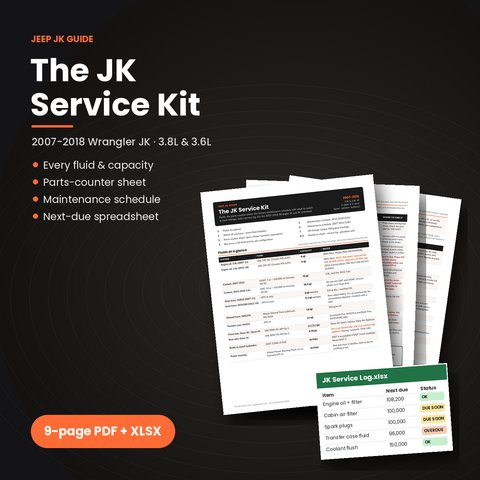
Stay ahead of it: The JK Service Kit
The factory maintenance schedule with a wear watch at each mileage (what owners and shops most often find worn, and whether to replace it now or note it for next service), recalls to check, every fluid spec by year, and a next-due spreadsheet. 9-page PDF plus Excel/Google Sheets tracker, $12.
Get the JK Service KitThe Bottom Line
The JK is a reliable vehicle, but knowing these common issues helps you:
- Negotiate a better price
- Budget for future repairs
- Avoid problem vehicles
- Use the buying used JK checklist to thoroughly inspect vehicles before purchase
The best years for reliability are 2013-2017. They have the Pentastar engine with all first-year bugs sorted. For detailed year recommendations, see our best year JK to buy guide.
Related Articles
- The Complete JK Buyer’s Guide - Everything you need to know before buying
- Best Year JK to Buy - Our recommendations by model year
- JK Death Wobble: Causes and Fixes - Deep dive into the most common JK issue
- JK vs JL Comparison - Should you buy JK or JL?
Related Guides
Explore more JK upgrade guides to complement your build:
- JK Buyers Guide — our complete JK buying overview
- Rubicon vs Sport vs Sahara — trim level comparison
- Best JK Hardtops — hardtop replacement options
- Best JK Soft Tops — soft top options
- Best JK Lift Kits — first modification most owners make
Frequently Asked Questions
Are Jeep Wrangler JKs reliable?
Yes, overall. The JK is considered a reliable vehicle, especially the 2013-2017 models with the 3.6L Pentastar engine. Common issues like death wobble and TIPM failures are well-documented with established fixes. Proper maintenance and pre-purchase inspection are key.
What is the most common JK problem?
Death wobble is the most notorious, though not the most common by numbers. It’s a violent steering oscillation caused by worn front-end components. More frequent issues include exhaust manifold cracks (3.8L engines) and TIPM electrical failures (2007-2013). All have known fixes.
How much does it cost to fix death wobble?
Typically $500-1,500 depending on which components need replacement. The most common culprits are the track bar ($200-400), ball joints ($300-600 per side), and tie rod ends ($150-300 per side). Sometimes it’s a simple track bar bolt retorque that costs nothing.
Should I avoid all 2012 JKs?
Not necessarily. Early 2012 builds (before April) had cylinder head issues. Later 2012 builds are fine. Check the build date on the door jamb sticker - anything built May 2012 or later had the issues resolved.
Are high-mileage JKs reliable?
Yes, with proper maintenance. JK drivetrains commonly exceed 200,000 miles. Higher-mileage vehicles will need more suspension and steering component attention, but the engines and transmissions are durable. Focus on maintenance records rather than mileage alone.
What problems do lifted JKs have?
Lifting accelerates wear on ball joints, tie rod ends, and CV joints due to changed geometry. Death wobble is more common on lifted JKs. Driveshaft vibration can occur if lift isn’t paired with proper geometry correction. Learn more about quality lift kits and proper installation. Budget for faster replacement intervals on front-end components.
Free: JK Fluids at a Glance
Every fluid, spec and capacity for the 2007-2018 Wrangler JK on one page, plus a cut-out glovebox card. Checked against the owner's manuals. From the JK Service Kit.
Email me the download and new guides when they are published. Unsubscribe anytime. Privacy Policy.
Frequently Asked Questions
What are the most common Jeep JK problems?
The most common JK issues are death wobble (worn steering/suspension), TIPM electrical failures (2007-2016), 3.8L oil consumption (2007-2011), and hardtop leaks. Most are fixable for under $1,500.
Is the Jeep JK 3.8 or 3.6 engine more reliable?
The 3.6L Pentastar (2012-2018) is more reliable overall. The 3.8L (2007-2011) is known for oil consumption after 100k miles and less power. Both engines can exceed 200k miles with proper maintenance.
What is TIPM failure in a Jeep JK?
The TIPM (Totally Integrated Power Module) controls electrical functions. When it fails, you get random issues: fuel pump problems, horn honking, wipers activating randomly. Replacement costs $400-800. Affected years: 2007-2016.
What year JK has the least problems?
2015-2018 JKs have the fewest issues - the 3.6L engine was refined, TIPM issues were addressed, and build quality peaked. 2013-2014 offer good reliability at lower prices.
Are JK problems expensive to fix compared to other SUVs?
JK repair costs are generally moderate thanks to the massive aftermarket — parts are widely available and often cheaper than OEM. Common fixes like ball joints ($200-400), tie rod ends ($150-300), and exhaust manifold cracks ($300-600 with aftermarket headers) are well-documented with DIY guides available. The 3.6L engine is particularly affordable to maintain.
Allan
I'm Allan. I own a 2014 Jeep Wrangler JKU and I research the hell out of every mod before I touch it. When I've fitted something to my own Jeep, I say so. Everything else is researched from manufacturer specs and other owners' reports. No sponsored fluff.
Learn more about me →Free: JK Fluids at a Glance
Every fluid, spec and capacity for the 2007-2018 JK on one page, plus a glovebox card.
Email me the download and new guides when they are published. Unsubscribe anytime. Privacy Policy.
Related Articles
Jeep JK Rubicon Off-Road Capability: What the Factory Locker & Rock-Trac Package Actually Does
The Jeep Wrangler JK Rubicon is the factory-built, trail-ready variant of the 2007–2018 Wrangler. What separates it from every other JK trim is four...
Best Jeep JK Mods for Every Budget: From $50 Bolt-Ons to Full Builds
Jeep JK mods are aftermarket upgrades — from bolt-on accessories to full mechanical builds — that improve the capability, comfort, protection, or...
Best Jeep JK Accessories in 2026: The 15 Upgrades Every Wrangler Owner Actually Buys
Walk into any JK forum and you'll see the same pattern repeating. Someone buys a used 2014 JKU, gets excited about the possibilities, and immediately...