Best Fog Light Upgrades for Jeep Jk Off-Road Visibility
Best Fog Light Upgrades for Jeep JK Off-Road Visibility
When you’re threading a rocky trail at dusk or pushing through dust clouds, your Jeep JK’s factory fog lights fall silent fast. They’re designed for paved roads and light rain — not for the kind of visibility demands that come with serious off-roading. This guide walks you through the upgrade options that actually work: LED drop-ins for budget builds, auxiliary pod lights for mid-range rigs, and bumper-integrated systems for full trail setups. All three paths work across every 2007–2018 JK and JKU model, though the wiring details differ between early and late trucks in ways that matter more than most people realize.
We’ll cover why your factory setup falls short, how the three upgrade tiers compare head-to-head, the wiring trap that catches most DIYers, full product recommendations with specs and real-world tradeoffs, installation tips from someone who’s wired these systems before, and a detailed buyer’s checklist. By the end, you’ll know exactly which upgrade fits your JK and your terrain.
Why Factory Fog Lights Don’t Cut It Off-Road
The factory fog lights on a stock 2007–2018 Jeep JK produce somewhere in the 500–700 lumen range — respectable for parking lot visibility, inadequate the moment you’re picking your way through a dark rock garden or crossing water at night. But it’s not just raw output that’s the problem.
The beam pattern is narrow and center-weighted, which means peripheral obstacles (boulders at 10 o’clock, ruts at 2 o’clock) sit in shadow even when the fog lights are running full blast. Halogen bulbs also have a finite lifespan — roughly 500–1,000 hours in real-world use — so if you’re wheeling regularly at night, you’re burning through replacements. The warm color temperature around 3,200K washes out in dust or heavy rain, where that yellowy glow scatters instead of cuts through the particles.
I’ve installed a 50” LED light bar on my JK and learned the hard way that lumen numbers in a spec sheet don’t tell the full story. The bar itself was rated at something impressive, but the real-world beam quality depended entirely on how well the reflector focused the light. A poorly diffused unit with high lumen output can underperform a 1,200-lumen setup with a sharp, wide cutoff designed specifically for trail use. What matters is how the light actually lands on the terrain 30 feet in front of you — not the number printed on the box.
There’s also the compatibility angle. Early 2007–2011 JKs ran a positive-switched fog light circuit; the 2012–2018 redesign changed how the electrical system manages that load. This distinction matters when you’re choosing plug-and-play LED replacements, and it’s the reason many people experience flickering or lights that won’t turn off when they swap bulbs without addressing the underlying wiring.
The bottom line: factory fog lights are a starting point, not a solution for serious night wheeling.
Get new guides by email
One email when we publish something worth reading. Unsubscribe anytime.
Three Paths to Better Visibility: Drop-Ins, Pods, or Bumper-Integrated
The right upgrade tier depends on your budget, how much you’re willing to modify, and how seriously you wheel after dark. Each path delivers real improvements — the question is which tradeoff makes sense for your rig.
| Upgrade Type | Install Time | Approx. Cost | Lumen Output | Best For | Wiring |
|---|---|---|---|---|---|
| LED Drop-In Bulb | 30 min | $20–$60 | 800–2,000 lm | Budget builds, daily drivers | Factory switch, minimal wiring |
| Auxiliary Pod Lights | 2–4 hrs | $60–$200 | 2,000–6,000 lm | Trail rigs, overlanders | Relay harness required |
| Bumper-Integrated System | Half day + | $140–$500+ | Varies by pod | Full builds, rock crawlers | Harness routing planned pre-install |
LED Drop-In Bulbs: The Fast Entry Point
Swap your H11 halogen for an LED drop-in and you’re done. The housing stays factory, the switch stays factory — you just replace the bulb. Output jumps 200–300% in many cases, lifespan moves to 30,000+ hours, and heat output drops dramatically. The tradeoff is real: the factory housing wasn’t designed for LED, so beam consistency can be uneven, and you’re still limited by the OEM reflector’s design.
Best for: New trail builders on a budget, daily drivers who want better rainy-day visibility, anyone who wants a quick win without touching their bumper or wiring harness.
Auxiliary Pod Lights: Maximum Flexibility
Mount dedicated LED pods to your hood hinges, A-pillar brackets, or light bar and you’ve got complete control over beam pattern, aim angle, and positioning. They require a relay harness and a dedicated switch (usually an A-pillar mount), but the output-per-dollar ratio is the highest of the three options. You can aim them independently, adjust them as you lift your JK, and upgrade to better units later without touching the bumper.
Best for: Mid-build overlanders, rigs that see mixed road and trail use, anyone planning to add other lighting later.
Bumper-Integrated Fog Lights: Purpose-Built Trail Geometry
Move the light source down and forward, right where trail visibility actually happens. A bumper-integrated system replaces your OEM bumper with an aftermarket unit that includes fog light housings positioned for maximum low-angle coverage. Recovery points and winch mounts often come as bonus features. The commitment is real — you’re swapping bumpers — but the result is a truck built deliberately for night trail work.
Best for: Serious rock crawlers, overlanders doing extended trips, rigs where lighting and protection need to work together.
The Wiring Detail That Trips Up Most JK Owners
Here’s what happens when most people plug new LED fog lights into a 2007–2011 JK without a relay harness: the lights flicker at idle, won’t turn fully off when the switch is down, or blow a fuse on first test. None of these are product failures. They’re all symptoms of a wiring mismatch.
The factory fog light circuit on early JKs was engineered for halogen bulbs — higher current draw, more stable voltage behavior. LEDs draw far less current, which can confuse the factory switch or cause voltage instability that manifests as flickering. And the fuse that protects a halogen load isn’t sized for an LED driver’s inrush characteristics.
A relay harness solves this by intercepting power delivery at the battery (via a fused, dedicated relay) while keeping your OEM switch in the control loop. Instead of the factory switch pushing power through to the fog light directly, it triggers a relay that handles the actual current delivery. Clean, stable, no flickering. The True Mods H6054 wiring harness is the industry standard for this fix.
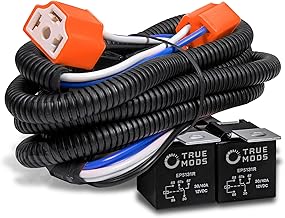
True Mods H6054 H4 LED Wiring Harness [Negative Switched Relay, Fused]
• Negative-switched relay design (works on 2007–2011 JK positive-switched circuits) • 40A fused relay rated for LED headlights and fog lights • Battery-direct power delivery for stable voltage • Plug-and-play with OEM switch
Check Price on Amazon →2012–2018 JK owners: Your CANBUS-managed electrical system is more forgiving with modern LEDs, but a relay harness still prevents dashboard warning lights. Check the product listing for CANBUS compatibility before buying.
Bumper-Integrated Systems: Four Real Options for Your JK
If you’re committing to a bumper swap, these four systems give you integrated fog light positioning plus recovery capability. All are compatible with 2007–2018 JK and JKU models (2-door and 4-door). Harness routing should be planned before the bumper is fully torqued down.
ECOTRIC Stubby Bumper with Fog Light Housing
Pros:
- Excellent approach angle improvement over full-width designs
- Fog light housings built in — just add your pod lights or LED units
- D-rings welded on — no separate recovery point purchase
- Best value at sub-$150
Cons:
- Fog lights not included — housing only, requires pod purchase
- Stubby design limits winch tuck options versus full-width
- Light positioning narrower than full-width bumpers
Real-world takeaway: This is the entry point for JK owners who want integrated fog lighting without spending $400+. You’ll improve your approach angle, gain recovery points, and have a clean place to mount your actual fog light pods. Pair it with any of the LED pod lights covered below and you’ve got a functioning trail setup under $300 total.
YZONA Stubby Bumper with Winch Plate and OE Fog Light Holes

YZONA Stubby Bumper with Winch Plate and OE Fog Light Holes
• Compatible: 2007–2026 JK, JKU, JL, JLU, Gladiator JT • Steel construction with reinforced winch plate • OE fog light hole placement (factory harness routing works) • Integrated bull bar protection • Weight: ~95 lbs
Check Price on Amazon →Pros:
- OE fog light hole placement means your existing factory harness reaches without extension harnesses
- Winch plate rated for standard recovery winches — no separate mounting plate needed
- Bull bar adds front protection without eating your approach angle
- Better long-term value than the ECOTRIC if you’re adding a winch
Cons:
- Higher price than the ECOTRIC ($50 difference)
- Bull bar aesthetic doesn’t suit every build style
- Slightly heavier than stubby-only options
Real-world takeaway: If you’re planning to add a winch alongside your lighting upgrade, this bumper’s integrated winch plate and factory fog light hole positioning make it the smarter mid-range choice. It saves you from running extension harnesses and eliminates a separate winch mount purchase.
Full-Width Steel Bumper with Integrated Light Mounts

Full-Width Front Bumper with Integrated Light Mounts and D-Rings
• Compatible: 2007–2025 JK/JL, 2-door and 4-door • Textured black steel, full-width design • Integrated light mounts for dual fog pods • Heavy-duty D-ring recovery points • Weight: ~135 lbs
Check Price on Amazon →Pros:
- Full-width profile provides maximum frontal protection
- Light mounts positioned for wide, low fog coverage — excellent trail visibility
- Suits overlanders and rock crawlers who prioritize protection over approach angle
- Heavy steel construction withstands serious off-road impacts
Cons:
- Approach angle reduced significantly versus stubby options
- Highest price point at $420
- Noticeably heavier — adds ~50 lbs unsprung weight
- More difficult solo installation
Real-world takeaway: This is built for rigs that need maximum frontal protection alongside integrated lighting — serious rock crawlers and overlanders doing week-long trips. The weight penalty is real, but the durability and light positioning are worth it if night wheeling is a core part of your trips. Pair it with best rock crawling tires for the JK and lift kit options for daily driving JKs for a complete purpose-built setup.
What Actually Matters When You’re Shopping for Fog Light Upgrades
Spec sheets lie by omission. A manufacturer will tout peak lumen output that reflects one ideal measurement point, not what’s actually useful on a trail. Here’s what to actually evaluate.
Beam pattern and cutoff. You want wide and flat, not floody or spotty. Fog lights should have a sharp horizontal cutoff so light doesn’t wash into oncoming traffic. Check user reviews and beam photos, not just the marketing claim.
Color temperature for your terrain. Amber (3,000K) cuts through dust and rain because longer wavelengths scatter less in particulates. Cool white (5,500–6,500K) is crisper on dry, clear nights. Serious wheelers keep both — amber pods for the Moab-style dust runs, white for forest trails at altitude. Manufacturers usually specify this explicitly.
IP rating for trail abuse. IP67 or IP68 minimum — dust-tight and submersion-rated. IP65 (splashproof) is acceptable for rain; it’s marginal for water crossings and mud spray.
CANBUS compatibility on 2012–2018 models. Non-CANBUS LEDs trigger dashboard warning lights on newer JKs. Check the product listing explicitly. It’s a two-second catch that prevents a frustrating dashboard issue.
Mounting location and aim angle. OEM-location drop-ins are simple but limited by the housing. Pod-mounted lights give you aim flexibility that matters more than you’d think, especially as you lift your JK higher. Bumper-integrated options relocate the light source forward and low — genuinely better for trail visibility but non-reversible.
Warranty coverage. Reputable manufacturers back their products for 1–3 years. A longer warranty suggests confidence in durability. Trail use is harder on electrical components than street driving, so this matters.
Installation: The Steps That Separate Clean Builds from Redo Installs
I’ve wired lighting systems on my JK more than once, and the difference between a solid install that lasts years and a frustrating one that causes problems is usually three details most people skip.
Start with the battery disconnected. Every single time. Turn off the engine, disconnect the negative terminal, and wait five minutes for residual voltage to bleed off. This prevents shorts and protects your BCM on 2012–2018 trucks. It’s a 30-second step that saves hours of debugging.
Know your bulb size before you order anything. Most 2007–2018 JKs use H11 bulbs in the fog housing, but verify with the existing bulb or your owner’s manual. Ordering the wrong size and having it arrive is the most common beginner frustration — and it’s entirely preventable.
Test fit everything dry before you tighten anything. Pod brackets need clearance from the bumper at full turn. Relay harnesses need routing that doesn’t pinch wires against metal. Bumper-integrated harnesses need to reach the fog lights without being under tension. Spend 20 minutes here and save two hours of rework later.
Route harnesses before bumper installation. For bumper swaps, thread your fog light harness before you torque the bumper down. Trying to feed a harness through a mounted bumper is significantly harder and the routing is often messier.
Use dielectric grease on every connector. This is the detail that prevents creeping electrical issues in muddy, temperature-swinging trail environments. Corrosion at a connector joint kills otherwise solid installs over time. A tiny amount on every connection costs $3 and prevents $200+ in diagnosis work.
Aim your lights at a wall before the first trail run. This is the single most overlooked step, and it’s critical. Level ground, 25 feet from a wall, switch on the fog lights, and adjust mounting hardware so the beam hits the wall evenly without washing the hood. Improperly aimed lights either blind oncoming traffic or illuminate nothing useful ahead of you.
For more on the wiring side of JK electrical modifications, the step-by-step halo headlight installation guide walks through relay and CANBUS considerations in detail. If you’re building a full recovery kit, the best air compressor for Jeep JK trail recovery pairs well with your lighting setup.
Buyer’s Checklist: Before You Buy
Use this checklist before adding anything to your cart.
✓ Verify your JK’s year and wiring type. 2007–2011 JKs need a relay harness for most LED retrofits. 2012–2018 models are more tolerant but still benefit from one. Check your door jamb or documentation to be certain.
✓ Confirm bulb size or pod type. H11 for OEM-location drop-ins. Pod lights come with their own connectors — verify the mount style matches your bracket plan (A-pillar, hood hinge, bumper, light bar).
✓ Check CANBUS compatibility on 2012+ models. Non-CANBUS LEDs will trigger warning lights. Explicitly verify in the product listing.
✓ Look at real user photos and reviews. Spec sheets don’t tell you how a beam actually looks on a trail. Read reviews from wheelers, not just road drivers.
✓ Verify return policy and warranty. Trail use is demanding. At least a 30-day return window and 1-year warranty are baseline expectations.
✓ Calculate your total cost including harnesses and mounts. A $40 LED bulb that requires a $60 relay harness and $30 wiring adapters is actually a $130 job. Budget accordingly.
✓ Plan your wiring path before you order. Bumper swaps and pod mounts require harness routing through specific chassis points. Sketch it out mentally or on paper.
FAQ: Your Fog Light Upgrade Questions, Answered
Do aftermarket LED fog lights work with the factory switch on a 2007–2018 Jeep JK?
Yes, most plug-and-play LED replacements are designed to work with the OEM switch. However, 2007–2011 JKs with positive-switched circuits often experience flickering or lights that won’t fully shut off. A relay harness like the True Mods unit eliminates these symptoms without modifying your factory switch. 2012–2018 JKs are more electrically tolerant, but a relay harness still prevents potential CANBUS warning lights.
What fog light bulb does my JK use?
Most 2007–2018 JK and JKU models use an H11 bulb in the OEM fog housing. Verify by checking the existing bulb or consulting your owner’s manual — it takes 30 seconds and prevents a wrong-size return. Some trim levels may differ, so don’t assume.
Are bumper-integrated fog lights really worth the cost and installation effort?
For serious off-road use, yes. Bumper-integrated systems position the light source lower and wider than OEM fog lights, improving low-angle trail illumination where you actually need it. You also gain recovery points and often a winch mount. The cost is higher ($140–$500 depending on bumper choice) and the install requires bumper removal, but the visibility and protection improvement is substantial for rigs that wheel regularly after dark.
What color temperature is best for off-road fog lights?
Amber (3,000K) is superior in dust, rain, and fog because longer-wavelength light scatters less in particulate air. Cool white (5,500–6,500K) is crisper on dry, clear nights. Many serious wheelers run both — amber for dusty terrain and wet conditions, white for clear desert or forest trails. Check the product listing to see what color temperature you’re buying.
Can I install fog light upgrades on a stock-height JK?
Absolutely. Fog light upgrades work independently of suspension setup. A lift does change the effective aim angle of bumper-mounted lights, so if you plan to lift later, mount fog lights slightly lower than feels ideal now to account for that change. OEM-location drop-in bulbs and pod lights are fully compatible with stock-height trucks.
What’s the difference between IP65 and IP67 fog light ratings?
IP65 is splashproof — fine for rain and light spray. IP67 is dust-tight and submersion-rated — suitable for water crossings and muddy spray. For serious trail use, IP67 or IP68 is worth the investment. It’s the difference between a light that fails after a water crossing and one that runs for years.
The Right Upgrade for Your Trail Setup
The path forward depends on three things: your budget, your build stage, and how seriously you wheel after dark.
If you wheel occasionally or mostly on well-maintained roads: A quality LED drop-in bulb (H11, CANBUS-compatible, 1,200+ lumens) costs $30–$60 and improves visibility immediately. No wiring headaches, no bumper swaps. You’ll notice the difference in rain and dusk driving.
If you’re building a mid-range trail rig: Auxiliary pod lights with a relay harness give you flexibility, better output, and the ability to upgrade later. Install time is a Saturday afternoon. Cost is under $250 for a decent setup. This is the sweet spot for most serious wheelers who aren’t (yet) committed to major bumper work.
If you’re doing a full build or rock crawling regularly: A bumper-integrated system like the YZONA bumper or full-width steel option relocates your fog lights for optimal trail geometry while adding recovery capability and protection. It’s the highest commitment but also the most purpose-built for night wheeling.
One more critical detail: If you own a 2007–2011 JK and you’re adding LEDs, don’t skip the relay harness. It’s $24 and it prevents the flickering, won’t-shut-off symptoms that frustrate people into thinking they bought a bad product.
For a complete picture of lighting on the JK, the complete LED headlight upgrade guide covers headlights, halos, and how they integrate with your fog light setup. And if you’re building out full trail protection alongside your lighting, the transfer case skid plate guide for JK drivetrain armor covers the underside strategy.
Your JK will thank you on the first dark trail run.
Free: JK Fluids at a Glance
Every fluid, spec and capacity for the 2007-2018 Wrangler JK on one page, plus a cut-out glovebox card. Checked against the owner's manuals. From the JK Service Kit.
Email me the download and new guides when they are published. Unsubscribe anytime. Privacy Policy.
Allan
I'm Allan. I own a 2014 Jeep Wrangler JKU and I research the hell out of every mod before I touch it. When I've fitted something to my own Jeep, I say so. Everything else is researched from manufacturer specs and other owners' reports. No sponsored fluff.
Learn more about me →Free: JK Fluids at a Glance
Every fluid, spec and capacity for the 2007-2018 JK on one page, plus a glovebox card.
Email me the download and new guides when they are published. Unsubscribe anytime. Privacy Policy.
Related Articles
Best Winch for Jeep JK: Rated Pull, Line Speed & Mount Compatibility Guide
A jeep winch is an electric or hydraulic recovery device mounted to the front (or rear) of your Jeep that spools a steel cable or synthetic rope under...
Jeep JK Door Removal and Storage During Off-Road Season
Pull your Jeep JK's doors off, and something shifts. The whole driving experience changes — wind noise replaces engine sound, sightlines open up, and...
Adaptive LED Headlight Systems Jeep JK: Automatic Beam Adjustment Explained
Adaptive LED headlight systems for the Jeep JK sound like they should do something fancy — something that tracks corners or levels itself with a load....