2017 Jeep Wrangler JK Maintenance Schedule: Complete Service Guide
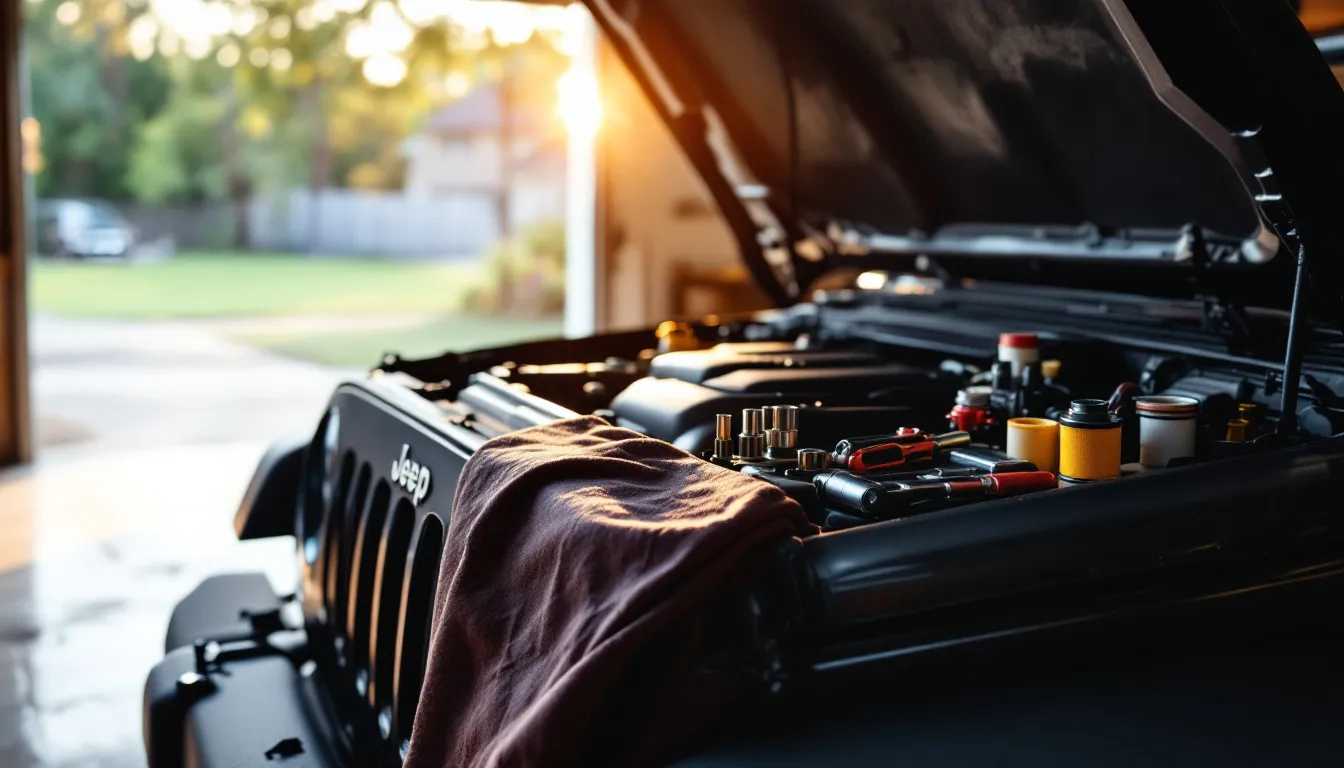
2017 Jeep Wrangler JK Maintenance Schedule: Complete Service Guide
Introduction
I didn’t grow up around engines. My first oil change nearly ended in disaster — I torqued the drain plug like I was settling a score, and aluminum doesn’t forgive gorilla strength. That one mistake, and the three-hour research session that followed, taught me something: maintenance isn’t optional, and neither is precision.
Now, years into JK ownership, I keep a repair journal. Every service gets logged with the date, mileage, part numbers, and whatever I learned that day. It sounds obsessive until you need to know exactly what fluid went in the differential five years ago, or when the brake fluid was last flushed. Then it becomes insurance.
This guide covers the 2017 Jeep Wrangler JK maintenance schedule — everything from oil change intervals to severe-duty off-road service timing. If you’re building that same knowledge base for your own rig, this is the reference I wish I’d had starting out.
Affiliate Disclosure: This article contains affiliate links. If you purchase through them, we may earn a small commission at no extra cost to you. We only recommend tools and products we’d actually use on a JK.
For context on what makes the 2017 model year tick, check out 2017 JK model year specifics and changes and common problems JK owners face by year.
2017 Jeep Wrangler JK Maintenance Schedule: Quick-Reference Table
The table below is your master reference. Every major service interval for the 2017 JK is here in one place.
| Service | Normal Interval | Severe/Off-Road Interval |
|---|---|---|
| Engine Oil & Filter (5W-20) | Every 5,000–7,500 miles | Every 3,000–5,000 miles |
| Tire Rotation | Every 5,000–7,500 miles | Every 5,000 miles |
| Air Filter (Engine) | Every 30,000 miles | Every 15,000 miles or as needed |
| Spark Plugs (Pentastar) | Every 30,000 miles | Every 30,000 miles |
| Brake Fluid | Every 2 years / 45,000 miles | Annually |
| Transmission Fluid (NSG370 Manual) | Every 45,000 miles | Every 20,000–30,000 miles |
| Transmission Fluid (65RFE Auto) | Every 60,000 miles | Every 30,000–40,000 miles |
| Transfer Case Fluid | Every 30,000 miles | Every 15,000 miles |
| Front Differential Fluid | Every 30,000 miles | Every 15,000 miles |
| Rear Differential Fluid | Every 30,000 miles | Every 15,000 miles |
| Coolant Flush | Every 5 years / 100,000 miles | Every 3 years |
| Battery Inspection | Annually | Annually |
| Steering & Suspension Inspection | Annually | Every 6 months |
How to read this table: The “Normal” column applies to street-driven JKs under routine conditions. The “Severe/Off-Road” column applies any time your Jeep sees trails, water crossings, heavy towing, or consistent short-trip driving.
Severe-Duty Service Note
Severe duty means more than just wheeling. Jeep’s definition includes frequent off-road use, water fording, extreme heat or cold, stop-and-go city driving, towing near max capacity, and any scenario where fluids get exposed to contamination. If your 2017 JK fits any of those categories — and most do — cut every interval in half as a baseline.
The 2017 JK’s 3.6L Pentastar V6 has a solid reliability track record. The engine itself isn’t the weak link. It’s the drivetrain fluids — differentials and transfer case especially — where neglect shows up first and costs the most.
For more on how trim level affects your service needs, see 2017 JK trim levels (Rubicon, Sahara, Sport).
Engine Oil & Filter: The Most Important Service on Your 2017 JK
The 2017 Jeep Wrangler JK with the 3.6L Pentastar takes 5W-20 full synthetic oil with a capacity of approximately 6 quarts including filter. Chrysler specifies MS-6395 — check the jug before you pour.
Normal interval is every 5,000–7,500 miles, but the owner community runs 5,000-mile intervals regardless. It’s cheap insurance on an engine you’re likely keeping for 150,000+ miles.
About that drain plug: 20 ft-lb and no more. The JK’s aluminum oil pan doesn’t forgive overtightening. I’ve seen threads pulled completely out by people assuming “more is better.” It isn’t. Torque wrench every time. Replace the crush washer every other change or whenever it looks flattened — that’s where leaks start.
The oil filter sits in an awkward spot, accessible but annoying without help. A quality filter wrench makes the job clean:

57010 Import Oil Filter Swivel Wrench
$16.17
- Swivel head for tight spaces
- Works on filters 2.75" to 3.25" diameter
- Chrome-plated finish
Pros: Saves knuckles, reaches awkward filter locations
Cons: Single-purpose tool; requires proper grip technique
Check Price on Amazon →The single best thing you can do for your 2017 JK is stay current on oil changes. Everything else on this list matters, but nothing matters more than this one.
Transmission & Transfer Case Fluid: Don’t Skip These
Transmission and transfer case fluid services get skipped more often than they should. They’re also more consequential than most owners realize. Here’s what the 2017 JK uses across its drivetrain.
Manual Transmission (NSG370)
The NSG370 6-speed manual runs on Mopar Manual Transmission Lubricant (MTL) or equivalent GL-4 75W-85 gear oil. Fill plug torque is approximately 25 ft-lb. Service interval under normal conditions is every 45,000 miles; slice that to 20,000–30,000 miles if you’re on trails regularly or towing frequently. Watch for grinding or notchy 1st-to-2nd shifts — that’s the NSG370 telling you the fluid has absorbed too much contamination.
Automatic Transmission (65RFE)
The 65RFE automatic demands Mopar ATF+4 — no substitutions. Generic fluids won’t work here. ATF+4 has specific friction modifiers tuned to the 65RFE’s clutch packs. Use anything else and you’ll get harsh shifts and accelerated wear. Normal interval is 60,000 miles; severe duty drops that to 30,000–40,000 miles. Check the fill level with the fluid hot — a quick highway run before checking makes the reading accurate.
Transfer Case (NV241/NV241OR)
Both the NV241 (Sport/Sahara) and NV241OR (Rubicon) take Mopar NV241 Transfer Case Fluid or ATF+4 equivalent. Every 30,000 miles normally; 15,000 miles in severe duty. The fill and drain plugs use a 3/4” square drive — a complete mechanics set handles this without specialty tools:

185 Piece Mechanics Hand Tool Set - 1/4", 3/8", & 1/2" Drive | 90 Tooth | SAE & Metric | GW90MCBMTS
$129
- 1/4", 3/8", and 1/2" drive sockets
- 90-tooth ratchets with quick-release
- Includes hex keys, screwdrivers, extensions
- SAE and metric coverage
Pros: Comprehensive coverage for most JK maintenance tasks, 90-tooth ratchets for tight spaces
Cons: Takes up toolbox space; some pieces rarely used
Check Price on Amazon →Trim level differences affect which drivetrain components you’re working with — check Rubicon vs Sahara vs Sport service differences for the specifics.
Front & Rear Differential Fluid: Where Neglect Gets Expensive
When I bought my JK, it needed work. The radiator was shot, the AC barely functioned, and then came the cylinder heads — warped on the 3.6L Pentastar, a known issue on that generation. None of that was glamorous. But it taught me something: fix the foundation first. You can’t upgrade a Jeep with blown gaskets and call it ready for anything serious.
Differential fluid is exactly that kind of foundation work.
The 2017 JK uses 80W-90 gear oil in both the front (Dana 30 on Sport/Sahara, Dana 44 on Rubicon) and rear Dana 44. If you have a Rubicon with the rear locker, add a friction modifier additive — skip it and you’ll get chatter, then clutch wear, then an expensive repair bill.
Normal interval: every 30,000 miles. Off-road use, water crossings, and rough terrain cut that dramatically — 15,000 miles, or immediately after any significant water fording.
⚠️ Warning: Milky, gray, or foamy differential fluid means water contamination. If you drain the diff and it looks like a chocolate milkshake, the bearings and gears have been running in emulsified water. Inspect immediately — don’t refill and hope for the best.
Fill and drain plugs torque to 25 ft-lb. They’re often seized after years of neglect. A short ratchet will only encourage you to yank harder than you should. Use a proper breaker bar instead:

1/2 Inch Drive x 24 Inch Breaker Bar | SBH00224
$55
- 1/2" drive, 24" length
- Chrome-plated steel
- Works with standard 1/2" sockets
Pros: Long leverage for stuck fasteners, durable construction, affordable
Cons: Requires space to work with; not ideal in tight engine bays
Check Price on Amazon →For more on what happens when differential service gets skipped, read axle and drivetrain problems on JK Wranglers.
Brakes, Tires & Steering: The Safety-Critical Stuff
Brakes
Inspect brake pads every 15,000 miles or annually. The 2017 JKU weighs around 4,400 lbs — brake wear accelerates quickly, especially with larger tires or frequent trail descents. Replace pads at 3mm remaining thickness. Brake fluid absorbs moisture and its boiling point drops over time — flush every 2 years regardless of mileage.
Tires
Rotate every 5,000–7,500 miles. If you’re running a full-size spare and you have five matching tires, use a 5-tire rotation pattern to wear all five evenly. Check pressure every month — JK tires bleed slowly but consistently, and under-inflation accelerates shoulder wear on a heavy rig.
When reinstalling wheels, lug nuts need 95–100 ft-lb. A quality torque wrench makes this non-negotiable:

1/2 Inch Drive 90-Tooth Dual-Direction Micrometer Torque Wrench (40-300 ft-lb) | TRQ52403
$150
- 40–300 ft-lb range
- 90-tooth ratchet head
- Dual-direction (tightening and loosening)
- Click-type with audible notification
Pros: Accurate to ±4%, handles most automotive fasteners, reliable click mechanism
Cons: Requires careful storage; don't leave cocked under tension
Check Price on Amazon →For lug nut removal, an impact socket set saves time and knuckles:

39 Pc. 1/2" Drive 6 Pt. Impact Socket Set, Standard & Deep, SAE - 84947N, Black
$179.99
- 39 pieces: standard and deep sockets
- SAE sizes, 1/2" drive
- Black oxide finish
- Impact-rated construction
Pros: Deep sockets reach lug nuts; impact-rated for power tools
Cons: Bulky set; you'll probably use only a few pieces regularly
Check Price on Amazon →Steering
Inspect the track bar, drag link, tie rod ends, and steering stabilizer annually — every 6 months if you wheel regularly. I learned this lesson the hard way. Death wobble hit at highway speed with my family in the car. The cause? A worn track bar bushing. A quick annual inspection would have caught it. That wobble at 65 mph is something I won’t forget. A track bar replacement and better habits fixed it. For more on this specific issue, read about death wobble and steering problems on JK Wranglers.
Spark Plugs, Air Filter & Coolant: Engine Health at 30K+ Miles
Spark Plugs
The 2017 JK’s 3.6L Pentastar uses iridium-tipped spark plugs rated for 30,000-mile intervals. At replacement, inspect them for oil fouling or abnormal wear — those patterns signal deeper engine issues developing. Stick with factory-spec or equivalent iridium plugs. Don’t downgrade to copper.
Air Filter
Every 30,000 miles under normal driving. Cut that to 15,000 miles or inspect more frequently if you drive dusty roads, forest trails, or dry desert. A clogged air filter quietly kills fuel economy and power. It’s a $20 part and a 5-minute job that pays for itself in the first tank of gas.
Coolant
The 2017 JK uses HOAT (Hybrid Organic Acid Technology) coolant — orange or yellow formula, not the traditional green. Mix 50/50 with distilled water. Full flush every 5 years or 100,000 miles normally.
Here’s the real math: a $15 coolant check beats a $400 radiator replacement. I’ve paid for the expensive version of that lesson. A neglected cooling system on a JK will cost far more than the fluid ever would. Watch for level drops, unusual odor, or discoloration — those five-minute checks keep a radiator from becoming a story.
A Bluetooth scan tool catches codes early, before symptoms get expensive:

Bluetooth Pro OBDII Scan Tool for iPhone & Android - No Subscription Fee - OBD2 Car Scanner and Code Reader
$84.95
- Bluetooth connectivity to smartphone
- Reads and clears engine, ABS, SRS codes
- No monthly fees or subscriptions
- Works with iOS and Android apps
Pros: Saves diagnostic shop visits, catches issues early, instant code definitions
Cons: Requires compatible smartphone; limited to basic diagnostics
Check Price on Amazon →For context on how the Pentastar stacks up against earlier JK engines, see 2017 JK’s 3.6L Pentastar compared to earlier model years.
Battery & Electrical Health: Often Missed on Older JKs
Your 2017 JK is now pushing 9 years old. The original battery, if never replaced, is running on borrowed time. Most automotive batteries last 4–6 years. Inspect terminals annually for corrosion and test voltage with a multimeter to confirm the charging system is working.
How to test your JK’s battery:
- Engine off: Touch multimeter leads to battery terminals (red to positive, black to negative). A healthy resting voltage reads 12.4–12.7V.
- Engine running and idling: Retest. The alternator should push voltage to 13.5–14.5V.
- If resting voltage falls below 12.2V or charging voltage strays outside 13.5–14.5V, your battery or charging system needs attention.

MM325 Multimeter, Digital Manual-Ranging 600V AC/DC Voltage Tester, Tests Batteries, Current, Resistance
$29.98
- 600V AC and DC voltage range
- Current, resistance, and continuity testing
- Manual ranging for precision
- Durable construction, backlit display
Pros: Affordable, accurate for battery testing, manual ranging prevents damage from wrong settings
Cons: Requires manual range selection; not auto-ranging
Check Price on Amazon →Severe-Duty & Off-Road Service Intervals for Your 2017 JK
Here’s what most owner’s manuals won’t tell you straight: the spec sheet is written for a vehicle that mostly sees pavement. Severe duty is the default for most Wranglers, not the exception.
That’s the pattern you see in JK communities and forum threads year after year. Real-world owners consistently report that fluids degrade faster under trail conditions — especially after water crossings, sand runs, and sustained low-range operation — than manufacturer intervals suggest. Community data usually beats theoretical specs when it comes to trail-tested intervals.
| Service | Normal Schedule | Severe / Off-Road Schedule |
|---|---|---|
| Engine Oil | 5,000–7,500 mi | 3,000–5,000 mi |
| Differential Fluid | 30,000 mi | 15,000 mi or after water fording |
| Transfer Case Fluid | 30,000 mi | 15,000 mi |
| Transmission Fluid | 45,000–60,000 mi | 20,000–40,000 mi |
| Air Filter | 30,000 mi | 15,000 mi or as needed |
| Brake Fluid | 2 years | Annually |
| Steering Inspection | Annually | Every 6 months |
Severe duty includes: off-road driving, water fording, towing, consistent short trips under 5 miles, extreme heat or cold operation, and dusty or sandy environments.
For perspective on how the JK’s maintenance demands compare to the newer generation, see JK vs JL Wrangler comparison. If you’re evaluating a used example, what to check before buying a used JK Wrangler gives you the inspection checklist.
Essential Tools for DIY Maintenance on a 2017 Jeep JK
DIY service on a 2017 JK doesn’t require a professional shop — but it does require the right tools. Here’s a practical reference for everything covered in this guide.
| Tool | Best For | Approximate Price |
|---|---|---|
| 185-Piece Mechanics Hand Tool Set | Oil changes, fluid swaps, underhood work | $129 |
| 1/4” Drive Micrometer Torque Wrench | Small fasteners, sensor bolts, drain plugs | $85 |
| 1/2” Drive Micrometer Torque Wrench | Lug nuts, diff fill plugs, track bar bolts | $150 |
| 1/2” Drive 24” Breaker Bar | Seized differential and transfer case plugs | $55 |
| 39-Piece 1/2” Impact Socket Set | Wheel removal, suspension bolts | $179.99 |
| Bluetooth OBDII Scan Tool | Check engine, ABS, SRS code reading | $84.95 |
| Digital Multimeter (600V) | Battery and charging system testing | $29.98 |
For smaller fasteners, a dedicated 1/4” torque wrench keeps drain plugs precise:

1/4 Inch Drive 90-Tooth Dual-Direction Micrometer Torque Wrench (20-200 in-lb) | TRQ50402
$85
- 20–200 in-lb range (also reads in ft-lb)
- 90-tooth ratchet for tight spaces
- Dual-direction (tightening and loosening)
- Click-type notification
Pros: Precise for oil drain plugs and small fasteners, 90-tooth ratchet fits tight spaces
Cons: Limited range; need a separate 1/2" wrench for larger fasteners
Check Price on Amazon →If you’re evaluating a used JK, what to check before buying a used JK Wrangler walks you through the complete inspection.
How to Track Your 2017 JK’s Service History
A repair journal started early becomes valuable fast — and it adds real value at resale. A documented service history proves the Jeep was maintained properly. Here’s how to build one that actually works:
The basics:
- Keep a dedicated log — a notebook works, but digital is searchable later. Notes app, spreadsheet, whatever you’ll actually maintain.
- Log the odometer at every service, not just the date. Mileage-based intervals matter more than calendar dates on a daily-driver JK.
- Note exactly what went in — fluid brand, filter part number, spark plug spec. This prevents compatibility mistakes on future services.
- Record anything unusual — fluid colors, sounds, leak locations, wear patterns. Those observations become diagnostic gold when you need it.
- Photograph unexpected findings — timestamped photos of worn parts, leak sources, or corrosion beat memory every time.
A complete service history can add hundreds of dollars to your JK’s resale value — and it shows any buyer that the Jeep was taken seriously. See how a 2017 stacks up at resale in 2017 JK compared to other model years.
2017 Jeep Wrangler JK Maintenance: Frequently Asked Questions
What oil does a 2017 Jeep Wrangler JK take?
The 2017 Jeep Wrangler JK with the 3.6L Pentastar V6 uses 5W-20 full synthetic engine oil meeting Chrysler’s MS-6395 specification. Capacity is approximately 6 quarts with a filter change. Using the correct viscosity and spec matters on the Pentastar — wrong oil can trigger VVT system issues and rough starts in cold weather.
How often should I change the oil on a 2017 Jeep Wrangler?
Every 5,000–7,500 miles under normal driving. Most JK owners choose 5,000 miles regardless of conditions — it’s inexpensive insurance for an engine that may see trail stress. For severe duty (trails, towing, extreme temperatures), drop to 3,000–5,000 miles.
What is the transmission fluid for a 2017 Jeep Wrangler JK?
It depends on your transmission. The NSG370 6-speed manual requires Mopar MTL (GL-4 75W-85). The 65RFE automatic requires Mopar ATF+4 — this is proprietary and friction-modifier tuned to that transmission. Generic ATF will cause shift quality issues and accelerated clutch wear. Use the correct fluid or don’t bother changing it.
How often should differential fluid be changed on a Jeep Wrangler JK?
Every 30,000 miles normally, and every 15,000 miles for off-road use or after any significant water crossing. Rubicon models with the rear locker require a friction modifier additive in the rear differential — don’t skip it. Deferred differential service is one of the most common mechanical problems on JK Wranglers at higher mileage.
How much does it cost to maintain a Jeep Wrangler JK per year?
DIY annual maintenance typically runs $300–$600 per year covering oil changes, filters, and a differential/transfer case fluid service cycle. Dealer servicing for the same work runs $600–$1,200 annually. A major fluid change cycle (transmission, transfer case, both diffs) adds another $150–$300 in parts if done at home, or $400–$700 at a shop. JK vs JL maintenance cost comparison breaks down how these costs differ across generations.
What is the severe-duty maintenance schedule for a Jeep Wrangler JK?
Severe duty means halving most standard intervals. Oil moves to 3,000–5,000 miles, differentials and transfer case to every 15,000 miles, and transmission fluid to 20,000–40,000 miles depending on type. Air filters get checked every 15,000 miles, brake fluid flushed annually, and steering components inspected every 6 months. Any JK used for off-road driving, water fording, towing, or city stop-and-go qualifies as severe duty.
Keep Your 2017 JK Running Strong
The 2017 JK is a proven platform. With consistent maintenance, these trucks run well past 200,000 miles — my goal is to keep mine running for another 150,000 at least. Three core takeaways from this guide:
Stay current on fluids. Oil, differentials, transfer case, and transmission fluid are where neglect shows up first and costs the most. These services compound over time.
Use the severe-duty schedule if your JK goes off-road, tows, or lives in temperature extremes. Which covers most Wranglers. Community experience beats theoretical specs here.
Document every service. A maintenance log protects your investment and simplifies troubleshooting. It adds real value at resale.
A well-maintained JK holds value better than almost anything in its class. The time you invest now pays back directly at resale and keeps you from surprises that proper fluid checks would have caught months earlier.
Ready to go deeper on your JK? Explore best soft tops for Jeep JK owners, best hardtops for the Jeep JK, and the complete JK buyers guide for everything else you need to know about owning and upgrading one of these rigs.
Get the Free JK Build Planner
Complete PDF with mod checklists, gear ratios, tire sizing charts, and budget worksheets. Everything you need to plan your JK build.
No spam. Unsubscribe anytime. By subscribing, you agree to our Privacy Policy.
Allan
I'm Allan. I bought a 2014 Jeep Wrangler JKU and I research the hell out of every mod before I touch it. Everything here is tested or deeply researched on my own rig - no sponsored fluff, just honest findings.
Learn more about me →Get the JK Build Planner
Free PDF with complete build checklists, gear ratios, and tire fitment guides.
By subscribing, you agree to our Privacy Policy.
Related Articles
2018 Jeep JK Maintenance Schedule PDF
Every used Jeep has a story. Mine had a few it hadn't finished telling yet.
Jeep JK Maintenance Schedule PDF: Complete Service Guide (All Years)
Complete JK maintenance schedule with intervals, fluid specs, and torque specs for 2007-2018 Wranglers. Severe duty intervals, DIY tips, and downloadable checklist.
2018 Jeep Wrangler JK Maintenance Schedule: Final Year Service Guide
Complete 2018 Jeep Wrangler JK maintenance schedule with severe service intervals, fluid specs, and cost breakdowns. Keep your final-year JK running strong.