Jeep JK Maintenance Schedule PDF: Complete Service Guide (All Years)
Jeep JK Maintenance Schedule PDF: Complete Service Guide (All Years)
The Jeep Wrangler JK (2007-2018) has two factory maintenance schedules, not one: the 3.8L V6 years (2007-2011) and the 3.6L Pentastar years (2012-2018) use different oil intervals, coolant, spark plug timing and filters. This guide sets out both, taken from the Jeep owner’s manuals, and adds the extra services the manual calls for if you tow, go off-road, drive in dust or water, or idle a lot.
The short version: on a 2012-2018 3.6L, change the oil when the oil-change indicator says so (up to 10,000 miles or 12 months, every 4,000 miles under severe duty), replace the engine air filter every 30,000 miles, spark plugs at 100,000 miles and coolant at 10 years or 150,000 miles. On a 2007-2011 3.8L, oil goes every 6,000 miles (2008 manual) or 8,000 miles (2011 manual) or 6 months, and spark plugs and coolant come due around 96,000 to 104,000 miles. Axle, transfer case and transmission fluid changes are mostly severe-use items. If you wheel, tow or cross water, treat yourself as severe use.
This covers every 2007-2018 JK and JK Unlimited, 2-door and 4-door, Sport, Sahara and Rubicon. If you’re not sure which axles, transfer case or transmission your Jeep has, the JK Buyers Guide and the Rubicon vs Sport vs Sahara comparison will tell you, and it matters when you order fluids.
Jeep JK Maintenance Schedule: Complete Interval Table (All Years)
This is the printable summary. “Severe use” is the owner’s manual’s term: towing, off-road driving, dusty or wet conditions, lots of idling, or commercial use. Where the two engine generations differ, both are shown.
| Service item | 3.6L Pentastar (2012-2018) | 3.8L V6 (2007-2011) | Severe use |
|---|---|---|---|
| Engine oil & filter | Oil-change indicator, up to 10,000 mi / 12 months | 6,000 mi (2008 manual) or 8,000 mi (2011 manual) / 6 months | 3.6L: every 4,000 mi. 3.8L: sooner with off-road use |
| Tire rotation | Every oil change | Every oil change | Same |
| Brakes, hoses, cooling system, exhaust, battery | Inspect every oil change | Brake linings at 12,000 (2008) or 16,000 (2011) | Same |
| Cabin air filter | Replace every 20,000 mi (2015/2018 manuals) | 12,000 mi (2008 manual) | Same |
| Engine air filter | Replace every 30,000 mi | Replace at 30,000 (2008) / 32,000 (2011) | Inspect more often in dust |
| Axle fluid, front & rear | Inspect at 20,000 mi | Inspect at 18,000 (2008) / 24,000 (2011) | Change every 40,000 mi (3.6L); change at the inspection points (3.8L) |
| Transfer case fluid | Inspect at 30,000 mi | Inspect at 30,000 (2008) / 32,000 (2011) | Change at 60,000 mi if towing or fleet |
| Manual transmission fluid (NSG370) | No normal interval | No normal interval | Change every 30,000 mi (3.6L); 30,000 (2008) / 32,000 (2011) |
| Automatic transmission fluid & filter | Replace at 120,000 mi | Replace at 120,000 mi | 60,000 mi (3.6L); 60,000 (2008) / 64,000 (2011) |
| Spark plugs | Replace at 100,000 mi | Plugs and ignition cables at 102,000 (2008) / 96,000 (2011) | Same |
| PCV valve | Inspect at 100,000 mi | Inspect at 90,000 (2008) / 96,000 (2011) | Same |
| Coolant | Replace at 10 years / 150,000 mi (OAT, 2013-2018) | Replace at 102,000 (2008) / 104,000 (2011) mi or 60 months (HOAT) | Same |
| Accessory drive belt | No factory interval; inspect from 100,000 mi | Replace at 120,000 mi | Same |
| CV/U-joints, front suspension, tie rod ends | Inspect every 20,000 mi | Inspect every 24,000 mi (first at 12,000 on 2008) | Inspect at every oil change if you wheel |
The 2007, 2009, 2010, 2016 and 2017 manuals weren’t checked one by one. The 2007-2011 columns come from the 2008 and 2011 manuals, and the 2012-2018 column from the 2013, 2015 and 2018 manuals (the 2013 manual has no cabin-filter row). If your year isn’t one of those, confirm against your own owner’s manual; Jeep publishes them at vehicleinfo.mopar.com.
For the tools you’ll need, see essential tools for Jeep JK maintenance.
Oil Change Intervals for Jeep JK: What the Manual Actually Says
On the 3.6L (2012-2018), the oil-change indicator decides, up to a maximum of 10,000 miles or 12 months. Under severe duty (dust, off-road, mostly idling) the manual says every 4,000 miles. On the 3.8L (2007-2011) the interval is 6,000 miles in the 2008 manual and 8,000 miles in the 2011 manual, or 6 months, whichever comes first. The old “3,000 miles” rule isn’t in any JK manual we read, but plenty of owners who wheel hard stay well under the maximum, and nothing is lost by doing so.
What goes in:
- 3.6L Pentastar: 6 quarts of SAE 5W-20 meeting Chrysler MS-6395. The 2012 manual lists 5W-30, so on a 2012 read the oil filler cap. The 2016 manual allows 5W-30 if 5W-20 isn’t available. It is not 0W-20 and not 5 quarts, which some online charts still say.
- 3.8L V6: 6 quarts of SAE 5W-20 meeting MS-6395.
- Filters: 3.8L spin-on Mopar 04105409AE. 3.6L cartridge 68079744AD (2012-2013) or 68191349AC (2014-2018). The 3.6L filter changed in 2014, so match your year.
Torque matters more than people think. The JK drain plug is 20 ft-lb on both engines. The 3.6L’s plastic filter housing cap is 18 ft-lb; clean the threads and fit the new O-ring that comes with the filter. The 3.8L spin-on filter is 15 ft-lb, or hand-tight plus the filter maker’s turn spec. Reset the oil-change indicator afterwards on a 3.6L.
The 3.8L is known to use some oil between changes. Check the dipstick every other fill-up and write down what it takes; a rising number is worth knowing before it becomes a problem.
On a 3.8L, the spin-on filter can be hard to reach with a rigid wrench. A swivel filter wrench helps with removal; install the new one by hand.
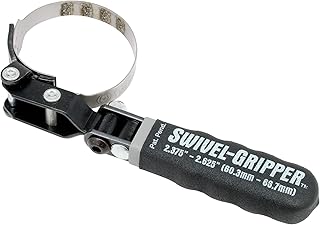
57010 Import Oil Filter Swivel Wrench
Check Price on Amazon →Buying a used JK with no history? Do an oil change early whatever the sticker says, and look at the drain plug threads before you assume the last owner got them right. More on intervals in our JK oil change interval guide.
Transfer Case, Axle & Transmission Fluid: JK Service Intervals
For normal driving, the owner’s manual has you inspect the axle and transfer case fluid rather than change it on a fixed interval. Under severe use, change the axle fluid every 40,000 miles on a 3.6L, and the transfer case fluid at 60,000 miles if you tow or run the Jeep as a fleet vehicle. And whatever the mileage: if the axle vents or the transfer case went under water, the fluid is suspect. Milky or light brown fluid means water. Change it before the next highway drive.
Here’s what each system takes (full detail in our JK fluid specifications guide):
Transfer case (NV241J Command-Trac on Sport/Sahara, NV241OR Rock-Trac on Rubicon)
- Fluid: licensed ATF+4, about 2.1 quarts
- Both versions take the same fluid; it is not gear oil
Front axle (Dana 30 on Sport/Sahara, Dana 44 on Rubicon)
- Fluid: SAE 80W-90, API GL-5, about 2.1 pints (Dana 30) or 2.7 pints (Dana 44)
- Synthetic 75W-140 if you tow
Rear axle (Dana 44, all trims)
- Fluid: SAE 80W-90, API GL-5, about 4.75 pints; synthetic 75W-140 for towing
- Limited-slip additive (4 oz) only if the axle is a Trac-Lok. Rubicon e-lockers are not Trac-Lok and don’t get additive. Check the axle tag or your VIN build sheet if you’re not sure.
Transmission
- 42RLE 4-speed automatic (2007-2011): ATF+4 only, about 4 quarts for a service
- W5A580 5-speed automatic (2012-2018, also called NAG1): ATF+4 only, about 5.3 quarts for a service. It has no conventional dipstick; the level is checked with a tool.
- NSG370 6-speed manual (all years): Mopar Manual Transmission Lubricant, MS-9224, 1.6 quarts. Not gear oil, and not 75W-85.
Capacities are for buying, not pouring. Axles, transfer case and the NSG370 are filled on level ground until fluid reaches the bottom edge of the fill hole. Always crack the fill plug before you drain; if it won’t come out, don’t drain.
Seized plugs are common on trail rigs. A breaker bar cracks them loose without leaning on the casting.
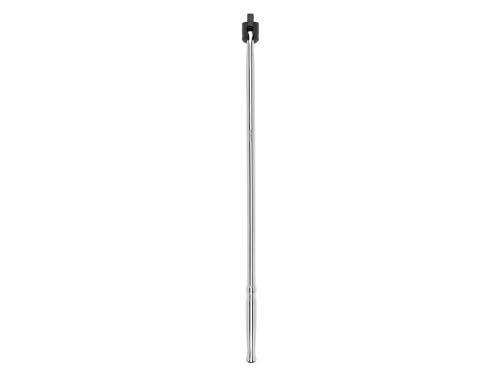
1/2 Inch Drive x 24 Inch Breaker Bar | SBH00224
Check Price on Amazon →When you drain, read the old fluid and the drain-plug magnet. Fine grey paste is normal wear; glitter or flakes that come back mean worn gears or bearings; a burnt smell or dark ATF points to heat (towing, big tires, gearing); grit means dirt got past a seal. If you’ve regeared for bigger tires, see best gear ratio for your JK after a tire upgrade.
Spark Plugs, Air Filter & Belts: Engine Service by JK Model Year
Spark plugs are a six-figure-mileage job on both JK engines: 100,000 miles on the 3.6L Pentastar, and 102,000 (2008 manual) or 96,000 miles (2011 manual) on the 3.8L, where the ignition cables are replaced at the same time. The 30,000-mile plug interval quoted in some JK schedules isn’t in the owner’s manuals.
Spark plugs
- 3.6L (2012-2018): replace at 100,000 miles, with a PCV valve inspection at the same service
- 3.8L (2007-2011): plugs and ignition cables at 96,000 to 102,000 miles depending on year; 3.8L plugs torque to 12 ft-lb into a cold engine
Engine air filter
- Replace every 30,000 miles (3.6L) or 30,000 to 32,000 miles (3.8L)
- In dust, inspect it at every oil change and replace it when it’s dirty, not when the calendar says so
- The 3.6L cabin air filter is every 20,000 miles in the 2015 and 2018 manuals
Accessory drive belt
- 3.8L: the manual replaces it at 120,000 miles
- 3.6L: there’s no factory interval on 2012 and later; inspect the belt and tensioner from about 100,000 miles and replace on condition (cracks, glazing, missing ribs, a noisy or bouncing tensioner)
The JK uses both SAE and metric fasteners, sometimes on the same assembly, so a mixed set saves a trip to the store mid-job.
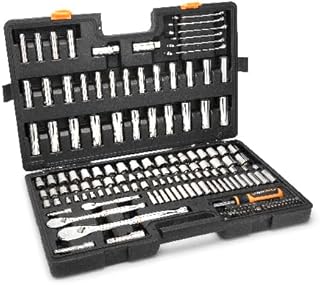
185 Piece Mechanics Hand Tool Set - 1/4", 3/8", & 1/2" Drive | 90 Tooth | SAE & Metric | GW90MCBMTS
Check Price on Amazon →Brakes, Coolant & Front-End Checks
The owner’s manual has you inspect the brake pads, rotors, hoses and park brake at every oil change on a 3.6L, and the front suspension, tie rod ends and CV/U-joints every 20,000 miles (24,000 on the 3.8L). If you wheel or run big tires, check the front end at every oil change instead.
Front end. Death wobble, the violent shake that starts after a bump at speed, is usually traced to a worn track bar end, tie rod ends, drag link or ball joints. Loose parts wear gradually, so the useful habit is to check all of them at every service and write down what you find: good, watch, or replace at the next service. If the wobble starts, slow down firmly and pull over. If you find worn arms, see best control arms for Jeep JK and our JK shocks guide.
Brake fluid. The JK takes DOT 3 (SAE J1703) for the brakes and the clutch hydraulics. DOT 4 is acceptable if DOT 3 isn’t available; never DOT 5. DOT 3 absorbs water over time, so buy small sealed bottles, and if you do a lot of water crossings, have the fluid checked or changed more often.
Coolant. This is where JK generations differ most:
- 2007-2012 (all 3.8L, and the 2012 3.6L): HOAT, the 5-year / 100,000-mile formula, about 13 quarts of 50/50
- 2013-2018 3.6L: OAT, the 10-year / 150,000-mile formula, about 10.5 quarts of 50/50
- Don’t mix OAT and HOAT. If you don’t know what’s in it, flush completely before you switch.
While the hood is up, a quick battery check takes 30 seconds.
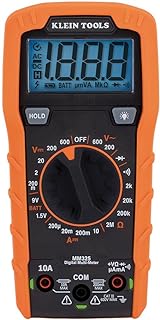
MM325 Multimeter, Digital Manual-Ranging 600V AC/DC Voltage Tester, Tests Batteries, Current, Resist
Check Price on Amazon →A healthy battery reads about 12.4 to 12.7 V with the engine off, and the charging system should show roughly 13.7 to 14.7 V with it running.
Adjusting Your JK Service Schedule for Off-Road & Severe-Duty Use
The owner’s manual defines severe use as towing, off-road driving, dusty or wet conditions, extended idling, or commercial use, and it adds specific services rather than “halving everything.” For a 2012-2018 3.6L that means oil every 4,000 miles, axle fluid every 40,000, manual transmission fluid every 30,000, automatic transmission fluid and filter at 60,000, and transfer case fluid at 60,000 if you tow. For a 2007-2011 3.8L, the axle and transfer case “inspect” points become “change” points, and the automatic is serviced at 60,000 (2008) or 64,000 miles (2011).
On top of the manual, two habits are worth it for anyone who wheels:
-
After water: if the axles or transfer case went under, check the fluid. Milky means water; change it.
-
Keep a wear watch. These aren’t in the manual, but parts makers, shops and many owners report them often enough to look at:
- Every oil change: track bar, tie rods, drag link, ball joints, and brake pad thickness front and rear
- Around 30,000 miles (3.6L): the plastic thermostat housing (dried coolant crust) and the oil filter housing/cooler (oil in the back of the engine valley)
- Around 60,000 miles: front axle u-joints and unit bearings (play, clunk, hum), radiator tank seams, the water pump weep hole, and on a 3.6L a ticking that follows engine speed
- 2007-2009: intermittent crank-no-start or stalling traced to the TIPM fuel pump relay
These are things to inspect, not predictions. A healthy part stays.
Also check recalls once with your VIN at nhtsa.gov/recalls. The two most relevant to JKs are the airbag clockspring on 2007-2010 models (campaign S33, NHTSA 16V-290) and heated mirror connector corrosion on 2011-2013 models (P61, NHTSA 14V-631). The known 3.6L left cylinder head issue on 2012 and some 2013 engines is covered on our JK common problems by year page.
An OBD2 scanner that pairs with your phone catches a misfire or ABS fault in the driveway, before a trail run.
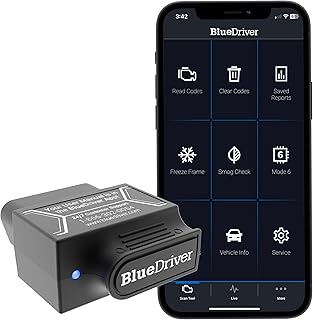
Bluetooth Pro OBDII Scan Tool for iPhone & Android - No Subscription Fee - OBD2 Car Scanner and Code
Check Price on Amazon →Bigger tires load the driveline harder too. If you’re upgrading to 37 inch tires or choosing mud terrain tires for a JK, expect to watch the u-joints, unit bearings and fluids more closely.
Recommended Tools for DIY JK Maintenance
Four tools cover most scheduled JK maintenance: a mixed SAE/metric socket set, a small torque wrench for plugs and the oil filter cap, a large torque wrench for lug nuts, and an impact socket set for wheel and suspension work. Buy a mixed set from the start; the JK needs both standards.
Best overall: 185-piece mechanics hand tool set
185 Piece Mechanics Hand Tool Set - 1/4", 3/8", & 1/2" Drive | 90 Tooth | SAE & Metric | GW90MCBMTS
Check Price on Amazon →The 90-tooth ratchet swings in tight engine-bay spots where a coarse ratchet won’t.
Small torque wrench (1/4-inch, in-lb)
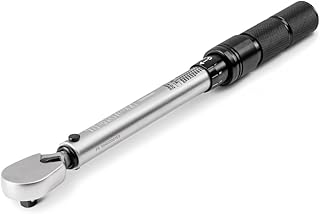
1/4 Inch Drive 90-Tooth Dual-Direction Micrometer Torque Wrench (20-200 in-lb) | TRQ50402
Check Price on Amazon →Good for low-torque fasteners such as 3.8L spark plugs (12 ft-lb is 144 in-lb). Note its range tops out at about 16.7 ft-lb, so for the 20 ft-lb drain plug and 18 ft-lb 3.6L filter cap you’ll want a 3/8-inch wrench that covers roughly 10 to 80 ft-lb.
Large torque wrench (1/2-inch, ft-lb)
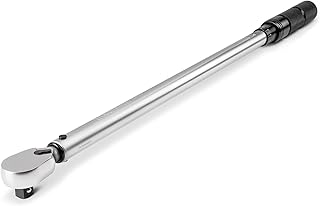
1/2 Inch Drive 90-Tooth Dual-Direction Micrometer Torque Wrench (40-300 ft-lb) | TRQ52403
Check Price on Amazon →Covers JK lug nuts (95 to 100 ft-lb; use the value in your own manual, and re-check after the first 50 to 100 miles on new wheels) and suspension fasteners.
1/2-inch impact socket set
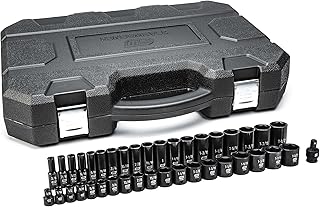
39 Pc. 1/2" Drive 6 Pt. Impact Socket Set, Standard & Deep, SAE - 84947N, Black
Check Price on Amazon →Impact sockets won’t crack under a pneumatic or cordless impact, and the 6-point design grips corroded hardware better than 12-point.
For the full list, see our guide to essential Jeep JK maintenance tools.
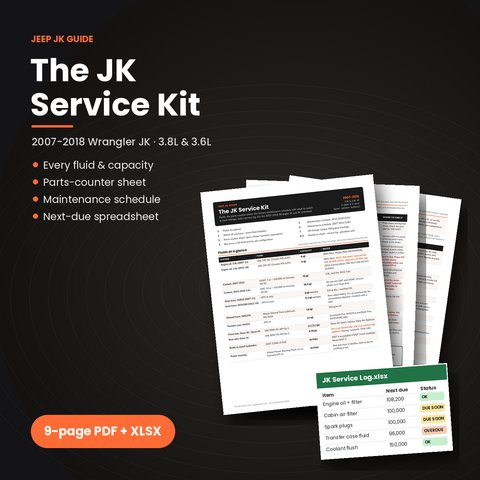
The printable version: The JK Service Kit
The factory maintenance schedule for 2007-2011 and 2012-2018 on printable pages, with what to check at each mileage, every fluid and spec, a parts-counter sheet, service and wear logs, and a spreadsheet that tells you what is due next. 9-page PDF plus Excel/Google Sheets tracker, $12.
Get the JK Service KitHow to Track Your JK Service History (and Why It Matters at Resale)
A service log is the cheapest diagnostic tool a JK owner has, and it’s the first thing a careful buyer asks for. It tells the next owner, or you in 50,000 miles, what was done, when, and with which parts.
For each entry, write the date, odometer, the job, the fluid or part used (with the part number), what you noticed, and when it’s next due. Add a condition mark for anything you inspected: G for good, W for watch (recheck next service), R for replace at the next service. Over a few services, patterns show up on their own: a pad wearing faster on one side, a quart of oil between changes where there used to be none, a tie rod end that went from G to W.
Paper in the glovebox, a note on your phone, or a spreadsheet all work. What matters is writing something every time.
When you’re shopping for a used JK, missing records on a high-mileage example are a reason to negotiate and to budget for a full fluid service straight away.
Frequently Asked Questions: Jeep JK Maintenance Schedule
Q: How often should I change the oil on my Jeep JK?
A: On a 2012-2018 3.6L, follow the oil-change indicator, up to 10,000 miles or 12 months, or every 4,000 miles under severe duty. On a 2007-2011 3.8L, every 6,000 miles (2008 manual) or 8,000 miles (2011 manual), or 6 months, sooner with off-road use. Both take 6 quarts of 5W-20 meeting Chrysler MS-6395; on a 2012, read the filler cap, because that year’s manual lists 5W-30.
Q: Is there a free Jeep JK maintenance schedule PDF I can download?
A: Jeep publishes the owner’s manuals, including the maintenance schedule, at vehicleinfo.mopar.com. The table on this page summarizes both JK generations, and you can print it straight from your browser. If you want printable schedule pages with a service log and a next-due spreadsheet, that’s what the JK Service Kit above is.
Q: What is the most commonly missed maintenance item on a Jeep JK?
A: Axle and transfer case fluid. The owner’s manual lists them as inspections for normal driving and changes for severe use, and anyone who wheels, tows or crosses water is in the severe-use column. Water in the gear oil (milky fluid) is the most common reason to change it early.
Q: Does the maintenance schedule differ between the 2-door JK and the 4-door JKU?
A: No. The 2-door and 4-door share engines, transmissions and schedules. What changes the fluids is the model year (3.8L or 3.6L, HOAT or OAT coolant, which oil filter) and the trim (Dana 30 or Dana 44 front axle, Command-Trac or Rock-Trac transfer case, and whether the rear axle is a Trac-Lok).
Q: How do I know if my Jeep JK needs service sooner than the schedule says?
A: Milky gear oil (water), oil consumption that keeps rising, a check-engine light or misfire, dried coolant crust around the thermostat housing, oil in the back of the engine valley on a 3.6L, or new noise from the axles or wheel bearings. Any water crossing that reached the axle vents is reason enough to check fluids regardless of mileage.
Get new guides by email
One email when we publish something worth reading. Unsubscribe anytime.
Keep Your JK Healthy: Final Thoughts on Staying on Schedule
Follow the schedule for your engine, not a generic one, and a JK stays reliable for a long time. Three habits make the difference:
- Know your JK: model year and trim decide the oil filter, coolant, axle and transfer case, and whether you need limited-slip additive
- Inspect at every service: front end, brakes, and any wear-watch items for your mileage
- Log everything: a written record catches patterns early and protects resale value
For the day-to-day version of this schedule, see our Jeep Wrangler JK maintenance schedule, and for tools, the essential tools for DIY JK maintenance guide.
Specs and intervals come from the Jeep Wrangler owner’s manuals (2008, 2011, 2012, 2013, 2015, 2016 and 2018). Wear-watch items are reported by parts makers, repair shops and owners, and are things to inspect, not predictions. This is reference information, not a repair manual; your own owner’s manual for your VIN takes precedence. Jeep JK Guide is independent and not affiliated with Stellantis.
Free: JK Fluids at a Glance
Every fluid, spec and capacity for the 2007-2018 Wrangler JK on one page, plus a cut-out glovebox card. Checked against the owner's manuals. From the JK Service Kit.
Email me the download and new guides when they are published. Unsubscribe anytime. Privacy Policy.
Allan
I'm Allan. I own a 2014 Jeep Wrangler JKU and I research the hell out of every mod before I touch it. When I've fitted something to my own Jeep, I say so. Everything else is researched from manufacturer specs and other owners' reports. No sponsored fluff.
Learn more about me →Free: JK Fluids at a Glance
Every fluid, spec and capacity for the 2007-2018 JK on one page, plus a glovebox card.
Email me the download and new guides when they are published. Unsubscribe anytime. Privacy Policy.
Related Articles

JK Fluid Specifications: Complete Reference Guide
Every fluid, spec and capacity for the 2007-2018 Jeep Wrangler JK, by engine and model year, checked against the owner's manuals: oil, ATF+4, NSG370, NV241, Dana 30/44, coolant, brakes.
Jeep JK Fall Trail Prep: 10-Point Checklist Before the Last Runs of the Year
Fall is when your JK needs attention most. Cooler temps, shorter daylight, and slicker trails expose what summer's heat masked. A Jeep JK fall trail...
Jeep JK Death Wobble: Every Cause, How to Diagnose It, and the Permanent Fix
Imagine this: you're cruising the highway at a steady clip when your front tire catches a seam in the pavement. Suddenly, your steering wheel is trying...