Best JK Shocks for Jeep Wrangler JK: Complete Buyer's Guide 2026
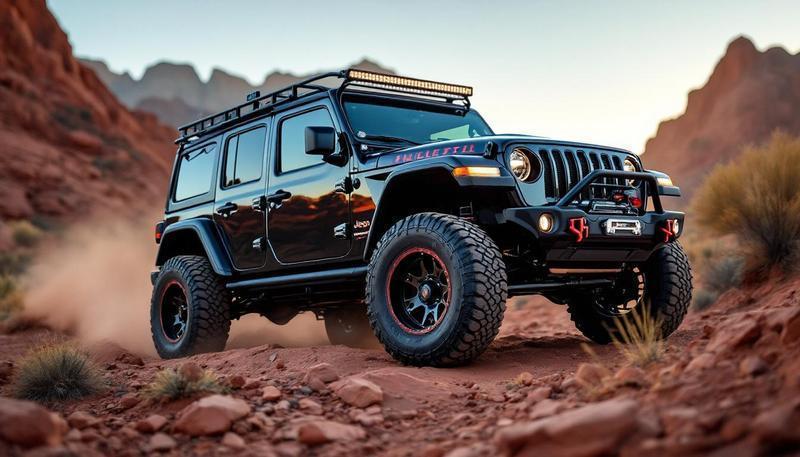
Introduction: Finding the Perfect JK Shocks
The best shocks for JK Wranglers are the Bilstein 5100 Series ($300-400 per shock), offering excellent on-road comfort and reliable off-road performance. Premium choice: Fox 2.0 Performance ($400-500 each) for serious wheeling. Budget option: Rancho RS9000XL at $150-200 each with adjustable compression.
This guide compares all five top shock options by lift height and driving style to help you choose the perfect suspension upgrade for your specific needs.
Understanding Shock Absorber Technology
Before diving into specific products, understanding shock fundamentals helps you make an informed decision. Shocks work in tandem with your lift kit to provide proper suspension performance at your desired height.
Monotube vs. Twin-Tube Shocks
Twin-Tube Shocks feature a nested design with an outer and inner tube. The inner tube contains the piston, while the outer tube houses additional fluid. The piston rod extends through the inner tube, and damping occurs in both the compression and rebound strokes.
Twin-tube shocks are:
- More affordable
- Better at self-cooling (dual tubes dissipate heat)
- Adequate for light to moderate use
- More susceptible to performance degradation under sustained heavy use
Monotube Shocks contain a single tube with a floating piston that separates hydraulic fluid from nitrogen gas. The piston rod moves within a single chamber, providing direct, consistent damping.
Monotube shocks excel at:
- Performance consistency under extreme conditions
- Superior heat dissipation with larger surface area
- Better damping response across a wider range
- Withstanding sustained heavy use and abuse
For serious off-roaders, monotube construction is worth the premium cost.
Reservoir Shocks Explained
Non-Reservoir Shocks contain only the main shock body with no external fluid storage. They’re lighter, cheaper, and work well for mild builds and street-focused setups.
Reservoir Shocks include an external reservoir (either remote canister or piggyback-style) that provides additional fluid volume. This extra capacity allows for:
- Superior heat management
- Consistent damping during sustained use
- Better performance with larger lift heights
- Extended service life under demanding conditions
Reservoir shocks are particularly valuable if you have a lift over 4 inches, frequently trail ride, or run larger tires.
Adjustability: Fixed vs. Adjustable
Fixed Shocks have preset damping curves. Once installed, they perform consistently without adjustment. They’re simpler, cheaper, and eliminate tuning complications.
Adjustable Shocks allow you to modify compression and/or rebound damping independently. This lets you:
- Match your specific driving style
- Adapt to different terrains
- Optimize for seasonal changes
- Fine-tune load-carrying capacity
Adjustable shocks cost 30-50% more but provide versatility for versatile drivers.
Get new guides by email
One email when we publish something worth reading. Unsubscribe anytime.
Top 5 Best JK Shocks: In-Depth Comparison
1. Fox 2.0 Coil-Over Shocks
Overview: Fox Performance Products is a legendary off-road manufacturer with decades of racing heritage. Their 2.0 coil-over shocks have become the gold standard for serious JK builders seeking premium performance.
Technology & Construction:
- Monotube design with floating piston
- 2.0-inch diameter shock body
- Piggyback-style remote reservoir
- Dual-speed compression adjustment
- Rebound adjustment capability
- Available in various ride heights
Pros:
- Superior build quality and engineering
- Excellent damping response on rough terrain
- Highly adjustable for multiple driving conditions
- Remote reservoir provides excellent heat management
- Industry-leading reputation backed by professional racing
- Responsive handling both on-road and off-road
- Works well with aggressive lift kits (4-6+ inches)
- Extensive aftermarket support and tuning knowledge
Cons:
- Premium pricing ($3,500-$5,000+ for front/rear pair)
- Requires careful tuning to optimize performance
- Piggyback reservoir adds weight and bulk
- Steeper learning curve for adjustment
- May be overkill for casual trail drivers
- Installation complexity slightly higher
Best For: Serious off-roaders, competitive drivers, aggressive lift kits, those prioritizing performance above budget.
Shock Length Options: Available from 9.8” to 16.2” depending on lift height.
Lift Compatibility: 2-8+ inches with proper selection.

Fox 2.0 Performance Series Shocks
Check Price on Amazon →2. Bilstein 5100 Series
Overview: Bilstein, a German precision manufacturer, offers the 5100 Series as their premium JK shock solution. These shocks combine quality engineering with reasonable pricing.
Technology & Construction:
- Twin-tube design with standard piston
- 5100 designation indicates premium series
- Monotube option available (5110)
- Velocity-sensitive damping
- Load-carrying adjustment capability
- Non-reservoir design (standard)
- Available in multiple lengths
Pros:
- Excellent balance of quality and affordability ($1,200-$1,800 per pair)
- Reliable, consistent performance
- Velocity-sensitive damping adapts to driving conditions
- Load-carrying adjustment for different payloads
- Widely available from multiple retailers
- Easy installation with minimal fabrication
- Lower maintenance requirements
- Good warranty support
- Works across various lift heights
Cons:
- Twin-tube design not ideal for extreme use
- Limited adjustability compared to premium options
- Can feel harsh on very rough terrain
- Load adjustment requires disassembly
- Not ideal for aggressive off-road competition
- Less sophisticated damping curve than monotube designs
- May need frequent adjustment for varying conditions
Best For: Budget-conscious buyers, daily drivers with light trail use, 2-4 inch lifts, balanced street/off-road use.
Shock Length Options: Multiple lengths from 10.6” to 15.5”.
Lift Compatibility: 2-5 inches with appropriate selection.

Bilstein 5100 Series Shocks
Check Price on Amazon →3. King Shocks for JK
Overview: King Shocks is a relatively newer premium player in the JK market, but they’ve quickly earned respect through innovative designs and performance focus. Their JK-specific shocks are engineered for serious applications.
Technology & Construction:
- Monotube construction standard
- 2.5-inch diameter shock body
- Remote reservoir standard on most models
- Adjustable compression and rebound
- Purpose-built for JK geometry
- Multiple valving options available
- Competition-grade internals
Pros:
- Purpose-built engineering for JK suspension geometry
- Exceptional build quality matching Fox at lower cost
- Monotube performance with reservoir cooling
- Excellent damping characteristics on rough terrain
- Adjustable compression and rebound independently
- Remote reservoir without excessive weight
- Strong customer support and technical knowledge
- Capable across entire lift range
Cons:
- Premium pricing ($2,800-$4,500 per pair)
- Smaller brand means less widespread knowledge
- Limited dealer network compared to Fox/Bilstein
- Longer lead times sometimes available
- Requires proper tuning to fully appreciate
- Higher installation complexity
Best For: Knowledge-seeking builders, those seeking alternatives to Fox, 3-6 inch lifts, performance-focused drivers.
Shock Length Options: 10.3” to 16.5” depending on application.
Lift Compatibility: 2.5-8 inches with proper selection.
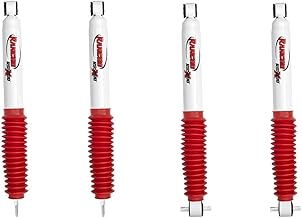
Rancho RS5000X Shocks
Check Price on Amazon →4. Rancho RS9000XL Adjustable
Overview: Rancho is an American icon in the suspension industry. The RS9000XL series brings adjustable performance to the mid-range market, offering tweakability without the premium price.
Technology & Construction:
- Twin-tube design
- Adjustable compression damping (9 levels)
- External adjustment knob
- Load-carrying range adjustability
- Non-reservoir design
- Smaller shock body diameter
Pros:
- Very affordable ($800-$1,200 per pair)
- Nine-position compression adjustment
- Easy external adjustment—no disassembly needed
- Good reliability in moderate conditions
- American manufacturing heritage
- Easy installation
- Works adequately for various lift heights
- Excellent value proposition
Cons:
- Twin-tube limits extreme off-road performance
- Adjustment is compression-only, no rebound tuning
- External adjustment adds bulk to shock body
- Not ideal for aggressive trails or competition
- Can lose damping consistency if adjusted too soft
- Heat management not optimal for sustained use
- Limited availability in some regions
- Doesn’t inspire confidence in brutal terrain
Best For: Budget builders, casual trail drivers, first-time lift installers, those wanting adjustability on a budget.
Shock Length Options: Multiple lengths available up to 15.5”.
Lift Compatibility: 2-4 inches optimal; beyond that, consider alternatives.
5. Teraflex Falcon Series
Overview: Teraflex manufactures specialized JK suspension components, including the Falcon series shocks designed to work harmoniously with their lift kits and suspension components.
Technology & Construction:
- Monotube or twin-tube options available
- Multiple variant levels (Falcon, Falcon Series)
- Available with and without reservoirs
- Adjustable options in premium models
- Engineered for Teraflex geometry
Pros:
- Excellent integration with Teraflex lift kits
- Multiple options across different price points
- Good damping characteristics in monotube versions
- Solid build quality in premium models
- Works well with JK suspension geometry
- Decent technical support from specialty manufacturer
Cons:
- More expensive if not using Teraflex lift system
- Less proven track record than Fox or Bilstein
- Smaller availability network
- Varying quality across product line
- May require more maintenance
- Limited independent reviews available
- Best performance when matched with Teraflex kits
Best For: Those building with Teraflex lift kits, JK builders who want integrated suspension design, mid-range budget seekers.
Shock Length Options: 10.8” to 15.2” depending on variant.
Lift Compatibility: 2.5-6 inches with proper component selection.
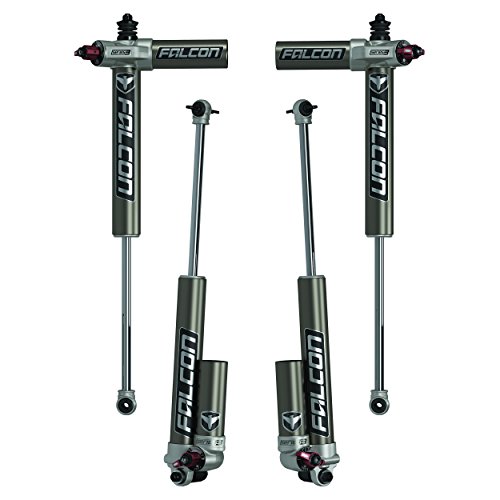
Teraflex Falcon Shocks
Check Price on Amazon →Comparison Table: JK Shocks at a Glance
| Feature | Fox 2.0 | Bilstein 5100 | King Shocks | Rancho RS9000XL | Teraflex Falcon |
|---|---|---|---|---|---|
| Price Range | $3,500-$5,000+ | $1,200-$1,800 | $2,800-$4,500 | $800-$1,200 | $1,500-$3,500 |
| Construction | Monotube | Twin-tube | Monotube | Twin-tube | Varies |
| Reservoir | Yes (Piggyback) | No | Yes (Remote) | No | Optional |
| Adjustable | Yes (2-way) | Limited | Yes (2-way) | Yes (Compression) | Varies |
| Lift Range | 2-8+ inches | 2-5 inches | 2.5-8 inches | 2-4 inches | 2.5-6 inches |
| Off-Road Rating | 10/10 | 7/10 | 9/10 | 6/10 | 7/10 |
| Street Comfort | 8/10 | 9/10 | 8/10 | 8/10 | 8/10 |
| Reliability | Excellent | Excellent | Excellent | Good | Good |
| Warranty | 3 years | 3 years | 3 years | 2 years | 2-3 years |
| Installation Difficulty | High | Low | Medium | Low | Low |
| Best For | Serious Off-Road | Daily Driver | Performance Build | Budget Conscious | Teraflex Builds |
Shock Selection by Lift Height
Choosing the right shock diameter and length is critical for proper suspension function and ride quality.
2-3 Inch Lifts
For mild lifts, you have maximum flexibility. Stock-length or slightly extended shocks work well.
Recommendations:
- Bilstein 5100 (best value)
- Rancho RS9000XL (if wanting adjustability on budget)
- King Shocks (if wanting performance)
Stock shocks work for 2-inch lifts if budget is extremely tight, but quality aftermarket shocks provide dramatic improvements.
3-4 Inch Lifts
This sweet spot range is popular for daily drivers wanting capability without excessive height.
Recommendations:
- Bilstein 5100 (excellent balance)
- King Shocks (performance-focused)
- Teraflex Falcon (if using Teraflex lift)
- Fox 2.0 (for overkill capability)
Ensure shock length is properly matched to your springs’ compressed/extended height.
5-6 Inch Lifts
Larger lifts require shocks with extended travel and superior damping.
Recommendations:
- Fox 2.0 (ideal choice)
- King Shocks (excellent alternative)
- Teraflex Falcon (with matching components)
Non-reservoir shocks begin showing limitations at this height. Consider reservoir options.
6+ Inch Lifts
Aggressive builds need premium, reservoir-equipped shocks.
Recommendations:
- Fox 2.0 (only real choice for longevity)
- King Shocks (capable alternative)
Twin-tube shocks like Bilstein and Rancho are not recommended for this height range.
Installation Considerations
Professional Installation vs. DIY
DIY Installation Pros:
- Save $300-$600 in labor
- Learn your suspension system
- Complete on your schedule
DIY Installation Cons:
- Requires proper tools
- Risks improper alignment if not careful
- Time-consuming (4-8 hours)
Professional Installation Pros:
- Proper alignment guaranteed
- Shorter downtime
- Warranty coverage
- Expert adjustments
Professional Installation Cons:
- Additional $400-$800 cost
- Scheduling required
For complex options like Fox with remote reservoirs, professional installation is recommended.
What You’ll Need
- Jack and jack stands
- Socket and wrench sets
- Spring compressor tool (for coil-over designs)
- Torque wrench
- New bump stops (often recommended)
- Possibly new hardware kit
Shock Maintenance and Lifespan
Proper maintenance extends shock life and maintains performance.
Regular Checks
Monthly:
- Visual inspection for leaks
- Check for proper ride height
- Listen for odd noises
Every 6 Months:
- Inspect seals and rod for damage
- Check mounting bolts for tightness
- Clean shock bodies
Annually:
- Professional inspection
- Damping function check
- Consider complete fluid flush for extreme use
Typical Lifespan
- Bilstein 5100: 50,000-75,000 miles with moderate use
- Fox 2.0: 75,000-150,000 miles (longer with proper maintenance)
- King Shocks: 70,000-120,000 miles
- Rancho RS9000XL: 40,000-60,000 miles
- Teraflex Falcon: 50,000-100,000 miles
Heavy off-road use shortens these ranges significantly. Extreme heat and sustained rough terrain can reduce lifespan by 30-50%.
Real-World Performance Insights
Fox 2.0: The Gold Standard
Users consistently praise Fox shocks for:
- Responsive handling even at speed
- Confidence on rocky terrain
- Minimal bounce after hits
- Satisfaction justifying premium cost
Complaints center on:
- Initial tuning complexity
- Piggyback reservoir packaging
- Premium pricing
Bilstein 5100: The Practical Choice
Owners love:
- Smooth ride on highways
- Solid trail capability
- Consistent performance
- Great warranty support
Noted limitations:
- Can feel stiff when new
- Single-purpose damping
- Not ideal for aggressive terrain
King Shocks: The Rising Star
Feedback highlights:
- Impressive performance relative to cost
- Excellent customer service
- Smooth operation
- Technical knowledge from company
Observations:
- Requires proper initial setup
- Less brand recognition
- Smaller community
Rancho RS9000XL: The Budget Champion
Users appreciate:
- Affordable price point
- Easy on-the-fly adjustment
- Decent reliability
- Simple maintenance
Drawbacks mentioned:
- Softer feel than premium brands
- Lacks rebound adjustment
- Not for serious off-road
- Can fade in extreme heat
Teraflex Falcon: The Specialist
Builders using Teraflex systems report:
- Perfect integration with lift kits
- Good performance when matched
- Adequate support
- Mid-range pricing
Issues noted:
- Cost premium if not using full Teraflex system
- Less third-party data available
- Brand-specific availability
Making Your Decision: Buyer’s Guide
Budget: $800-$1,500
Best Choice: Rancho RS9000XL or Bilstein 5100
Pros:
- Designed specifically for Jeep JK fitment and proven trail compatibility
- Well-reviewed by the JK community with consistent positive feedback
- Good value for the quality and durability offered
Cons:
- Higher cost compared to universal or no-name alternatives
- Installation may require basic tools and mechanical knowledge
- Limited finish options depending on manufacturer availability
You get solid reliability with real adjustability or proven engineering. Perfect for casual trail use and daily driving with mild lifts.
Budget: $1,500-$2,500
Best Choice: Bilstein 5100 or Teraflex Falcon
Pros:
- Designed specifically for Jeep JK fitment and proven trail compatibility
- Well-reviewed by the JK community with consistent positive feedback
- Good value for the quality and durability offered
Cons:
- Higher cost compared to universal or no-name alternatives
- Installation may require basic tools and mechanical knowledge
- Limited finish options depending on manufacturer availability
This range offers excellent capability with quality components. Bilstein provides proven reliability; Teraflex works great if building with their system.
Budget: $2,500-$4,000
Best Choice: King Shocks or lower-end Fox 2.0
Pros:
- Designed specifically for Jeep JK fitment and proven trail compatibility
- Well-reviewed by the JK community with consistent positive feedback
- Good value for the quality and durability offered
Cons:
- Higher cost compared to universal or no-name alternatives
- Installation may require basic tools and mechanical knowledge
- Limited finish options depending on manufacturer availability
Now you’re in premium territory. King offers excellent value; Fox delivers unmatched performance reputation.
Budget: $4,000+
Best Choice: Fox 2.0
Pros:
- Designed specifically for Jeep JK fitment and proven trail compatibility
- Well-reviewed by the JK community with consistent positive feedback
- Good value for the quality and durability offered
Cons:
- Higher cost compared to universal or no-name alternatives
- Installation may require basic tools and mechanical knowledge
- Limited finish options depending on manufacturer availability
You’re committing to premium performance. Fox is the industry standard for serious builds and competitive use.
Technical Specifications Comparison
Fox 2.0 Coil-Over
- Bore Diameter: 2.0”
- Tube Type: Monotube
- Reservoir: Piggyback (0.5L capacity)
- Adjustments: Compression (2-way), Rebound (continuous)
- Max PSI: 300
- Piston: Floating
Bilstein 5100
- Bore Diameter: 1.5”
- Tube Type: Twin-tube
- Reservoir: Integrated (non-removable)
- Adjustments: Load-carrying range
- Max PSI: 200
- Piston: Standard sealed
King Shocks
- Bore Diameter: 2.5”
- Tube Type: Monotube
- Reservoir: Remote cartridge style
- Adjustments: Compression (High/Low speed), Rebound (continuous)
- Max PSI: 350
- Piston: Floating
Rancho RS9000XL
- Bore Diameter: 1.375”
- Tube Type: Twin-tube
- Reservoir: None
- Adjustments: External compression (9-position)
- Max PSI: 150
- Piston: Standard
Teraflex Falcon
- Bore Diameter: Varies by model
- Tube Type: Monotube or twin-tube
- Reservoir: Optional
- Adjustments: Varies by model
- Max PSI: Varies
- Piston: Varies
Related Guides
Explore more JK upgrade guides to complement your build:
- Best JK Lift Kits — top lift kit recommendations
- Best 3.5-4 Inch Lifts — mid-range lift kits
- Steering Stabilizer — steering stability after lift
- Best Track Bar — track bar upgrade
- Best Control Arms — adjustable control arms
Frequently Asked Questions
See frontmatter FAQ section above for detailed Q&A covering monotube vs. twin-tube, reservoir necessity, shock length, adjustability value, and brand mixing.
Final Recommendations
Best Overall: Fox 2.0 Coil-Over Shocks
If budget allows, Fox shocks represent the pinnacle of JK shock performance. Their reputation is earned through superior engineering, excellent adjustability, and proven reliability across countless builds and extreme conditions. The investment pays dividends in performance, longevity, and resale value.
Best Value: Bilstein 5100 Series
Bilstein balances quality, affordability, and reliability better than any other option. For the vast majority of JK owners who want significant improvement over stock without premium pricing, the 5100 series is the obvious choice. German engineering at a reasonable price point delivers consistent satisfaction.
Best Adjustable Budget Option: Rancho RS9000XL
If you want adjustability without the Fox price tag, Rancho delivers. The nine-position compression adjustment lets you find your sweet spot across different driving conditions. It’s the obvious choice for budget-conscious builders who still want some tunability.
Best Alternative to Fox: King Shocks
If Fox is out of reach but you want monotube performance, King Shocks offer an excellent alternative. Their purpose-built JK engineering combines with pricing that’s 20-30% below Fox. For performance-focused builders, King represents excellent value.
Best for Teraflex Builds: Teraflex Falcon Series
If your foundation is a Teraflex lift kit, the Falcon series provides optimal integration and proven compatibility. The tuning and geometry work together seamlessly.
Related Articles
- Complete JK Lift Kit Guide
- Best JK Steering Stabilizer
- JK Lift Kit Installation Guide
- JK Regear Cost Guide
- Gear Ratio Guide for JK Wrangler
Conclusion
Selecting the right JK shocks requires balancing performance, budget, lift height, and driving style. Whether you’re building a mild-mannered daily driver or an aggressive off-road machine, this guide provides the information needed to make a confident decision.
The five shocks compared here represent the best options available to JK builders. Each excels in specific applications. There’s no single “perfect” shock—only the right one for your specific needs and budget.
Remember that shocks are only one component of a complete suspension system. Pair your shock selection with quality springs, control arms, and geometry corrections for optimal results. Learn more about how all these components work together in our Complete JK Lift Kit Guide. When in doubt, consult with the manufacturers or experienced JK forums to ensure proper fitment with your specific lift kit and driving plans. If you’re concerned about handling issues, check our guide on preventing death wobble.
Invest in quality shocks today, and enjoy years of reliable, capable suspension performance on every adventure your JK takes you on.
Affiliate Disclosure
Free: JK Fluids at a Glance
Every fluid, spec and capacity for the 2007-2018 Wrangler JK on one page, plus a cut-out glovebox card. Checked against the owner's manuals. From the JK Service Kit.
Email me the download and new guides when they are published. Unsubscribe anytime. Privacy Policy.
Frequently Asked Questions
What's the difference between monotube and twin-tube shocks for a JK?
Monotube shocks have a single tube with a floating piston separating oil and gas, offering better performance, heat dissipation, and consistent damping under extreme conditions. Twin-tube shocks use two nested tubes and are typically more affordable, making them suitable for light to moderate use. Monotube shocks are better for serious off-road use, while twin-tube shocks work well for casual driving and light trail use.
Do I need reservoir shocks for my JK?
Reservoir shocks (remote or piggyback) provide additional fluid volume for better heat management and extended damping performance, making them ideal for serious off-roading, heavy-duty use, or larger lift heights. Non-reservoir shocks are sufficient for street-focused builds, light trails, and budget-conscious builds. If you plan to spend significant time on challenging terrain or have a lift over 3 inches, reservoir shocks are recommended.
How do I know what shock length to use with my JK lift kit?
Shock length depends on your lift height and suspension geometry. A 2-3 inch lift typically uses stock-length or slightly longer shocks. A 3-6 inch lift usually requires extended shocks. Measure your compressed and extended spring heights, then consult your lift kit manufacturer's specifications. Most quality shock manufacturers provide fitment guides. When in doubt, contact the shock maker or lift kit producer for exact measurements.
Are adjustable shocks worth the extra cost?
Adjustable shocks allow fine-tuning of compression and rebound damping to match your specific driving conditions and preferences. For casual driving, fixed shocks are adequate and more affordable. For those who frequently switch between street and trail driving, or who want to dial in their suspension feel, adjustable shocks justify the investment. Budget approximately 30-50% more for adjustability.
Can I mix and match different shock brands on my JK?
Technically possible, but not recommended. Mixing brands can lead to uneven damping characteristics, unpredictable handling, and potential safety issues. Stick with a complete set from the same manufacturer to ensure consistent performance, matched damping curves, and proper weight distribution. If upgrading one shock due to damage, replace the pair on the same axle at minimum.
Allan
I'm Allan. I own a 2014 Jeep Wrangler JKU and I research the hell out of every mod before I touch it. When I've fitted something to my own Jeep, I say so. Everything else is researched from manufacturer specs and other owners' reports. No sponsored fluff.
Learn more about me →Free: JK Fluids at a Glance
Every fluid, spec and capacity for the 2007-2018 JK on one page, plus a glovebox card.
Email me the download and new guides when they are published. Unsubscribe anytime. Privacy Policy.
Related Articles
ICON Vehicle Dynamics Lift Kits for Jeep JK: Are They Worth the Premium?
ICON Vehicle Dynamics lift kits pair coilovers, remote-reservoir shocks, and precision-valved components to deliver a noticeably smoother, more capable...
Lifted Jeep JK: What to Expect After Installing a 2–4 Inch Lift Kit
A lifted Jeep Wrangler JK is a 2007–2018 Wrangler that has had its suspension or body raised between 1 and 6 inches above factory height. The payoff:...
Best JK Shocks for Off-Road: Complete Bilstein, Fox & King Comparison
A shock absorber does one essential job: it controls how fast your suspension bounces. When your tire hits a rock, the spring compresses. The shock...