JK Lift Kit vs Leveling Kit: Which Is Right for Your Jeep Wrangler?
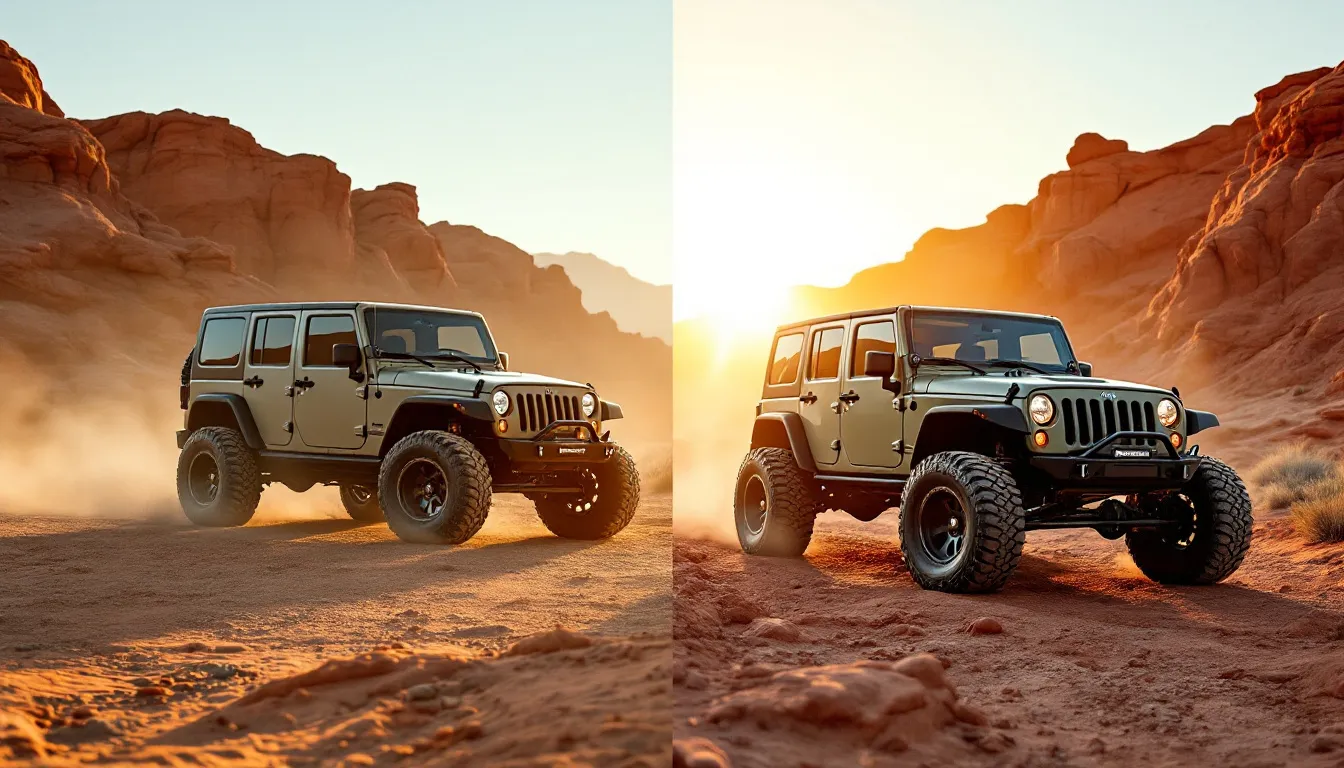
JK Lift Kit vs Leveling Kit: Which Is Right for Your Jeep Wrangler?
A leveling kit corrects the JK’s factory front-to-rear rake with low-cost spacers, while a lift kit raises the entire vehicle with new springs, shocks, and control arms for serious off-road capability. If you just want to fit 33-inch tires and improve the stance, a leveling kit is enough — but if you want 35s or genuine trail performance, a lift kit is the only real answer.
The JK lift kit vs leveling kit decision comes down to how far you plan to take your build. After picking up a 2014 Jeep Wrangler JKU Unlimited with the 3.6L Pentastar V6 - solid axles front and rear, four doors - the first question wasn’t what looked coolest. It was what the Jeep actually needed to survive the kind of overlanding I’d planned through Namibia and Botswana. Leveling kits are cheap, bolt-on, and low-risk. Lift kits cost more and add complexity, but they unlock tire sizes and suspension articulation that no spacer can match. Both require an alignment afterward. Both will interact with your sway bar links. Understanding the difference before you order saves you from buying the wrong thing twice.
Ready to skip ahead to hardware? See our best lift kits for the Jeep JK for verified picks across every budget.
What Is a Leveling Kit for the Jeep JK?
A leveling kit for the Jeep JK is a set of spacers — typically 1 to 1.5 inches — installed on the front coil springs to raise the front of the truck to match the factory rear height. The JK, like most trucks, ships from the factory with a slight nose-down rake built in to account for payload. A leveling kit eliminates that rake.
The typical JK leaves the factory sitting roughly an inch lower in the front than the rear. A 1-inch front spacer brings the nose up flush, giving the truck a level, more aggressive stance without touching the rear suspension at all.
What a leveling kit does NOT do is increase suspension travel, improve articulation, or meaningfully upgrade your off-road capability — that is the detail most buyers overlook. You are moving the spring perch up, not replacing the spring. Droop travel stays the same. If you wheel hard, a leveling kit offers no advantage over stock suspension geometry.
For street-driven JKs and light trail use, the benefits are real: better appearance, slightly increased ground clearance under the front differential, and room for up to 33-inch tires on most JK trims without rubbing. Whether you’re on a 2-door JK or a 4-door JKU, the front rake dimension is similar, so a 1-inch spacer corrects the stance on both body styles.
The way your JK is configured — including roof, doors, and cargo — affects how load sits across the chassis. Learn how JK configuration affects load distribution if you’re trying to dial in your final stance before ordering.
A 1-inch front spring spacer leveling kit is one of the lowest-cost suspension investments you can make on a Wrangler.
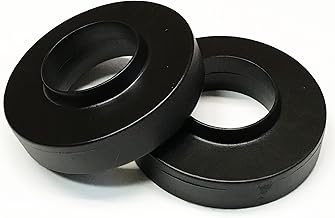
1" Front Spring Spacer Leveling Kit, Compatible with Jeep Wrangler JK 2007-2018, JL 2018-2026
Check Price on Amazon →What Is a Lift Kit for the Jeep JK?
A lift kit for the Jeep JK is a full suspension upgrade — typically including coil springs, shocks, and often adjustable control arms — that raises both the front and rear of the vehicle by a measured amount, usually 2 to 4.5 inches. Unlike a leveling kit, a lift kit changes the entire suspension geometry.
Entry-level lift kits in the 2 to 2.5-inch range include new coil springs and shocks front and rear. More comprehensive kits at 3.5 inches and above add adjustable upper control arms, track bars, and brake line extensions to maintain correct geometry as the suspension cycles. This is where the JK’s Dana 30 (front) and Dana 44 (rear) axle angles become a real engineering consideration: the steeper the CV axle angle at full droop, the faster you’ll wear joints.
Lifts above 3.5 inches on a JK require adjustable control arms to correct axle caster and pinion angle — skipping this step accelerates driveshaft vibration and CV wear noticeably.
After months of research into lift options for my own 2014 JKU — weighing budget kits against midrange options with adjustable arms — a 2.5-inch lift with adjustable control arms proved to be the sweet spot. The geometry correction from adjustable uppers eliminated the death wobble risk that plagues many JKs running fixed-arm lifts at this height, and it left enough budget for quality shocks that wouldn’t destroy my kidneys on rough terrain.
A 2.5-inch lift opens up 35-inch tires with a quality wheel backspacing combination. Pair that with re-gearing and you have a genuinely capable trail rig. See our guide to best 37-inch tires for the Jeep JK for what’s possible once you go higher, and consult the gear ratio guide for 33-inch tires on the JK to understand why gearing matters the moment tire size climbs.
The Rough Country 2.5-inch lift kit for 2007-2018 JK Unlimited is one of the most popular entry points for JKU owners who want a meaningful upgrade without a four-figure spend.
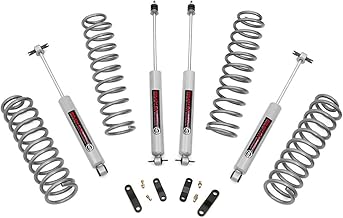
2.5" Lift Kit for 2007-2018 Jeep Wrangler JK Unlimited - 67930
Check Price on Amazon →For owners who want genuine shock quality built into the kit from day one, a 2.5-inch lift kit with all four 2.5-inch shocks represents a significant step up in ride quality and longevity.
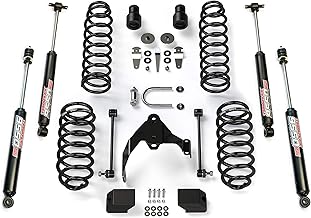
1251000 2.5" Lift Kit (JK 4 Door with All (4) 2.5" Shock)
Check Price on Amazon →Leveling Kit vs Lift Kit: Side-by-Side Comparison
Head-to-head, these two options serve different JK owners entirely. A leveling kit is a cosmetic and minor functional correction; a lift kit is a performance suspension upgrade. The table below captures the key differences so you can make a fast, informed decision.
| Feature | Leveling Kit | Lift Kit |
|---|---|---|
| Lift Range | 1–1.5 inches (front only) | 2–4.5 inches (front and rear) |
| Components | Spring spacers | Springs, shocks, often control arms |
| Price Range | $30–$150 | $250–$2,000+ |
| Max Tire Size | Up to 33 inches (stock width) | 35–37 inches depending on lift height |
| Install Difficulty | Beginner (2–4 hours) | Intermediate to advanced (4–10+ hours) |
| Alignment Needed | Yes — front at minimum | Yes — full 4-wheel |
| Off-Road Gain | Minimal (approach angle only) | Significant (articulation, approach angle) |
| Best For | Street-driven JKs, budget builds | Trail rigs, overlanders, serious off-roaders |
The decision crossover point is tire size: if you need anything larger than a 33-inch tire, a leveling kit is not enough and a lift kit is the only path forward.
Your trim level also plays into this. A Rubicon JK ships with a disconnectable sway bar, slightly higher ground clearance, and Dana 44 axles front and rear — meaning the lift kit calculus changes versus a Sport or Sahara. Understanding how trim level affects your suspension baseline before you order prevents you from buying hardware your trim doesn’t need or missing hardware it does.
Most JK owners land in one of two buckets: those who mostly drive on pavement and want better looks, and those who actually wheel. That single answer tells you which kit belongs under your Wrangler.
How Much Does Each Option Cost for a Jeep JK?
All-in costs for suspension work are always higher than the kit price alone — and the alignment bill is the number most buyers forget until it’s too late. Here’s what to realistically budget for each option on a 2007-2018 JK.
Leveling kit total cost:
- Kit hardware: $35–$150
- Alignment (front): $80–$130
- Total all-in: $115–$280
Lift kit total cost:
- Kit hardware: $250–$2,000+
- Alignment (full 4-wheel): $120–$200
- Extended brake lines (if not included): $40–$80
- Sway bar links (often needed): $35–$80
- Total all-in: $450–$2,400+
The spring spacer kit anchors the low end. On the opposite end of the spectrum, a genuine 2-inch lift kit represents what a quality OEM-adjacent solution costs before alignment and accessory hardware.
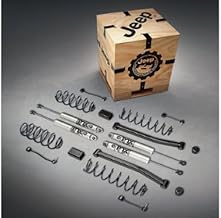
Genuine 2" Lift Kit
Check Price on Amazon →The alignment after any lift or leveling installation is not optional — skipping it causes uneven tire wear within a few thousand miles and can introduce handling instability at highway speeds.
If larger tires are part of your plan, budget for re-gearing as well. Our guide to regearing your JK when you go to larger tires breaks down exactly what that costs and when it becomes necessary.
Sway Bars, Links, and the Hardware You’ll Need Either Way
Both leveling kits and lift kits interact with your sway bar system — and knowing which hardware to replace before you start wrenching saves a frustrating callback to the parts site. For a 1-inch leveling kit, factory sway bar links usually survive without issue. The moment you go above 1.5 inches of lift, factory links become a problem.
At lifts above 1.5 inches, factory sway bar links will bind or stretch beyond their design range, causing a harsh, clunking ride on-road and reduced wheel travel off-road. This is not a comfort issue — a binding sway bar link can fail and separate, which creates a real handling problem at speed.
Rear sway bar links purpose-built for 2007-2018 JK builds running 2.5 to 4 inches of lift are a practical necessity for most lift kit installs and worth buying at the same time as your kit.

Rear Sway Bar Links for 2007-2018 Jeep Wrangler JK | 2.5-4" - 1134
Check Price on Amazon →For the front, the JKS 2034 Quick Disconnect System gives you the ability to manually disconnect the front sway bar on the trail for maximum articulation, then reconnect for highway driving. This is one of the highest-value trail upgrades you can pair with any JK lift.
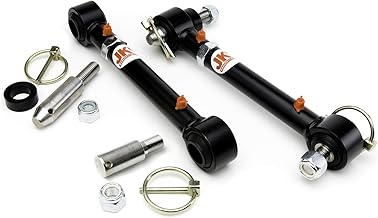
JKS 2034 Front Swaybar Quicker Disconnect System for Jeep JK
Check Price on Amazon →If you’re building a dedicated trail rig and want to eliminate sway bar management entirely, the Currie Antirock Front Swaybar Kit at $554 replaces the factory bar with a torsion-spring design that provides anti-roll resistance on-road while dramatically improving droop travel off it. It’s the premium solution for owners who want to skip the disconnect step and simply have the sway bar work in both environments.
For a deeper breakdown of front disconnect options and link comparisons, see our best front sway bar links and disconnect systems for the JK.
Leveling Kit or Lift Kit: Which Is Right for Your JK?
The right kit for your JK depends on one honest answer: what do you actually do with the truck? If your Wrangler is 90% road and you want better stance and a set of 33s, a leveling kit is the smart, budget-conscious choice. If you wheel regularly, run trails, or plan to put 35-inch or larger tires under the bumpers, a lift kit is the only option that will actually serve you.
Here is a fast decision matrix:
- Street driver, cosmetic upgrade, budget-conscious → 1-inch leveling kit
- Light trail use, 33-inch tires, moderate budget → 2-inch lift kit
- Regular trail use, 35-inch tires, serious capability → 2.5–3.5-inch lift with adjustable control arms
- Rock crawler or expedition build → 4+ inch lift with full geometry correction hardware
One thing experienced JK builders will tell you is that the order of modifications matters almost as much as the modifications themselves. A staged approach — lift first, then front bumper, then tires, then specialty gear — keeps the build financially manageable and lets each change inform the next. Adding a steel front bumper, for example, affects front end weight and can change how a 2.5-inch lift sits. Thinking through that sequence before spending money is exactly the kind of real-world context that spec sheets don’t give you.
The Rough Country 2.5-inch lift kit for the JK Unlimited is the best first lift for most JKU owners — it’s the entry point that unlocks meaningful capability without demanding an advanced install.
2.5" Lift Kit for 2007-2018 Jeep Wrangler JK Unlimited - 67930
Check Price on Amazon →For the full picture of your build path, start with the complete JK buyer’s guide. And once the suspension is sorted, JK grill inserts to complete your build is a natural next step.
Real Benefits of a JK Leveling Kit (And Its Limits)
Jeep JK leveling kit benefits are genuine, if specific. A leveling kit delivers real value for the right owner — but it is not a substitute for a lift, and treating it like one leads to disappointment.
Benefits:
- Eliminates the factory front-to-rear rake for a level, more aggressive stance
- Adds roughly 1 inch of front ground clearance, improving approach angle slightly
- Creates room for 33-inch tires on most JK trims without rubbing
- Bolt-on installation, typically complete in a few hours with basic tools
- Low cost — most quality kits run $35–$100
- Minimal impact on driveline angles, keeping factory CV and u-joint geometry intact
Limitations:
- Does NOT increase suspension travel or articulation
- Does NOT improve off-road capability beyond marginally better approach angle
- Does NOT allow tire sizes above 33 inches without other modifications
- Will not prevent front-end lift or squat under acceleration and braking — the suspension calibration remains factory stock
- Alignment is still required after install, adding to total cost
- At 1.5 inches, factory sway bar links begin to reach their limit
Choosing the right wheel to complement a leveled stance is the next step. See our picks for best wheels for the JK Wrangler to find fitments that work with stock and leveled ride heights.
Get new guides by email
One email when we publish something worth reading. Unsubscribe anytime.
Frequently Asked Questions: JK Lift Kit vs Leveling Kit
Most JK owners have the same handful of questions before committing to either option. Here are direct, JK-specific answers.
Q: Will a leveling kit let me fit 33-inch tires on my Jeep JK?
A: Yes, in most cases. A 1-inch leveling kit provides enough front clearance to run 33-inch tires on a stock-width JK without rubbing, particularly on Sport and Sahara trims. Rubicon owners may already clear 33s from the factory. Minor trimming of the front liner may still be needed on some builds.
Q: Does a leveling kit affect the ride quality of a Jeep JK?
A: A spring spacer leveling kit has minimal effect on ride quality because it does not change the spring rate or shock valving — it simply repositions the spring perch. Some owners report a slightly firmer feel, but most describe the change as negligible on well-maintained factory shocks.
Q: How much does it cost to lift a Jeep JK 2 inches?
A: A 2-inch lift kit for the JK ranges from roughly $250 at the budget end to $600 and above for kits with quality shocks included. Add $120–$200 for a full 4-wheel alignment afterward, and budget an additional $35–$80 for sway bar links if they’re not included. Total all-in cost typically runs $400–$900 depending on the kit chosen.
Q: Do I need to regear my JK after installing a leveling kit?
A: No. A leveling kit does not change your tire size enough to require re-gearing. Regearing becomes relevant when you increase tire diameter by 2 inches or more over stock. If you use a leveling kit to fit 33-inch tires on a JK that originally ran 31s, regearing is worth considering — but the leveling kit itself is not the trigger. Before any suspension modification, it’s also worth reviewing your JK maintenance schedule and service intervals to ensure your suspension components are in good shape going in.
Q: Is a leveling kit or lift kit better for a Jeep JK used mostly on the street?
A: For a street-driven JK, a leveling kit is almost always the better choice. It delivers the improved stance and minor clearance gain most pavement-focused owners want, at a fraction of the cost and complexity of a full lift. A lift kit on a street JK adds cost, ride firmness, and alignment sensitivity without delivering meaningful real-world benefit for typical daily driving.
Q: What model years does a leveling kit or lift kit fit on the JK platform?
A: Most leveling and lift kits are designed for the 2007-2018 Jeep Wrangler JK platform, which includes both the 2-door JK and the 4-door JKU (Unlimited). Always verify your specific model year and body style before ordering — kits are engineered to work with both configurations, but component specifications may differ slightly between them.
The Bottom Line: Choosing the Right Kit for Your JK
A leveling kit is right if you want stance, 33-inch tires, and a low-cost bolt-on. A lift kit is right if you want serious off-road capability, larger tires, and a build you can grow. The single most important rule: buy for what you actually do with the truck, not for what looks good on paper.
Spec sheets tell you lift height and component counts. What they don’t tell you is how a particular combo behaves on a specific trail, or which kit causes headaches at the 10,000-mile mark. That kind of knowledge lives in community experience — forums, build threads, and owner reviews from people who’ve already made the mistakes. Let their real-world data guide your decision as much as the numbers do.
When you’re ready to go further, our best lift kits for the Jeep JK covers the full range of verified options. And once the suspension is sorted, JK grill inserts to complete your build is a natural next step.
Free: JK Fluids at a Glance
Every fluid, spec and capacity for the 2007-2018 Wrangler JK on one page, plus a cut-out glovebox card. Checked against the owner's manuals. From the JK Service Kit.
Email me the download and new guides when they are published. Unsubscribe anytime. Privacy Policy.
Allan
I'm Allan. I own a 2014 Jeep Wrangler JKU and I research the hell out of every mod before I touch it. When I've fitted something to my own Jeep, I say so. Everything else is researched from manufacturer specs and other owners' reports. No sponsored fluff.
Learn more about me →Free: JK Fluids at a Glance
Every fluid, spec and capacity for the 2007-2018 JK on one page, plus a glovebox card.
Email me the download and new guides when they are published. Unsubscribe anytime. Privacy Policy.
Related Articles
ICON Vehicle Dynamics Lift Kits for Jeep JK: Are They Worth the Premium?
ICON Vehicle Dynamics lift kits pair coilovers, remote-reservoir shocks, and precision-valved components to deliver a noticeably smoother, more capable...
Lifted Jeep JK: What to Expect After Installing a 2–4 Inch Lift Kit
A lifted Jeep Wrangler JK is a 2007–2018 Wrangler that has had its suspension or body raised between 1 and 6 inches above factory height. The payoff:...
Best JK Shocks for Off-Road: Complete Bilstein, Fox & King Comparison
A shock absorber does one essential job: it controls how fast your suspension bounces. When your tire hits a rock, the spring compresses. The shock...