What Size Lift Do You Need for 35 Inch Tires on a Jeep JK?
What Size Lift Do You Need for 35 Inch Tires on a Jeep JK?
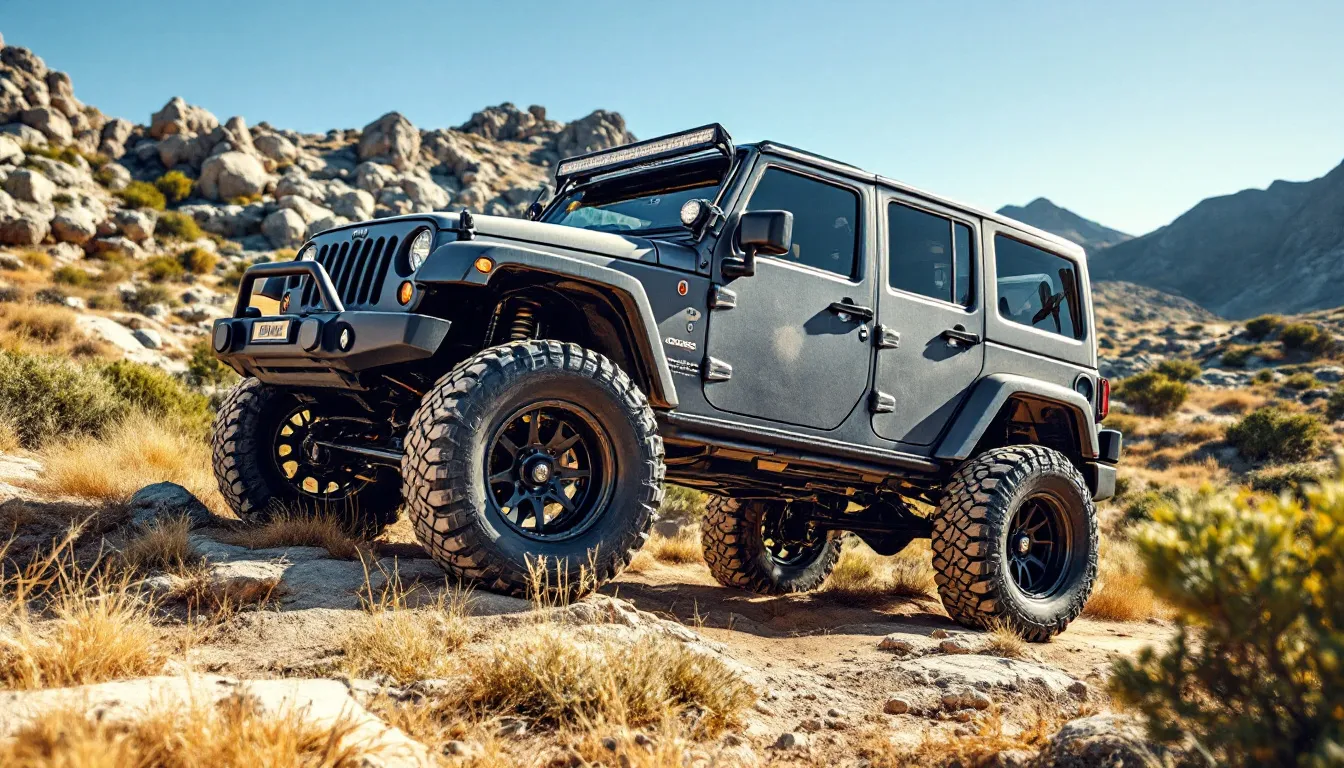
For most 2007–2018 Jeep JK and JKU owners, 3.5 inches of lift is the sweet spot — enough clearance to run true 35s without major trimming, though 2.5 inches works if you’re willing to do some fender work. A 4-inch lift gives you generous room but adds alignment geometry costs that catch many people off guard. This guide covers all two-door JK and four-door JKU models from 2007 through 2018.
Want a broader overview of suspension options first? Check out the best lift kits for Jeep Wrangler JK before diving into tire-specific sizing.
What Lift Height Is Needed to Accommodate 35-Inch Tires on a Jeep JK?
The minimum practical lift for 35-inch tires on a Jeep JK is 2.5 inches, but 3.5 inches is what most owners recommend. At stock height, a true 35-inch tire will contact the fender liner and lower control arms on full lock. You need at least some lift — plus potentially some trimming — to run 35s cleanly.
Here’s what the numbers look like in real-world setups:
- Stock height: 35s rub badly at full steering lock. Not viable for daily driving.
- 2-inch lift: Better than nothing, but many owners still hit the fenders at full lock, especially on the four-door JKU’s longer wheelbase.
- 2.5-inch lift: Workable for many builds, particularly on the JKU. Some fender trimming usually needed.
- 3.5-inch lift: The most common recommendation in the JK community. Runs 35s cleanly on most builds with minimal or no trimming.
- 4-inch and above: Clears 35s with room to spare, but requires extended control arms, alignment cams, or a full long-arm setup.
Here’s a critical mistake to avoid: don’t mix up lift height with gear ratio requirements. These are two completely separate decisions. How high you lift determines tire clearance. What gears you run determines whether your engine and transmission handle the bigger tire without struggling. Gear ratio gets its own section below — keep the two apart in your planning.
Also worth noting: the two-door JK and four-door JKU handle the same lift differently. The JKU’s longer wheelbase can give slightly more clearance in some scenarios, but the front differential position and control arm geometry are different enough that you should always confirm fitment for your specific body style.
Not sure whether a lift kit or a leveling kit is right for you? See the JK lift kit vs leveling kit comparison for the full breakdown. And if you’re considering swapping in fender flares alongside your lift, best JK fender flares is worth reading.
Get new guides by email
One email when we publish something worth reading. Unsubscribe anytime.
Lift Size vs 35-Inch Tire Fitment: At-a-Glance Comparison
The table below shows lift height versus fitment outcome so you can find your target in one glance. This data comes from community-tested fitment experience across 2007–2018 JK and JKU models — your actual results will vary by tire brand, wheel offset, and how your specific build is configured.
| Lift Height | Fits True 35s? | Rubbing Risk | Additional Mods Required | Typical Cost Range |
|---|---|---|---|---|
| Stock (0”) | No | Severe | Major trimming, not recommended | — |
| 2” | Marginal | High | Fender trimming, bump stop adjustment | $150–$400 |
| 2.5” | Yes (with work) | Moderate | Fender trimming, possibly sway bar spacers | $300–$700 |
| 3.5” | Yes (cleanly) | Low–Moderate | Minimal trimming on most builds | $500–$1,200 |
| 4” | Yes (comfortably) | Low | Extended control arms, alignment correction | $900–$2,500+ |
| 4.5”–6” | Yes (oversized) | Very Low | Full long-arm suspension, geometry correction | $2,000–$5,000+ |
The 3.5-inch row is bolded because it’s the lift size that clears 35s for the widest range of JK builds without hitting the expensive geometry corrections that kick in at 4 inches and above.
Will a 2.5-Inch Lift Kit Work With 35-Inch Tires on a Jeep JK?
A 2.5-inch lift can work with 35-inch tires, but it’s not plug-and-play — expect fender trimming and bump stop adjustments. On the four-door JKU, many owners report cleaner fitment at 2.5 inches than on the two-door JK, thanks to wheelbase and geometry differences. On the two-door, rubbing at full lock is a common complaint even with 2.5 inches installed.
Two solid 2.5-inch options for the JK are the Rough Country system (straightforward installation, solid community feedback, good for tight budgets) and the Quadratec kit with Nitro shocks (smoother ride quality, refined damping).
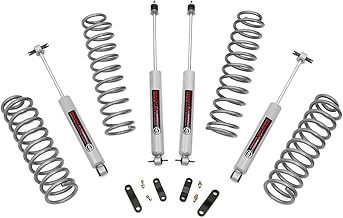
One caveat with the Quadratec kit: it’s rated for tires up to 34 inches, not 35. That one inch matters. If you run 35s on a kit spec’d for 34s, you’re beyond the manufacturer’s tested clearance — it often works with trimming, but you’re exceeding the rated fitment. Know that going in.

The two-door vs four-door distinction matters more than many buyers realize. Always specify your body style when researching 2.5-inch fitment — a setup that works cleanly on a JKU may still rub on a two-door at full steering lock.
For a premium 2.5-inch kit with better damping characteristics, check out the ICON range: see ICON Vehicle Dynamics lift kits for Jeep JK.
Is a 3.5-Inch Lift Sufficient for Running 35-Inch Tires?
Yes — a 3.5-inch lift is sufficient for 35-inch tires and is the most widely recommended height in the JK community for this tire size. At 3.5 inches, most JK and JKU builds clear 35s without significant trimming, even at full steering lock, with standard aftermarket wheel offsets. This is the lift height that balances clearance, cost, and geometry complexity.
The ICON Stage 1 system represents the engineering quality you should expect from premium suspension builders:

The ICON K22001 sits at 3 inches — that half-inch gap from the ideal 3.5 matters on some builds. Many owners running this kit with 35s report good results by pairing it with a slightly taller coil spacer or by choosing a tire that measures conservatively (plenty of “35-inch” tires actually measure 34.5 to 34.8 inches). Confirm the actual measured diameter of your chosen tire before assuming clearance. Marketing names aren’t always precise.
If you’re keeping the JK as a daily driver, ride quality at 3 inches is noticeably better than at 4 inches, where you start fighting driveline angles and vibration. See best lift kit for daily driving the JK for a detailed breakdown.
Can a 4-Inch Lift Kit Accommodate 35-Inch Tires on a Jeep JK?
A 4-inch lift comfortably fits 35-inch tires on a Jeep JK — you’ll have room to spare. The clearance question at 4 inches isn’t whether 35s will fit; they will. The real concern is what a 4-inch lift does to your driveline geometry and what it costs to fix it.
At 4 inches, front CV axles operate at steeper angles, control arms can bind at the extremes of travel, and caster angle needs correction. Most reputable 4-inch kits include upper control arm corrections or cam bolts, but real-world experience shows that a 4-inch lift budget needs to include alignment correction on top of the kit price. Plan for that.
For true 4-inch applications, look at full-system kits from Teraflex, Fox, or ICON that bundle the necessary geometry corrections. See how to install a body lift kit on a JK for installation context.
How to Determine What Lift Is Already Installed on Your Jeep JK
You can measure the lift on a Jeep JK by comparing key chassis-to-ground measurements against published OEM stock dimensions. If you bought a used or imported JK and don’t have the modification history, this is where you start before ordering new components.
Here are the three standard measurement methods:
-
Measure fender-to-ground height. Stock JKU front fender height is approximately 38–39 inches. Compare your measurement to OEM spec. The difference is roughly your lift height. (Account for any oversized tires already fitted — they affect this.)
-
Inspect the springs and shocks visually. Look for extended shocks, add-a-leaf packs, coil spacers, or aftermarket springs. Brand markings on the spring or shock usually identify the kit manufacturer and model.
-
Measure the front diff drop or control arm angle. A heavily angled lower control arm or a dropped diff bracket is a reliable visual signal that significant lift is installed.
Safe under-vehicle inspection requires proper equipment:


Never work under a lifted vehicle on a floor jack alone. Use rated jack stands every time. Once you know your existing lift height, use the comparison table above to figure out what additional lift (if any) you need to clear 35s. See the complete JK lift kit buying guide for kit selection from your measured baseline.
What Gear Ratio Should You Use With 35-Inch Tires on a Jeep JK?
The recommended gear ratio for 35-inch tires on a Jeep JK is 4.88:1 — and this is completely separate from your lift kit size. Many JK owners tangle these two decisions together. Lift height determines clearance. Gear ratio determines whether the engine and transmission perform correctly with a heavier, taller tire rolling at a lower RPM per mile.
Here’s the core logic: the 3.6L JK’s factory gears (typically 3.21:1 on non-Rubicons or 4.10:1 on Rubicons) were calibrated for stock tires. With 35s, the effective gear ratio becomes numerically lower. Your engine works harder at highway speeds and loses low-end torque. Re-gearing to 4.88:1 gets the powertrain back to near-stock performance feel.
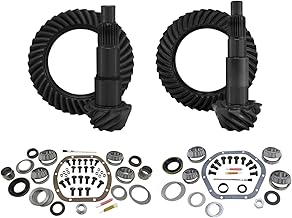
The Yukon 4.88 kit is well-regarded for non-Rubicon JKs. Rubicon owners (starting at 4.10:1) often find 4.56:1 sufficient for 35s, depending on use.
Tackle the lift kit first, then re-gear after — or plan them together if your budget allows. Re-gearing before the lift doesn’t hurt, but most owners install lift first and re-gear when drivetrain fatigue becomes noticeable on the highway.
For the full re-gear process, see how to re-gear a Jeep JK. Working out the upgrade sequence across your whole build? Jeep JK mods by budget maps a logical order.
How Much Taller Are 35-Inch Tires Compared to 33-Inch Tires?
A true 35-inch tire is approximately 2 inches taller in overall diameter than a 33-inch tire — about 1 inch more radius at each end. In actual measured diameters, a 33-inch tire (typically 285/70R17) usually measures 32.7 to 33.2 inches. A 35-inch tire (typically 315/70R17) usually measures 34.5 to 35.0 inches, depending on brand and inflation pressure.
That 2-inch diameter difference means you need roughly 1 inch of additional clearance at the fender and suspension — which is why a lift that works for 33s often falls just short for 35s. The bigger tire also raises your centre of gravity slightly and affects speedometer and odometer accuracy.
Wider tires stress fender flares more than taller ones. If you’re moving from 33s to 35s, check flare coverage too — see JK fender flare options for bigger tires for what fits your build.
Which 35-Inch Tire Models Perform Best on a Jeep JK?
The most consistently recommended 35-inch tires for Jeep JK builds are the BFGoodrich KO2, Falken Wildpeak AT3W, Mickey Thompson Baja Boss AT, and Nitto Ridge Grappler — all available in 315/70R17, the most common true 35-inch sizing for JK steel and alloy wheels.
The Falken Wildpeak AT3W stands out for mixed on- and off-road use, delivering excellent wet pavement performance and moderate trail capability. Many owners report it holds up well across the JK community.
Once you’ve fitted larger tires and more ground clearance, JK skid plates for undercarriage protection with larger tires is the next natural read.
Frequently Asked Questions
Here are direct answers to the most common questions about lift size and 35-inch tires on the Jeep JK, covering fitment, gear ratios, measurement, and tire selection for all 2007–2018 JK and JKU models.
What lift height is needed to accommodate 35-inch tires on a Jeep JK?
Most 2007–2018 Jeep JK and JKU owners need at least 2.5 inches of lift to fit 35-inch tires, with 3.5 inches being the widely recommended minimum for clean fitment at full steering lock. At stock height, 35s rub significantly at the fender and on the lower control arms. The two-door JK typically needs slightly more lift or trimming than the four-door JKU for the same tire size.
How much taller are 35-inch tires compared to 33-inch tires?
A 35-inch tire is approximately 2 inches taller in overall diameter than a 33-inch tire. A 285/70R17 (33-inch) commonly measures 32.7–33.2 inches in actual diameter; a 315/70R17 (35-inch) typically measures 34.5–35.0 inches. That 1-inch radius difference at each end is why a lift calibrated for 33s often falls short for 35s.
How can owners determine what lift size is already installed on a Jeep?
Measure the front fender-to-ground height and compare it to OEM stock specifications for your model year. Inspect the springs and shocks visually for aftermarket markings. Check the control arm angles for signs of significant lift. If you’ve bought a used or imported JK without a known history, these three steps give you a reliable baseline before purchasing additional components.
Which 35-inch tire models perform best on a Jeep Wrangler?
Community consensus consistently points to the BFGoodrich KO2, Falken Wildpeak AT3W, Mickey Thompson Baja Boss AT, and Nitto Ridge Grappler as top performers on the JK in 35-inch sizing (315/70R17 or 35x12.50R17 LT). The right choice depends on your ratio of on-road to off-road driving — the Wildpeak AT3W and KO2 lean toward mixed use, while the Baja Boss and Ridge Grappler offer more aggressive off-road capability.
What gear ratio should be used with 35-inch tires on a Jeep JK?
Non-Rubicon JKs (factory 3.21:1 gears) should re-gear to 4.88:1 when running 35-inch tires. Rubicon JKs (factory 4.10:1) often find 4.56:1 sufficient. Gear ratio is entirely separate from lift kit selection. Lift determines clearance; gear ratio determines drivetrain performance. See the complete JK re-gearing guide for a full breakdown.
Will a 2.5-inch lift kit work with 35-inch tires on a Jeep JK?
Yes, but not without additional work. A 2.5-inch lift can accommodate 35-inch tires on many JK builds, particularly the four-door JKU, but expect fender trimming and bump stop adjustment to eliminate rubbing at full steering lock. The two-door JK is more likely to need trimming at this lift height. Some 2.5-inch kits are rated only to 34 inches — check manufacturer specs before assuming 35s will fit.
Is a 3.5-inch lift sufficient for running 35-inch tires?
Yes. A 3.5-inch lift is the most widely recommended lift height for 35-inch tires on the Jeep JK. It clears 35s cleanly on the vast majority of JK and JKU builds, with minimal or no trimming required, and without triggering the expensive geometry corrections that come with 4-inch lifts. For a lift kit vs leveling kit for the JK comparison, see our dedicated guide.
Can a 4-inch lift kit accommodate 35-inch tires on a Jeep JK?
Absolutely. A 4-inch lift gives comfortable clearance for 35-inch tires with room to spare. The trade-off is cost and complexity: at 4 inches, CV axle angles steepen, caster correction becomes necessary, and upper control arm geometry often needs addressing. Budget for these corrections on top of the kit price. A 4-inch lift makes more practical sense if you’re planning to run 37-inch tires down the road.
The Bottom Line: Choosing the Right Lift for 35-Inch Tires on Your JK
For most 2007–2018 Jeep JK and JKU owners, a 3.5-inch lift is the right answer for 35-inch tires — enough clearance, manageable cost, and no expensive geometry correction. If budget is tight, a 2.5-inch lift with some trimming is workable, especially on the JKU. A 4-inch lift works, but it costs more to execute correctly.
The clearest pattern in the JK community is this: the best fitment advice comes from owners who have actually done it. They’ve measured the rub marks, tried different offsets, and figured out which fender corners to trim. Spec sheets and manufacturer claims are a starting point. Real-world community knowledge is where reliable answers live.
Use the comparison table in this guide as your reference, confirm your existing lift height before ordering, and treat gear ratio as the separate decision it is.
Start with the full JK lift kit buying guide to shortlist kits, then map the upgrade into your overall build sequence with JK mods by budget.
Free: JK Fluids at a Glance
Every fluid, spec and capacity for the 2007-2018 Wrangler JK on one page, plus a cut-out glovebox card. Checked against the owner's manuals. From the JK Service Kit.
Email me the download and new guides when they are published. Unsubscribe anytime. Privacy Policy.
Allan
I'm Allan. I own a 2014 Jeep Wrangler JKU and I research the hell out of every mod before I touch it. When I've fitted something to my own Jeep, I say so. Everything else is researched from manufacturer specs and other owners' reports. No sponsored fluff.
Learn more about me →Free: JK Fluids at a Glance
Every fluid, spec and capacity for the 2007-2018 JK on one page, plus a glovebox card.
Email me the download and new guides when they are published. Unsubscribe anytime. Privacy Policy.
Related Articles
Jeep JK Mopar 2-Inch Lift Kit: What You Get and Is It Worth It?
The Mopar 2-inch lift kit is a factory-engineered suspension lift developed by Jeep's own parts division for the 2007–2018 Wrangler JK and JK...
ICON Vehicle Dynamics Lift Kits for Jeep JK: Are They Worth the Premium?
ICON Vehicle Dynamics lift kits pair coilovers, remote-reservoir shocks, and precision-valved components to deliver a noticeably smoother, more capable...
Lifted Jeep JK: What to Expect After Installing a 2–4 Inch Lift Kit
A lifted Jeep Wrangler JK is a 2007–2018 Wrangler that has had its suspension or body raised between 1 and 6 inches above factory height. The payoff:...