Best Steering Stabilizers for Jeep JK: Fix Death Wobble & Improve Handling
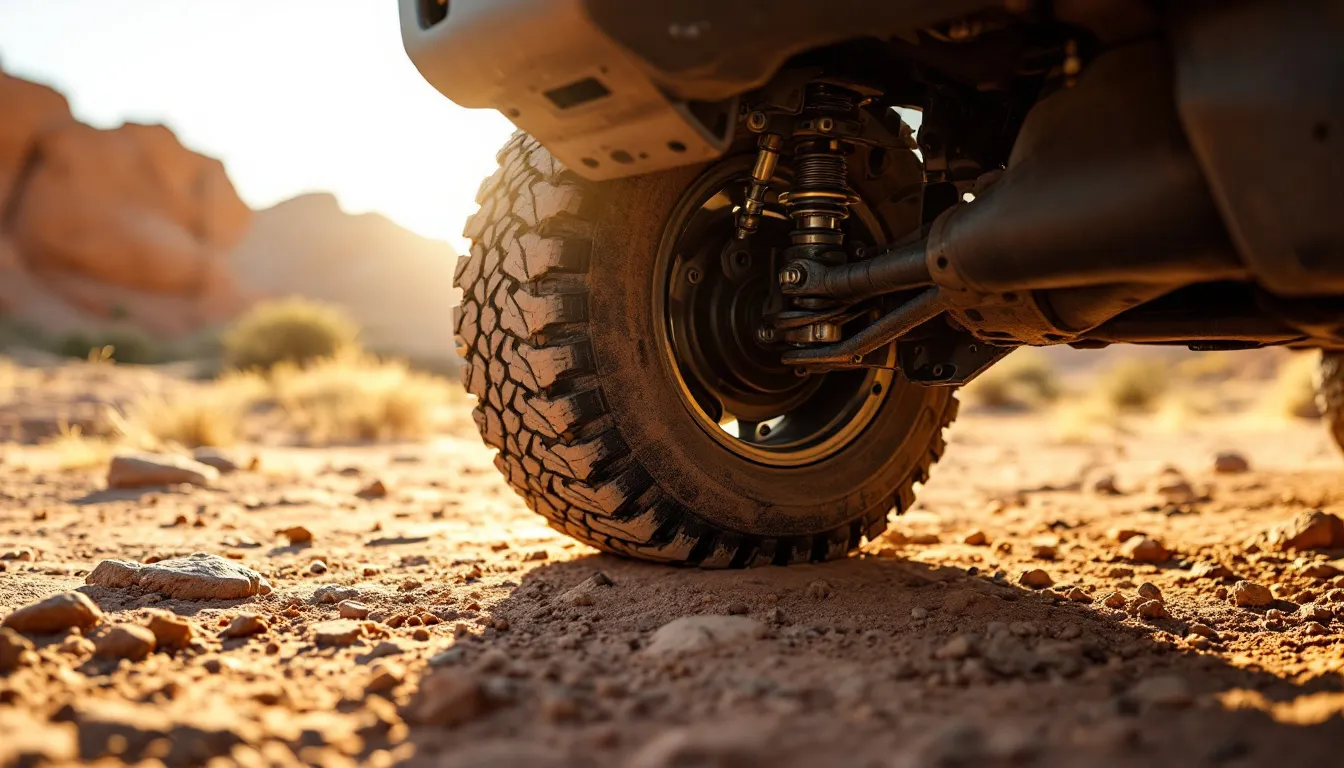
Best Steering Stabilizers for Jeep JK: Fix Death Wobble & Improve Handling
Affiliate Disclosure: JeepJK Guide earns a commission from qualifying Amazon purchases at no extra cost to you. We only recommend products we’ve researched thoroughly.
The Best Steering Stabilizer for Your Jeep JK
A steering stabilizer is a hydraulic damper mounted between your Jeep’s steering linkage and frame. Its job is straightforward: absorb road vibrations and reduce unwanted steering feedback so your wheel doesn’t shake itself out of your hands on rough terrain or at highway speeds.
The best steering stabilizer for a Jeep JK is the Rough Country N3 Dual Steering Stabilizer — especially if your JK is lifted 2.5 inches or more. It delivers superior damping compared to single units and fits all 2007–2018 JK and JKU models without modification.
But here’s the thing that catches a lot of people: a steering stabilizer alone will not fix death wobble if worn track bar bushings, loose track bar mounts, or degraded tie rod ends are actually responsible. Swapping out the stabilizer without diagnosing those components first is like treating the fever instead of fighting the infection.
This guide covers all 2007–2018 Jeep Wrangler JK and JKU models — both 2-door and 4-door. You’ll find detailed product reviews, a breakdown of single versus dual setups, a practical buying guide, and most importantly, a diagnostic checklist of what to inspect before you order anything. If you’re also considering a suspension lift, check out our guide to the best lift kits for Jeep JK and keep tabs on your Jeep JK maintenance schedule while you’re at it.
Quick-Pick Summary: Best Steering Stabilizers for Jeep JK
The right stabilizer depends on three things: how much lift you’re running, what size tires you’re pushing, and how hard you actually wheel. Here’s the short answer: if your JK is lifted or running 35s or larger, go dual — it’s not a luxury, it’s the right engineering decision. If you’re stock-height and mostly street-focused, a solid single unit or a sway bar kit refresh will make a real difference.
| Product Name | Type | Price Range | Best For |
|---|---|---|---|
| Rough Country N3 Dual Steering Stabilizer (2007–2018 JK) | Dual steering stabilizer | ~$149.95 | Lifted JKs (2.5”+ lift), larger tires, death wobble reduction |
| Front Suspension Stabilizer Bar Kit (2007–2018 JK/JKU) | Sway bar + links + bushing kit | ~$134.99 | Stock-height or mildly lifted JKs needing a complete front suspension refresh |
The Rough Country N3 Dual is the go-to for lifted JKs hunting death wobble fixes — solid mid-range pricing with real-world durability.
The Front Suspension Stabilizer Bar Kit is best for owners doing a full front suspension overhaul — it replaces the sway bar, end links, and bushings as one complete package.
One important distinction: The dual stabilizer is engineered for modified builds. If your JK is stock height and you’re chasing that vague, floaty steering feel on the highway, the sway bar kit is probably the smarter first move.
What Is Death Wobble — and Can a Steering Stabilizer Actually Fix It?
A steering stabilizer can reduce death wobble symptoms. It cannot cure it if the actual problem is a worn track bar, a loose track bar mount, or shot tie rod ends. That’s the straight answer — and it’s the one most parts sellers conveniently skip over.
Death wobble is a violent, high-frequency oscillation of the front axle that usually kicks in above 45–55 mph. Often it starts after you hit a bump or a highway expansion joint. Your steering wheel doesn’t just feel shaky — it feels like something is actively trying to tear the wheel from your hands. And once it starts, it won’t stop until you slow down significantly.
I learned this firsthand, and it wasn’t in a controlled test environment. We were heading back from a camping trip, doing about 60 mph on the N1 highway near Beaufort West. The family was in the car — my wife up front, our baby in the back. We hit a highway expansion joint with barely a thought. Then the front axle started oscillating violently. Side to side. Side to side. The steering wheel was pulling hard against my grip. My instinct was to brake — which I quickly realized made it worse. I eased off the throttle, gripped the wheel tighter, and pulled over shaking. Literally shaking.
My first assumption was the steering stabilizer. That’s what every forum thread had pointed to, and it seemed like the easy answer. But before I ordered anything, I got under the JK and found the real culprit: the track bar was shot at the axle-side bushing, with noticeable lateral play. The stabilizer was tired too, so I replaced both. But if I’d replaced only the stabilizer without fixing that track bar, the death wobble would have come back within a hundred miles.
This is the critical thing about death wobble diagnosis: the steering stabilizer is your last line of defense against wobble, not your first. It does an excellent job of masking minor vibrations. But if your front-end geometry is fundamentally compromised — loose track bar, worn ball joints, degraded tie rod ends — no damper on earth will hold that together at highway speed.
Check your front suspension components before you order. Inspect the track bar for play, grab the tie rod and feel for slop, test the ball joints with the truck jacked. Then check the best front sway bar links for Jeep JK to see if your end links are contributing to the problem — they’re often overlooked.
If your diagnosis comes back clean — good track bar, solid tie rods, tight ball joints — then yes, a new steering stabilizer (especially a dual unit on a lifted JK) will likely solve your death wobble. But start with the diagnosis.
Single vs Dual Steering Stabilizer for JK: Which Do You Actually Need?
Most lifted Jeep JKs benefit from a dual steering stabilizer. Any JK running 35-inch tires or larger essentially requires one. A single stabilizer is adequate for stock-height builds with stock rubber — but the physics change quickly once you add lift and tire mass to the equation.
| Configuration | Best For | Typical Price Range | Notes |
|---|---|---|---|
| Single steering stabilizer | Stock-height JK, OEM tire sizes (30–33”), street-focused driving | $50–$120 | OEM replacement or mild upgrade; performs fine for unmodified builds |
| Dual steering stabilizer | Lifted JK (2.5”+), 35”+ tires, trail and highway mixed use | $130–$250 | Substantially better high-speed damping; essentially required for any serious build |
Here’s what’s actually happening under the truck: a steering stabilizer works by resisting rapid directional changes in the steering linkage. A single damper mounted to the drag link can absorb moderate inputs without breaking a sweat. But the moment you add lift, the steering geometry changes. Your caster angle shifts. The drag link angle steepens. And larger, heavier tires create more rotational momentum when they start to oscillate. One damper can’t handle that load efficiently — it fatigues faster and loses damping authority more quickly.
A dual setup — like the Rough Country N3 Dual Steering Stabilizer — mounts a second damper on the opposite side of the steering linkage, providing resistance from both directions. The engineering result: dramatically more stable highway behavior and real resistance to the shock inputs that trigger death wobble.
2-door JK versus 4-door JKU: Both body styles share the same front axle and steering geometry, so most dual stabilizer kits fit both equally well. That said, always verify the specific kit’s fitment notes before purchasing — some budget kits have finicky bracket tolerances that don’t play well with every JK variant.
If you’re running large tires, dig into our guide on the best 37-inch tires for Jeep JK — tire selection and steering stabilization are closer decisions than most people realize.
Best Overall: Rough Country N3 Dual Steering Stabilizer for Jeep JK
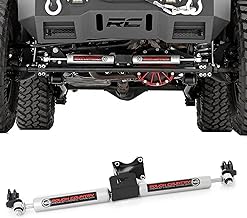
Rough Country N3 Dual Steering Stabilizer for 07-18 Jeep Wrangler JK
$149.95
Check Price on Amazon →If your JK is lifted and you’re fighting death wobble or fuzzy highway steering, the Rough Country N3 Dual Steering Stabilizer is the most practical steering stabilizer for the money. It’s not haute couture — Rough Country is a volume manufacturer, not a boutique brand — but that’s actually why it works so well. They understand what real JK owners need, and they price it accordingly.
Rough Country occupies a specific lane in the aftermarket: widely available, reasonably priced, and engineered for actual fitment on popular platforms like the JK. Their N3 nitrogen-charged dual stabilizer delivers noticeably better damping than bone-stock single-unit replacements. The kit is complete — brackets, hardware, everything — so you’re not hunting for missing pieces when you crack open the box.
Key Specs:
- Fits: 2007–2018 Jeep Wrangler JK and JKU (2-door and 4-door)
- Configuration: Dual steering stabilizer
- Damper type: N3 nitrogen-charged
- Includes: Both stabilizer units, mounting hardware, mounting brackets
- Price: $149.95
Pros:
- Dual-damper setup dramatically reduces high-speed steering oscillation
- N3 nitrogen charge resists fade during extended trail use
- Direct-fit for all 2007–2018 JK/JKU — zero fabrication required
- All hardware included; no separate bracket hunting
- Noticeable improvement over a worn OEM single stabilizer or even an aged replacement
Cons:
- Rough Country is mid-range, not premium — if you’re chasing absolute peak performance, Fox or Bilstein units exist at higher price points
- Does not address root-cause suspension issues like worn track bars or tie rod ends
- Installation can be tight on some builds with aftermarket skid plates or custom steering geometry
Compatibility note: This kit is engineered for all 2007–2018 JK and JKU models at stock height and with lifts up to 4–6 inches using factory-style geometry. If you’re running a very aggressive high-clearance steering system or a full long-arm kit, test bracket clearance before final installation.
For context on how Rough Country stacks up against competing suspension manufacturers on the JK platform, check our breakdown of comparing lift kit brands for the Jeep JK.
Best for Complete Suspension Refresh: Front Suspension Stabilizer Bar Kit for Jeep JK

This is a sway bar replacement kit — not a steering stabilizer — and that distinction matters more than most buyers realize. Both components affect how your JK feels on the road, but they do completely different jobs. If you’re hunting a death wobble fix specifically, this is not a direct substitute for a steering stabilizer. But if your front suspension is tired and you want to restore proper body roll control and on-road stability, this kit addresses something a steering stabilizer physically cannot.
A sway bar (or anti-roll bar) connects your left and right suspension sides and limits body lean in corners. A steering stabilizer dampens side-to-side movement in the steering linkage. They work together — both matter. Replacing one while the other is worn means you’re only halfway done with the job.
The Front Suspension Stabilizer Bar Kit replaces the OEM 52059971AC sway bar, end links, bushings, and mounting brackets as a complete system. If your 2007–2018 JK is due for a thorough front-end refresh, this is genuine value. The 31.1mm bar diameter matches OEM specs for stock-height builds.
Key Specs:
- Fits: 2007–2017 Jeep Wrangler JK and 2018 JK models
- Bar diameter: 31.1mm (OEM-equivalent)
- Replaces OEM part: 52059971AC
- Includes: Sway bar, end links, bushings, mounting brackets
- Price: $134.99
Pros:
- Complete kit — no separate hunting for end links or bushings
- OEM-spec bar diameter restores factory handling precisely
- Excellent value if you’d otherwise source parts separately
- Direct replacement fitment; zero modifications required
Cons:
- This is a sway bar kit, not a steering stabilizer — it will not address steering shimmy or death wobble
- OEM-spec bar diameter limits upgrade potential for heavily lifted or modified builds
- Not compatible with sway bar disconnect systems without additional hardware purchases
The key point: If your JK wanders at highway speed but your steering components check out clean, start here — sway bar end links and bushings wear out constantly, and they’re frequently overlooked. Pair this kit with a steering stabilizer upgrade for a genuinely complete front-end overhaul.
For more on sway bar choices and disconnect systems, see best front sway bar links for Jeep JK. If you’re planning a lift, our best lift kits for Jeep JK guide will help you pick components that work together harmoniously.
Jeep JK Steering Stabilizer Buying Guide: What Actually Matters
When you’re buying a Jeep JK steering stabilizer upgrade, five factors determine success: lift height compatibility, damper type, single versus dual configuration, hardware inclusion, and real-world brand support. Get those right, and the price bracket mostly takes care of itself.
Here’s what each criterion actually means when you’re under the truck:
Lift Height Compatibility
This is the factor most buyers overlook. A stabilizer designed for a stock-height JK might have the wrong mounting angle or travel range for a lifted truck. Before you commit to a purchase, verify the manufacturer’s stated lift compatibility. A kit rated for 0–3 inches is not the right choice for your 4-inch lift.
Damper Type: Standard Hydraulic vs. Nitrogen-Charged
Standard hydraulic stabilizers work adequately for mild use. Nitrogen-charged units (like the Rough Country N3) resist heat fade during extended trail running — the nitrogen prevents the damper fluid from aerating under repeated cycling. For mixed street and trail driving, nitrogen is worth the modest price bump.
Single vs. Dual Configuration
Covered in detail above, but the summary: dual is the engineering-correct answer for any JK running a 2.5-inch or larger lift. The damping load on a single unit at highway speed with 35-inch tires or larger is simply too high for consistent performance over time.
Hardware Inclusion
Budget kits sometimes ship without brackets, grade-8 fasteners, or end bushings. Check the manifest before purchase — sourcing missing hardware separately wastes both money and your installation day.
Brand Support and Real Fitment Data
Spec sheets never tell you what actually fits your specific setup. Community forums and real-world testing do. I’ve watched this play out repeatedly: a kit that looks perfect on paper has bracket clearance issues with aftermarket skid plates or specific axle configs. Cross-reference the manufacturer’s fitment notes with actual forum posts from owners running your exact setup before you buy.
The boldest point here: a $250 premium stabilizer on a truck with a worn track bar will handle worse than a $130 mid-range unit on a truck with solid suspension fundamentals. Fix the foundation first. The expensive damper can’t save bad geometry.
Before you finalize your setup, think through your gear ratios if you’re running larger tires. Our guides on regearing your Jeep JK for larger tires and the best gear ratio for 33-inch tires on Jeep JK walk you through the whole picture.
What to Inspect and Replace Alongside Your Steering Stabilizer
Before you install a new steering stabilizer, inspect these components — because a new stabilizer won’t compensate for worn front-end parts. This checklist is the difference between a real fix and a temporary mask.
- Track bar: Check for lateral play at both the axle-side and frame-side connections. Any noticeable movement is a red flag.
- Track bar bushings: Rubber degrades over time. Torn or compressed bushings allow the axle to shift laterally — the primary death wobble trigger.
- Tie rod ends: Grab the tie rod and check for vertical and horizontal play. Worn tie rod ends contribute directly to steering wander and wobble.
- Drag link: Look for bends (common after impacts) and worn end joints.
- Ball joints: Both upper and lower. Use a floor jack under the axle to unload the suspension and check for play.
- Wheel bearings: Spin each front wheel by hand and feel for roughness or grinding.
- Alignment: After replacing any front-end component, get a proper four-wheel alignment — especially caster angle, which affects straight-line stability on JKs.
For full service guidance and interval recommendations, see the Jeep JK maintenance and inspection schedule.
After my own death wobble incident revealed a worn track bar rather than just a tired stabilizer, I made front-end inspection a regular habit — not waiting for something to feel wrong, but checking on a schedule. That mindset shift has saved real money and, more importantly, real peace of mind on highway trips with family in the truck.
Installation Tips: Getting Your Steering Stabilizer Right
Installing a steering stabilizer on a JK is straightforward, but there’s a difference between “finished” and “done properly.”
Remove the old unit first. Support the front end safely with jack stands. Locate the existing steering stabilizer — usually mounted between the drag link and the frame. Disconnect the stabilizer from both ends. You may need penetrating oil if fasteners have been sitting for years.
Check your new hardware. Count and verify all fasteners, brackets, and bushings against the kit contents. Missing pieces now are a pain — missing pieces during install are a show-stopper.
Mount the new unit. Position the stabilizer carefully to ensure it’s not kinked or twisted. Attach it at both ends, but don’t fully torque yet.
Torque to spec. This is where most home installs go wrong. Get a torque wrench and follow the manufacturer’s fastener torque specifications exactly. Under-torque and the stabilizer can work loose. Over-torque and you risk stripped threads or cracked brackets.
Test before long drives. After installation, take the JK on a short test run before committing to highway speeds. Feel for any unusual steering response or binding. If something feels off, stop and re-examine the installation.
A dual unit installation typically takes 1–2 hours for a home mechanic with basic hand tools. No specialized equipment is required, but a torque wrench is non-negotiable for proper fastener torque.
Frequently Asked Questions: Steering Stabilizers for Jeep JK
Do I need a steering stabilizer on a stock Jeep JK?
Stock-height 2007–2018 JKs come factory-equipped with a steering stabilizer already. You don’t need to upgrade it unless it’s worn or you’re experiencing vague steering feel. If the OEM unit is in decent condition, it will handle street and mild trail use adequately. Upgrade when you add lift or notice steering degradation.
Will a dual steering stabilizer fix death wobble on my JK?
A dual steering stabilizer can substantially reduce death wobble, but it won’t cure it if worn front-end components are the root cause. Inspect your track bar, bushings, tie rod ends, and ball joints first. Replacing only the stabilizer when the track bar is compromised is a temporary fix that will likely resurface within a hundred miles.
What is the best steering stabilizer brand for Jeep JK?
For most JK owners, the Rough Country N3 Dual Steering Stabilizer delivers the best mix of performance and value. Premium options from Fox and Bilstein offer higher-end damping, but at significantly higher cost — the difference is most noticeable on heavily modified builds or competition-level trail use. For street and moderate trail work, mid-range dual units perform very well.
How long does it take to install a steering stabilizer on a Jeep JK?
A single stabilizer swap typically takes 30–60 minutes with basic hand tools. A dual stabilizer kit with new brackets runs 1–2 hours for most home mechanics. No special tools are required, but a torque wrench is strongly recommended for proper fastener torque. Check the manufacturer’s instructions for specific torque specifications.
Does a steering stabilizer affect off-road performance?
Yes — positively. A properly engineered stabilizer improves controlled steering on rutted trails and reduces arm fatigue during extended off-road driving. On technical terrain where constant steering input is needed, a dual stabilizer adds predictability. It doesn’t limit suspension articulation or ground clearance. For more on matching your JK’s setup to your driving style, check the JK buyers guide and Rubicon versus Sport versus Sahara trim comparison.
Can I install a steering stabilizer myself?
Absolutely. It’s one of the most accessible JK suspension upgrades for a home mechanic. You’ll need basic hand tools, a jack, jack stands, and a torque wrench. The critical step is torquing fasteners to specification — don’t skip that part. If you’re not confident with mechanical work, a shop can install it in under two hours.
Final Verdict: The Right Steering Stabilizer for Your Jeep JK
The Rough Country N3 Dual Steering Stabilizer is the top pick for 2007–2018 Jeep JK and JKU owners — but only buy it after you’ve inspected and confirmed your track bar, tie rod ends, and ball joints are in good shape. A new stabilizer on a compromised front end is a false fix that will leave you disappointed within weeks.
For stock-height JKs needing a complete front-end overhaul, pair the dual stabilizer with a proper sway bar kit to address both steering stability and body roll control at the same time.
Once your steering is sorted, natural next steps are armor and visual upgrades. Our guides to the best front bumper for Jeep JK and best wheels for Jeep Wrangler JK will help you keep the build moving forward.
Get the Free JK Build Planner
Complete PDF with mod checklists, gear ratios, tire sizing charts, and budget worksheets. Everything you need to plan your JK build.
No spam. Unsubscribe anytime. By subscribing, you agree to our Privacy Policy.
Allan
I'm Allan. I bought a 2014 Jeep Wrangler JKU and I research the hell out of every mod before I touch it. Everything here is tested or deeply researched on my own rig - no sponsored fluff, just honest findings.
Learn more about me →Get the JK Build Planner
Free PDF with complete build checklists, gear ratios, and tire fitment guides.
By subscribing, you agree to our Privacy Policy.
Related Articles
Coilover Suspension vs Traditional Lift Kit Jeep Jk Comparison
A coilover suspension is a single-unit shock absorber and coil spring assembly that replaces your JK's factory suspension components, offering height...
JK Lift Kit vs Leveling Kit: Which Is Right for Your Jeep Wrangler?
A leveling kit corrects the JK's factory front-to-rear rake with low-cost spacers, while a lift kit raises the entire vehicle with new springs, shocks,...
Teraflex vs Rock Krawler JK Lift Kit: Which is Better?
Compare Teraflex vs Rock Krawler JK lift kits in detail. Build quality, performance, and value analysis from real-world experience.