Coilover Suspension vs Traditional Lift Kit Jeep Jk Comparison
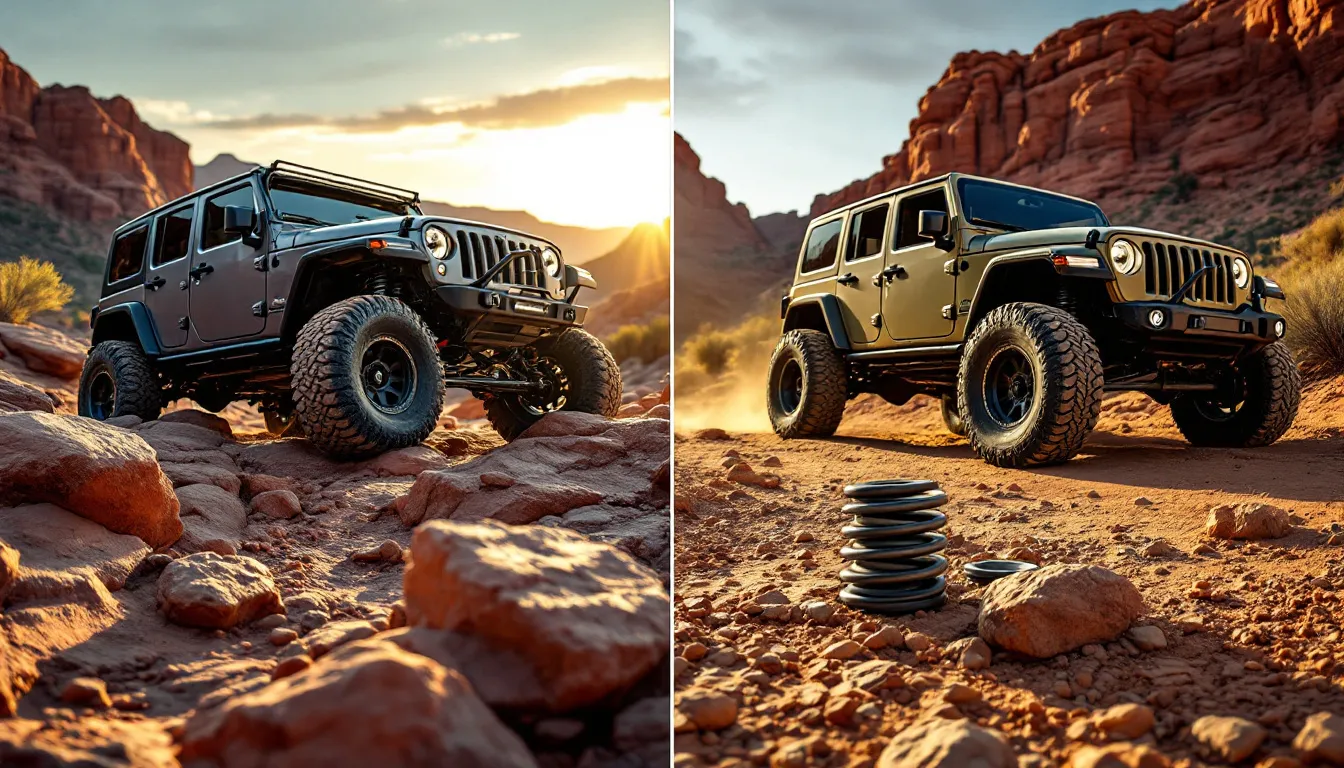
Coilover Suspension vs Traditional Lift Kit: Jeep JK Comparison
The Quick Answer
A coilover suspension is a single-unit shock absorber and coil spring assembly that replaces your JK’s factory suspension components, offering height adjustment, damping tuning, and improved articulation in one package.
Here’s the honest truth: most JK owners are better served by a quality traditional lift kit — unless you’re planning serious competitive off-roading or demand fully tunable on-road damping. For daily drivers and weekend trail rigs, a 2.5- to 3.5-inch traditional lift delivers excellent capability at a fraction of the coilover cost. Coilovers make sense when you need precise, repeatable tuning across varied terrain and you’re willing to invest $2,000–$5,000 or more in a complete system.
But specs alone don’t tell the full story. The JK community has strong opinions on this, and they’re based on real experience — the kind of hard-won knowledge that exposes the gap between what a manufacturer claims on paper and what actually happens at 65 mph on a dirt road.
For broader lift context, see our Complete JK Lift Kit Guide or if you’re still deciding on a JK, start with the JK Buyers Guide.
What Is Coilover Suspension on a Jeep JK?
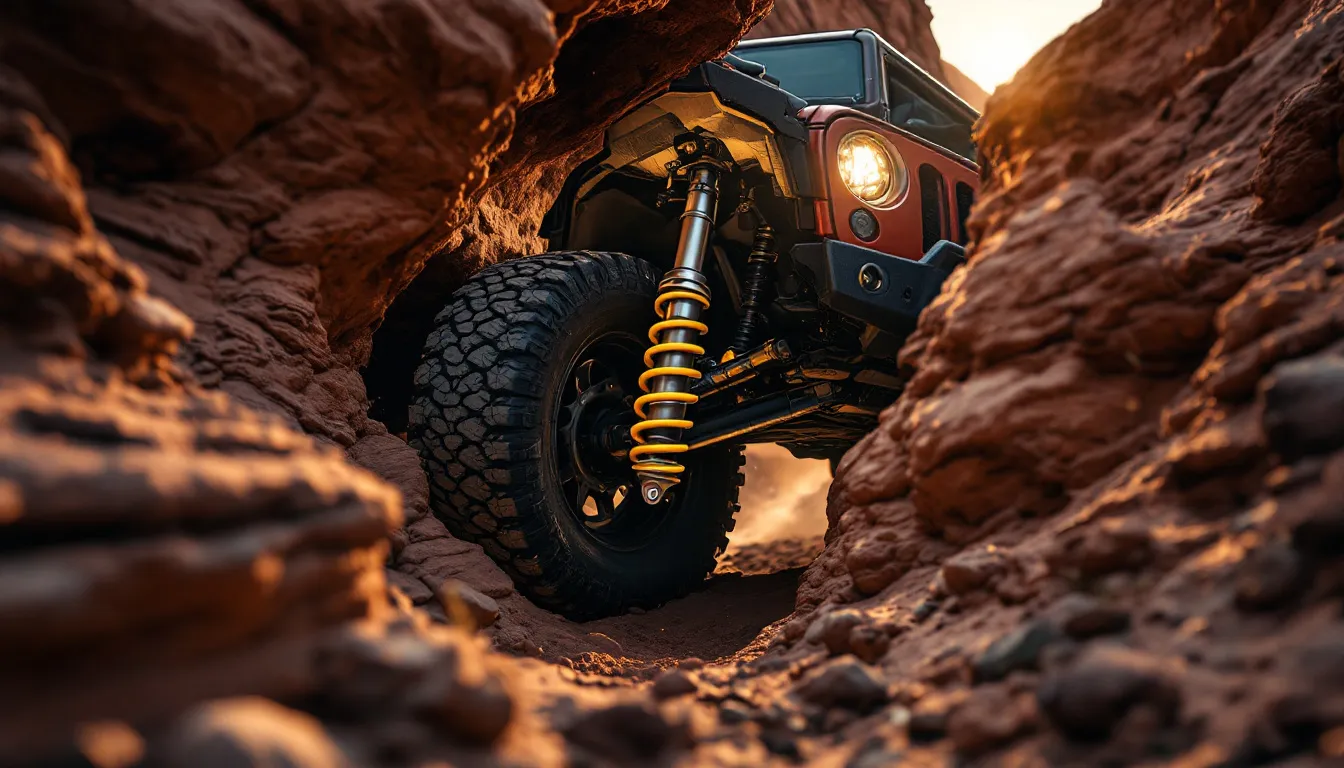
A coilover system replaces your JK’s separate coil spring and shock absorber with a single integrated unit where the spring wraps around a monotube or twin-tube shock body, and a threaded collar lets you dial in ride height independently of spring rate.
On a Jeep JK (model years 2007–2018), coilovers are typically installed on all four corners, often paired with new upper and lower control arms to correct geometry at lift heights of 3.5 inches and beyond. The defining advantage is adjustability — you can change ride height, corner-balance the vehicle, and tune compression and rebound damping to match terrain without swapping springs or paying for an alignment every time you want to tweak something.
This matters for JK owners because the factory suspension geometry is calibrated for stock ride height. Any significant lift changes your caster angle, pinion angle, and track bar geometry. A coilover setup with adjustable components lets you correct those angles precisely—something a bolt-in spring-and-spacer kit simply cannot do.
Two-door JK and four-door JKU Unlimited models have different wheelbase and weight distribution, which affects spring rate selection. The JKU carries more rear weight and typically needs stiffer rear spring rates to avoid sag under load. Good coilover kits address this with model-specific valving.
For a premium lift solution that approaches coilover-level quality without the full coilover price tag, the Genuine 2” Lift Kit delivers engineered components designed to work together as a system:
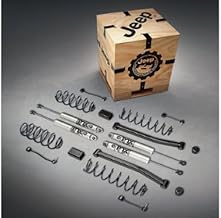
Genuine 2" Lift Kit
Check Price on Amazon →If you’re focused on shock performance specifically, our guide to the best JK shocks breaks down the top options across every budget.
What Is a Traditional Lift Kit for the JK?
A traditional lift kit raises your Jeep JK’s body and suspension using a combination of replacement coil springs, spacers, extended control arms, and new shocks—keeping the factory shock-and-spring architecture but increasing ride height and suspension travel.
Traditional kits range from simple 1-inch spacers all the way to full 4-inch systems with new control arms, track bars, and brake line extensions. Entry-level options like the 1” Front Spring Spacer Leveling Kit are a quick, low-cost way to level out the factory rake or clear slightly larger tires without touching geometry:
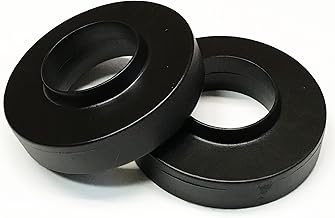
1" Front Spring Spacer Leveling Kit, Compatible with Jeep Wrangler JK 2007-2018
Check Price on Amazon →Beyond basic spacers, mid-range kits in the 2–3.5 inch range are where most JK owners land. A 2.5-inch traditional kit is the sweet spot for owners who wheel on weekends and drive on-road during the week—it clears 33-inch tires comfortably and keeps installation straightforward. Step up to 3.5–4 inches and you’ll want to budget for an adjustable track bar and potentially a control arm correction kit to prevent death wobble and excessive bump steer.
The Rough Country 2.5” Lift Kit is one of the most popular entry points for JK owners:
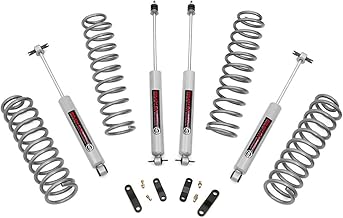
Rough Country 2.5" Lift Kit for 2007-2018 Jeep Wrangler JK Unlimited - 67930
Check Price on Amazon →For a full breakdown of what’s available, see our guide to the best JK lift kits and our deep-dive on the best 3.5–4 inch lift kits for the JK.
Coilover vs Traditional Lift Kit: Head-to-Head Comparison
When comparing coilover suspension to a traditional lift kit on the Jeep JK, cost and adjustability are the two factors that matter most for the majority of owners. The table below uses real price anchors from current kits so you can plan your budget accurately.
| Factor | Coilover System | Traditional Lift Kit |
|---|---|---|
| Cost — entry-level | ~$1,500–$2,500 (coilovers only) | ~$36–$300 (spacer to full 2.5” kit) |
| Cost — full build | $3,000–$6,000+ with arms/hardware | $600–$1,800 with arms/track bar |
| Installation difficulty | High — requires alignment, arm adjustment | Moderate — basic hand tools, 4–8 hrs |
| On-road ride quality | Excellent — fully tunable damping | Good — varies by shock quality |
| Off-road articulation | Excellent — full travel with tuned valving | Good to excellent — depends on kit tier |
| Adjustability | Full height + damping adjustment | Limited — spring rate is fixed |
| JK/JKU compatibility | Model-specific kits required | Universal and model-specific options |
| Best for | Serious wheelers, rock crawlers, builders | Daily drivers, weekend warriors, budget builds |
The $299.95 Rough Country kit and the $1,595.22 Genuine kit sit at opposite ends of the traditional lift spectrum—and both still undercut a full coilover build.
If you remember one thing from this table: a quality traditional lift kit at the $600–$1,800 tier delivers 80–90% of the off-road capability of a coilover system at roughly one-third the total cost.
For further guidance on pairing your lift choice with the right supporting hardware, visit our complete JK lift kit guide.
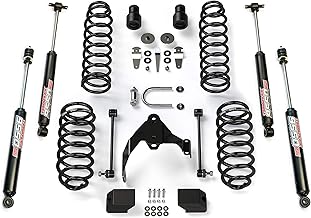
2.5" Lift Kit (JK 4 Door with All (4) 2.5" Shock) - 1251000
Check Price on Amazon →On-Road Ride Quality: What to Expect from Each System
Coilovers deliver noticeably better on-road ride quality than most traditional lift kits because you can tune damping to compensate for the changed geometry that any lift introduces. Traditional kits vary widely—a quality kit with name-brand shocks rides well; a budget spacer-and-stock-shock setup can feel harsh and imprecise.
The geometry point cannot be overstated. Any lift—coilover or traditional—changes your JK’s track bar angle, caster, and pinion geometry. Get those angles wrong and you introduce shimmy, wander, and in serious cases, death wobble.
I spent three months researching lift kits before committing to one. Every forum thread, every YouTube install video, every owner review I could find. The JK community is passionate about lifts—and passionately divided. Some swore I’d regret anything under 4 inches; others said even 2.5 was overkill for what I needed. I settled on 2.5 inches with adjustable control arms, and it’s been the best decision I’ve made on this build.
That 2.5-inch choice gave me clearance for 35s without cutting fenders, better ride quality than the bouncy factory JK suspension, and something equally important: I could still do 120 km/h on the highway without the steering feeling vague. Adjustable control arms were the upgrade I almost skipped. Once I dialed them in, I understood why other builders kept mentioning them. Being able to correct caster and keep the track bar angle right is the difference between a good lift and one that feels off.
Death wobble on a lifted JK is a real safety risk: a violent, high-frequency oscillation at highway speed that requires both hands on the wheel to control and stems from worn or incorrect track bar geometry, loose joints, or improper caster correction. The risk exists with both lift types, but it’s more common with traditional spacer lifts that don’t include corrective hardware.
Death wobble at highway speed sets the entire front axle oscillating violently side to side, and braking makes it worse. It is a safety issue, not a comfort one. The usual root cause is a worn track bar bushing combined with loose steering box bolts. The repair that holds is an adjustable track bar, everything torqued to spec, and a heavy-duty steering stabiliser as insurance. On a lifted JK, a front-end inspection before every long trip is the habit that prevents it.
Sway bar management plays directly into on-road feel, too. A disconnectable sway bar setup lets you stiffen things up on the highway and disconnect for trail flex. The JKS 2034 Quick Disconnect System gives you that flexibility at a reasonable price:
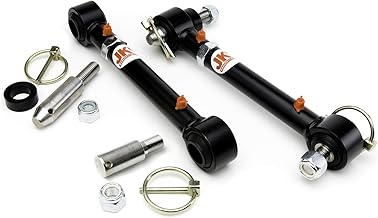
JKS 2034 Front Swaybar Quick Disconnect System for Jeep JK
Check Price on Amazon →If you’re building a dedicated trail rig and want maximum flex without manual disconnects, check our detailed comparisons in the best JK shocks guide for full system integration options including solid sway bar replacements.
Off-Road Performance: Articulation, Flex, and Trail Capability
Off the pavement, coilovers edge out traditional lift kits in sustained high-speed desert running and precise technical climbing—but a well-built traditional system with the right supporting hardware closes the gap significantly on most trails.
Articulation—the measure of how far your suspension can droop and compress before a tire lifts—is primarily determined by control arm length, shock travel, and sway bar setup, not whether you have coilovers or springs. A 2.5-inch traditional lift with good shocks, extended control arms, and disconnected sway bars will out-flex a coilover setup where the sway bar is still engaged.
Disconnecting the sway bar is the single biggest flex unlock you can make on a JK, regardless of which lift system you run. The Rear Sway Bar Links work with traditional lift kits to extend sway bar drop link length and maintain correct geometry at lifted ride heights:

Rear Sway Bar Links for 2007-2018 Jeep Wrangler JK | 2.5-4" - 1134
Check Price on Amazon →For four-door JKU owners who wheel regularly and want a proven full-shock lift system, a quality 2.5-inch kit delivers dedicated performance across varied terrain. When you add larger tires to either lift system, gear ratio becomes critical. A 35-inch tire on a JK with factory 3.73 gears will feel sluggish and put strain on the drivetrain. See our JK gear ratio guide and our roundup of the best 35-inch tires for the JK to plan that combination correctly.
Cost, Installation Difficulty, and Total Ownership
The true cost gap between coilovers and traditional lifts widens considerably once you factor in alignment, wear items, and supporting hardware—not just the initial kit price.
A traditional 2.5-inch kit like the Rough Country option at $299.95 looks inexpensive up front. Add adjustable control arms, an alignment, extended brake lines, and potentially a track bar correction, and you’re realistically at $800–$1,400 installed. A full coilover build with new upper and lower control arms, alignment, and hardware commonly runs $3,500–$6,000 depending on brand and whether you pay for professional installation.
The build path I took after months of research reflects what many JK owners discover: after cross-referencing forum threads, build logs, and spec sheets, the best decision landed on 2.5 inches with adjustable control arms instead of a more expensive coilover setup. The reasoning was straightforward: adjustable control arms solved the geometry problem that spacer-only kits create, ride quality was excellent with quality shocks, and the money saved funded larger tires and a regear. That decision process reflects a pattern common across the JK community: a mid-tier traditional lift with correct geometry hardware typically delivers better real-world value than an entry-level coilover system.
Don’t overlook the front stabilizer bar when budgeting. A worn or incorrect sway bar setup will undo the benefits of any lift. The [31.1mm] Front Suspension Stabilizer Bar Kit is a geometry-adjacent upgrade worth including in your initial build budget:

[31.1mm] Front Suspension Stabilizer Bar Kit with Sway Bar Links Bushing & Bracket
Check Price on Amazon →Installation difficulty is real, too. Traditional lifts can be completed in a driveway with basic hand tools in 4–8 hours. Coilovers require precise preload settings and a full alignment immediately after—plan for professional installation unless you have alignment equipment. See DIY JK lift kit installation tips and the JK regear cost guide to build out your complete project budget.
Which System Is Right for Your JK Build?
The right lift system depends on how you use your JK, what you plan to build toward, and what your realistic total budget is—not just the sticker price on the kit.
For roughly 80% of JK owners—those who daily drive, run moderate trails, and want 33- to 35-inch tires—a 2.5- to 3.5-inch traditional lift kit with quality shocks and corrective hardware is the right answer. It delivers strong trail performance, manageable installation, and leaves budget for tires, a regear, and the accessories that genuinely improve day-to-day ownership.
The remaining 20%—dedicated rock crawlers, competitive off-road builders, or owners who spend weeks at a time in remote terrain—will find coilovers worth the investment.
Pairing a lift with 35-inch tires and overland gear as an integrated system makes sense, where every component decision affects the next. That’s whole-build thinking. Choosing your lift in isolation, without accounting for tire size, gear ratio, and intended use, is how builds end up underperforming.
Here are the three buyer profiles:
- The Weekend Warrior (most common): 2.5–3.5 inch traditional kit, quality shocks, adjustable track bar, 33–35-inch tires. Best value, easiest build.
- The Overland/Expedition Builder: 3–4 inch traditional lift with full geometry correction, disconnectable sway bars, 35-inch tires, and a regear. Traditional lift wins on reliability and repairability in remote areas.
- The Serious Trail Rig / Rock Crawler: Full coilover system with long-travel arms, 37-inch+ tires, and locked differentials. Coilovers justify their cost here.
Before committing to a build direction, check out the Rubicon vs Sport vs Sahara comparison to see if your trim level affects which upgrades are redundant, and our guide to the best wheels for your JK to complete the picture.
Get new guides by email
One email when we publish something worth reading. Unsubscribe anytime.
Frequently Asked Questions
Q: Is a coilover better than a lift kit for a Jeep JK?
A: It depends entirely on your use case. Coilovers offer superior tunability and high-speed off-road performance, but for daily-driven trail rigs, a quality traditional lift with corrective geometry hardware delivers comparable results at significantly lower cost. Most JK owners don’t need coilovers.
Q: How much does a coilover suspension cost for a Jeep Wrangler JK?
A: A full coilover system for a JK typically costs $3,000–$6,000 or more once you include new control arms, hardware, alignment, and installation. Entry-level coilover-only kits start around $1,500–$2,500, but that price doesn’t include the supporting components needed for correct geometry.
Q: Will a traditional lift kit cause death wobble on my JK?
A: Death wobble is a real risk with any lift if corrective track bar, caster, and control arm geometry is not addressed. Spacer-only lifts are particularly vulnerable because they raise ride height without correcting geometry. Using a quality kit that includes an adjustable track bar, performing a proper alignment, and inspecting joints regularly significantly reduces that risk. Check out our best JK shocks guide for shock options that support proper geometry correction.
Q: Can I run 35-inch tires on a traditional 2.5-inch lift kit?
A: Yes, but clearance depends on your specific JK configuration. A 2.5-inch lift with a minor trim or bump stop adjustment will typically clear 35-inch tires on a JKU. Two-door JKs have a shorter wheelbase and can experience more scrub with 35s—a 3–3.5 inch lift is a safer fit for that tire size on the two-door.
Q: Do I need to regear after installing a lift kit on my JK?
A: If you’re staying with 33-inch tires, you can often keep factory gearing. Step up to 35s or larger and a regear to 4.56 or 4.88 is strongly recommended to restore performance and protect your drivetrain. See our guide on the best gear ratio for 35-inch tires for a detailed breakdown.
Q: What is the easiest lift kit to install on a Jeep JK?
A: A coil spring spacer kit—like a 1-inch front leveling spacer—is the simplest install, achievable in 2–3 hours with basic hand tools. Mid-range 2.5-inch kits with replacement springs and shocks require 4–8 hours and basic mechanical skills. Full coilover systems should be installed by a professional with alignment equipment unless you’re an experienced builder.
Free: JK Fluids at a Glance
Every fluid, spec and capacity for the 2007-2018 Wrangler JK on one page, plus a cut-out glovebox card. Checked against the owner's manuals. From the JK Service Kit.
Email me the download and new guides when they are published. Unsubscribe anytime. Privacy Policy.
Allan
I'm Allan. I own a 2014 Jeep Wrangler JKU and I research the hell out of every mod before I touch it. When I've fitted something to my own Jeep, I say so. Everything else is researched from manufacturer specs and other owners' reports. No sponsored fluff.
Learn more about me →Free: JK Fluids at a Glance
Every fluid, spec and capacity for the 2007-2018 JK on one page, plus a glovebox card.
Email me the download and new guides when they are published. Unsubscribe anytime. Privacy Policy.
Related Articles
ICON Vehicle Dynamics Lift Kits for Jeep JK: Are They Worth the Premium?
ICON Vehicle Dynamics lift kits pair coilovers, remote-reservoir shocks, and precision-valved components to deliver a noticeably smoother, more capable...
Lifted Jeep JK: What to Expect After Installing a 2–4 Inch Lift Kit
A lifted Jeep Wrangler JK is a 2007–2018 Wrangler that has had its suspension or body raised between 1 and 6 inches above factory height. The payoff:...
Best JK Shocks for Off-Road: Complete Bilstein, Fox & King Comparison
A shock absorber does one essential job: it controls how fast your suspension bounces. When your tire hits a rock, the spring compresses. The shock...