Jeep JK Death Wobble Fix: What Actually Works (and What Doesn't)
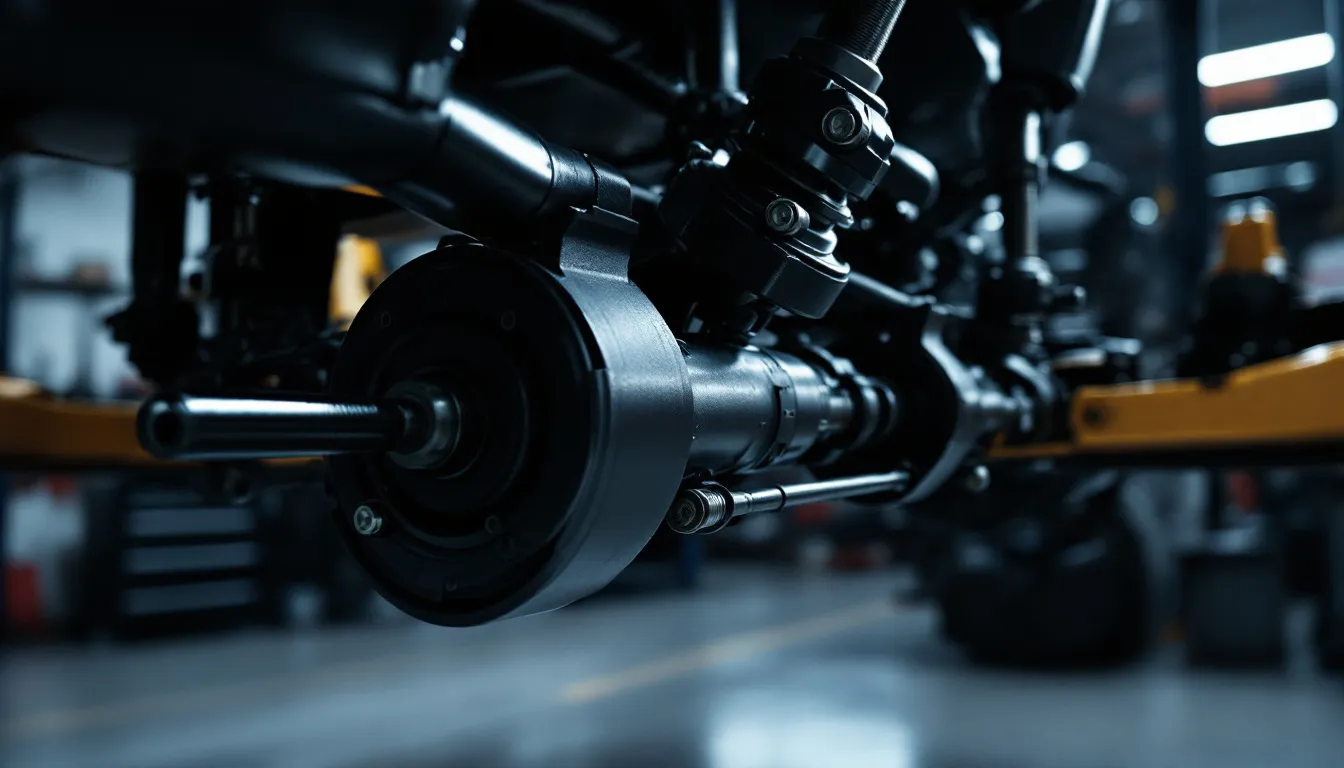
Death wobble is a violent, high-frequency oscillation of the front axle that causes the steering wheel and entire front end of your Jeep JK to shake uncontrollably, typically triggered by hitting a bump or expansion joint at highway speed. The jeep death wobble fix is not a steering stabilizer swap — replacing the worn mechanical component causing the oscillation is the only permanent solution. A new stabilizer may reduce the intensity temporarily, but the wobble will return until the root cause is addressed.
This article covers exactly what causes death wobble on the JK, how to find the worn part, which replacement components the community trusts, and what it will cost you.
One terminology note before diving in: many owners use “death wobble,” “death shake,” and “death rattle” interchangeably. These are all describing the same phenomenon — axle oscillation that feeds back through the steering. Don’t let the different names send you chasing different fixes; it’s the same problem.
For background on the JK platform generally, the JK buyers guide is a solid starting point. If a lift is already in your plans, check suspension lift kits for the JK — geometry changes from a lift directly increase death wobble risk.
What Is Death Wobble — and Is It Dangerous?
Yes, death wobble is dangerous. At highway speeds, the front end of your JK can shake so violently that you temporarily lose directional control. It is not a vague shimmy you can ignore. Owners report the steering wheel oscillating so severely it’s nearly impossible to grip, lasting anywhere from a few seconds to tens of seconds before the vehicle settles — or doesn’t.
When you hit that expansion joint at 65 mph, the front axle begins oscillating left and right at a frequency that the worn components can no longer dampen. The steering geometry feeds that movement back into the wheel, amplifying rather than absorbing it. The correct instinct is to ease off the throttle and reduce speed gradually — braking hard can make it worse.
The core danger is loss of steering control at speed. This is not a performance nuisance. It’s a safety event. Owners who experience death wobble consistently report pulling over as soon as it’s safe to do so, because maintaining lane position is genuinely difficult during an episode.
The JK’s solid front axle design makes it inherently more susceptible than independent front suspension vehicles. When one component in the steering or suspension system develops play, the entire axle can resonate freely. Death wobble has been reported across multiple Jeep generations — TJ, JK, JL, XJ, and even the Gladiator — which tells you this is a structural tendency of solid-axle geometry, not a defect unique to one production run.
It is dangerous. Treat it as such, and get it diagnosed before the next highway run.
Get new guides by email
One email when we publish something worth reading. Unsubscribe anytime.
Symptoms of Death Wobble: What You’ll Feel
The clearest sign of death wobble is a violent, whole-front-end oscillation triggered by a specific event — a bump, pothole, or expansion joint — rather than a speed that simply makes the vehicle vibrate.
The key differentiator: death wobble is event-triggered, not speed-dependent. This separates it from general front-end vibration caused by wheel balance or tyre issues, which typically appears at a specific speed range and smooths out above or below it.
Classic death wobble symptoms include:
- Violent, uncontrollable steering wheel shake starting suddenly after hitting a bump at highway speed (typically 45–75 mph)
- Full front-end oscillation — not just the wheel, but the whole axle shaking side to side
- Temporary recovery when you slow down significantly, only for the wobble to return if you hit another bump at speed
- Clunking or looseness felt in the steering at lower speeds — a sign of play in a component before full wobble sets in
- Pulling or wandering on straight roads, suggesting steering geometry is already compromised
Owners report that general front-end vibration (from out-of-balance tyres or a bent wheel) feels entirely different — smoother, more rhythmic, and speed-dependent. Death wobble is abrupt, violent, and frightening. If you’re unsure which you have, the event-triggered vs. speed-dependent test is your diagnostic starting point.
What Causes Death Wobble in a Jeep JK?
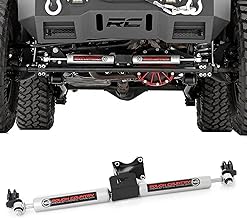
Death wobble results from excessive play in one or more front suspension or steering components that allows the axle to oscillate freely once a road input starts the resonance cycle. The track bar and its mounting hardware are the most commonly reported culprits, but rarely the only worn part by the time the wobble appears.
Community experience across JK forums and owner groups consistently points to these causes:
- Worn or loose track bar — the single most reported cause; a track bar with worn bushings or a loose frame-side bolt allows lateral axle movement that starts the oscillation cycle
- Worn tie rod ends — when the ball-and-socket joints develop play, steering inputs amplify rather than damp the wobble
- Worn ball joints — upper and lower ball joints carry the entire load of the front axle; worn joints introduce play into the knuckle pivot
- Loose or worn track bar bracket — the frame-side bracket can crack or the mounting hole can egg out, introducing play even with a new track bar
- Worn upper or lower control arm bushings — control arms locate the axle fore-and-aft; worn bushings let the axle move in ways it shouldn’t
- Worn drag link or drag link ends — connects the steering box to the passenger-side knuckle; play here feeds directly into wobble
- Out-of-balance or oversized tyres — provides the initial excitation energy; owners running larger tyres on stock suspension report significantly higher wobble frequency
- Loose wheel bearing — a loose bearing allows axle movement that can initiate or worsen the cycle
- Improper caster angle — particularly relevant after a lift; incorrect caster creates an unstable steering return that makes wobble harder to damp
Has there been an official recall for death wobble? As of writing, no official NHTSA recall has been issued specifically for death wobble on the JK. NHTSA received numerous complaints over the years, and Jeep issued a Technical Service Bulletin (TSB) covering steering pull and shimmy, but a mandatory recall never followed. Many owners found this frustrating given the safety implications.
Does the upper control arm cause death wobble? Yes, it can contribute. The upper control arms set caster angle. Worn upper control arm bushings introduce play into axle location. After a lift, stock upper control arms leave caster at a negative angle that makes the steering geometry unstable — a known contributor to wobble on lifted JKs. Adjustable upper control arms are a standard recommendation for any JK running more than 2 inches of lift, precisely because of this relationship.
Running larger tires on a JK adds rotational mass that amplifies any existing play. And lift kit geometry changes directly affect caster, making proper control arm geometry essential after any lift installation.
Which model years are most affected? Community reports suggest the JK in all years (2007–2018) is susceptible, with higher complaint volumes from 2007–2012 models as they age and components wear. That said, death wobble is not a production defect limited to specific build dates — it is a wear-driven condition that can appear on any year once components degrade.
How to Diagnose Death Wobble: A Step-by-Step Check
You can narrow the culprit down significantly before spending a cent on parts. The track bar check is the most important step. Start there, then work through the rest of the steering and suspension systematically.
Raise the front end safely on jack stands with both front wheels off the ground. Work through these steps in order:
-
Check the track bar first. Grab the track bar with both hands and try to move it in every direction — up, down, left, right, and rotationally. Any movement at all is unacceptable. Next, check the frame-side bolt; it should be torqued to spec (around 55 ft-lb for the OEM bolt) and the bracket should show no cracks. This is your highest-probability culprit.
-
Check the tie rod ends. Have a helper turn the steering wheel slightly while you watch each tie rod end. You are looking for any delay between the steering input and the tie rod movement — that delay is play in the joint. Grab each end and try to move it by hand. A good tie rod end has zero slop.
-
Check the drag link ends. Same method as the tie rod — look for play at both the pitman arm end and the knuckle end. Worn drag link ends are frequently found alongside worn tie rod ends.
-
Check the ball joints. Use a pry bar under the tyre and lever upward while watching the upper and lower ball joints. Any visible movement in the joint itself (not the tyre flexing) means the joint needs replacement. Upper ball joints on the JK are known to wear faster than lower ones.
-
Check the control arm bushings. Grab each control arm and try to move it in its pivot axis. Worn rubber bushings allow visible deflection. Upper control arm bushings in particular are worth scrutinising if the JK has been lifted.
-
Check wheel bearing play. Grab the top and bottom of the tyre (12 and 6 o’clock) and rock it. Any movement indicates a worn bearing. Then try 9 and 3 o’clock — movement there points to ball joints or tie rod ends rather than bearings.
-
Check tyre balance and condition. Spin each tyre by hand and look for wobble in the wheel or tyre itself. Even a small imbalance provides the excitation energy that starts the wobble cycle, so fix this alongside any mechanical repair.
Document every component that shows play. In most cases, owners find more than one worn part — which is why fixing just one and declaring victory often leads to a return of the wobble within months.
What Actually Fixes Death Wobble (Permanent Solutions)
The permanent jeep death wobble fix requires replacing every component that shows play — not masking the symptom with a steering stabilizer. Owners who replaced both tie rod ends and the track bar in one session report significantly better outcomes than those who replaced parts one at a time and re-tested.
Here are the components that actually resolve death wobble, in order of diagnostic priority:
- Track bar and/or track bar bracket — replace the bar and inspect the bracket; if the mounting hole is elongated, the bracket needs replacement or reinforcement too
- Tie rod ends — replace as a set; mixing old and new tie rod ends leaves residual play in the system
- Drag link ends — often worn alongside tie rod ends; replace simultaneously
- Ball joints — upper and lower; DV8 offers a full set covering 2007–2018 at a price point that makes doing all four at once financially sensible
- Upper control arms — particularly on lifted JKs; adjustable upper control arms restore correct caster angle and eliminate worn OEM bushings in one step
- Wheel bearing hubs — if bearing play was detected during diagnosis, address this at the same time
For tie rod replacement, the MOOG DS300043 is a well-regarded option in the community — note it covers 2007–2017, so 2018 JK owners will need to verify fitment or source an alternative.

For ball joints, DV8’s front upper and lower set for 2007–2018 replaces all four joints and is built to handle the stress of off-road use that accelerates OEM wear.

If the JK has any lift installed, adjustable front upper and lower control arms are not optional — they are part of the fix. Owners who corrected caster with adjustable arms alongside their mechanical repairs report more stable steering on return to highway speeds.

A steering stabilizer does not fix the root cause. It can reduce the severity of wobble temporarily, but as the worn components continue to degrade, the stabilizer loses its ability to mask the problem entirely. See the next section for a full breakdown of what stabilizers actually do. For a broader view of suspension upgrades by budget, that guide covers prioritisation across the full JK platform.
Steering Stabilizer and Death Wobble: What It Does (and Doesn’t Do)
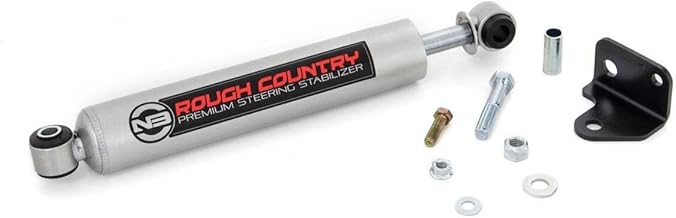
A steering stabilizer is a shock absorber mounted across the steering linkage — it dampens unwanted steering movement, but it does not repair worn joints, loose brackets, or incorrect geometry. This distinction matters enormously, because replacing a stabilizer is the most common first response to death wobble and the most common reason wobble returns.
A stabilizer masks the symptom. It does not fix the root cause.
Owners report short-term improvement after a stabilizer upgrade, sometimes for thousands of miles — particularly if the worn component is only mildly degraded and the new stabilizer has significantly more damping than the OEM unit. But as the worn component continues to wear, the wobble returns, usually worse than before. At that point, another stabilizer upgrade offers diminishing returns.
Here’s how the stabilizer progression typically plays out in the JK community:
- OEM replacement (~$39.95): The Rough Country RC11318 is a direct OEM swap — same dimensions, same function. Appropriate when the OEM unit is physically damaged or leaking, not as a death wobble fix.

- Upgraded single N3 stabilizer (~$79.95): The Rough Country N3 (8730630) offers more damping than OEM and is a reasonable upgrade for a JK with no death wobble history — good preventive maintenance or a mild improvement in steering feel.
- Dual N3 stabilizer (~$149.95): The Rough Country dual setup (8734930) adds a second stabilizer on the opposite side of the linkage. It provides noticeably more damping and is popular with lifted JKs running larger tyres. It still does not fix worn components.
- N3 conversion kit (~$49.95): The Rough Country 8731830 converts an OEM-style single mount to accept an upgraded N3 unit. Useful when the existing mount geometry doesn’t suit a direct N3 swap.

The correct use of a stabilizer: fit it after the mechanical repairs are done, as part of restoring the steering system to full health. A good stabilizer on a tight front end is a genuine improvement. A good stabilizer on a worn front end is a temporary mask.
Best Parts to Fix Jeep JK Death Wobble: Our Top Picks
Choosing the right parts starts with knowing which component failed — but since death wobble rarely involves just one culprit, here are the seven most useful products for a full JK death wobble repair, covering everything from tie rod ends to stabilizer upgrades.
Lead with the mechanical fix first, then consider the stabilizer as a finishing touch.
Best Overall: MOOG DS300043 Steering Tie Rod End
Best For: Owners whose diagnosis points to tie rod play as the primary or contributing cause — fits 2007–2017 JK (verify before ordering for 2018).
On Amazon and eBay
MOOG DS300043 Steering Tie Rod End for 2007-2017 Jeep
Check price on Amazon → See new and used on eBay →
See all current listingsPaid links. We may earn a commission from Amazon or eBay. Prices can change.
Key specs:
- Fits: 2007–2017 Jeep Wrangler JK and JKU
- Material: Forged steel with grease fitting
- Includes: Inner and outer tie rod ends
Pros:
- MOOG is a well-established name in OEM-quality steering components
- Grease fitting allows ongoing maintenance
- Addresses the root cause, not the symptom
Cons:
- Does not cover 2018 JK — confirm fitment carefully
- Tie rod alone may not fully resolve wobble if other components also have play
Check current reviews on Amazon before purchasing.
Best OEM Replacement Stabilizer: Rough Country RC11318
Best For: Owners replacing a physically failed OEM stabilizer, or as the final step after mechanical repairs are complete.
On Amazon and eBay
Rough Country OE Replacement Stabilizer for 07-18 Jeep
Check price on Amazon → See new and used on eBay →
See all current listingsPaid links. We may earn a commission from Amazon or eBay. Prices can change.
Key specs:
- Fits: 2007–2018 Jeep Wrangler JK
- Direct OEM replacement dimensions
Pros:
- Very affordable entry point
- Correct fitment for all JK years
- Good choice post-repair to restore OEM steering feel
Cons:
- OEM-equivalent damping only — not an upgrade
- Will not mask significant wobble from worn components
Best Upgraded Stabilizer: Rough Country N3 (8730630)
Best For: JK owners who have addressed mechanical wear and want improved steering feel, especially on slightly lifted builds.
On Amazon and eBay
Rough Country N3 Steering Stabilizer for 2007-2018 Jeep
Check price on Amazon → See new and used on eBay →
See all current listingsPaid links. We may earn a commission from Amazon or eBay. Prices can change.
Key specs:
- Fits: 2007–2018 Jeep Wrangler JK
- N3 nitrogen-charged monotube design
Pros:
- Noticeably more damping than OEM
- Good value for a post-repair steering upgrade
- Widely available and straightforward to install
Cons:
- Still a stabilizer — does not fix worn joints or loose track bar
- Owners report short-term improvement on worn front ends, but wobble returns
Best Dual Stabilizer Setup: Rough Country N3 Dual (8734930)
Best For: Lifted JKs running larger tyres where a single stabilizer isn’t enough to manage steering feedback.
On Amazon and eBay
Rough Country N3 Dual Steering Stabilizer for 07-18 Jeep
Check price on Amazon → See new and used on eBay →
See all current listingsPaid links. We may earn a commission from Amazon or eBay. Prices can change.
Key specs:
- Fits: 2007–2018 Jeep Wrangler JK
- Dual N3 setup with bracket hardware included
Pros:
- Maximum damping in the Rough Country stabilizer range
- Good for high-stress builds post-repair
- Addresses steering feedback from tyre size, not just component wear
Cons:
- Most expensive stabilizer option
- Still symptom management if mechanical wear hasn’t been addressed
Best Ball Joint Set: DV8 Front Upper & Lower Ball Joints
Best For: Any JK with diagnosed ball joint play, or as a proactive replacement on high-mileage builds planning a lift.
On Amazon and eBay
DV8 Ball Joints for Jeep Wrangler JK 2007-2018
Check price on Amazon → See new and used on eBay →
See all current listingsPaid links. We may earn a commission from Amazon or eBay. Prices can change.
Key specs:
- Fits: 2007–2018 Jeep Wrangler JK
- Includes: Front upper and lower ball joints (full set)
Pros:
- Covers all four ball joints in one purchase
- 2007–2018 coverage includes the full JK production run
- Heavier-duty construction than OEM for off-road use
Cons:
- Higher upfront cost (offset by replacing all four at once)
- Press-in installation typically requires a shop press
Best Control Arms: Adjustable Front Upper & Lower Control Arms
Best For: Lifted JKs (0–4.5 inches) where caster correction is needed alongside the mechanical repair.
On Amazon and eBay
Adjustable Front Upper & Lower Control Arms for 2007-2018
Check price on Amazon → See new and used on eBay →
See all current listingsPaid links. We may earn a commission from Amazon or eBay. Prices can change.
Key specs:
- Fits: 2007–2018 Jeep Wrangler JK
- Adjustable for 0–4.5 inch lift geometry correction
- Heavy-duty construction
Pros:
- Corrects caster angle that stock arms can’t achieve after a lift
- Eliminates worn OEM bushings at the same time
- Addresses a root cause of wobble on lifted builds specifically
Cons:
- Not necessary on stock-height builds with no caster issues
- Requires alignment after installation
Best Stabilizer Conversion: Rough Country N3 Conversion Kit (8731830)
Best For: Owners whose OEM stabilizer mount geometry doesn’t suit a direct N3 swap.
On Amazon and eBay
Rough Country N3 Steering Stabilizer Conversion Kit for
Check price on Amazon → See new and used on eBay →
See all current listingsPaid links. We may earn a commission from Amazon or eBay. Prices can change.
Key specs:
- Fits: 2007–2018 Jeep JK
- Converts OEM mount to N3-compatible
Pros:
- Budget-friendly path to an upgraded stabilizer
- Useful when the OEM mount configuration limits direct swap options
Cons:
- Stabilizer still doesn’t fix mechanical wear
- Narrower application than the full N3 kit
For context on how these costs fit into a broader build, the full JK mod budget guide is worth reading alongside this.
Death Wobble Fix: Parts Comparison at a Glance
Not sure which part addresses your specific problem? This table puts all seven products side by side so you can match the fix to the diagnosed failure.
| Part | What It Fixes | Price | Fits | Best For |
|---|---|---|---|---|
| MOOG DS300043 Tie Rod End | Tie rod play (root cause) | ~$139.78 | 2007–2017 only | Primary mechanical fix for tie rod wear |
| Rough Country RC11318 Stabilizer | OEM stabilizer wear/damage | ~$39.95 | 2007–2018 | Post-repair OEM replacement |
| Rough Country N3 Stabilizer | Steering feel / mild damping upgrade | ~$79.95 | 2007–2018 | Upgrade after mechanical repairs done |
| Rough Country N3 Dual Stabilizer | High-load steering feedback | ~$149.95 | 2007–2018 | Lifted builds with larger tyres |
| DV8 Ball Joints (Upper & Lower) | Ball joint play (root cause) | ~$219.99 | 2007–2018 | Full ball joint renewal |
| Adjustable Control Arms | Caster angle / bushing wear (root cause) | ~$179.99 | 2007–2018 | Lifted JKs needing geometry correction |
| Rough Country N3 Conversion Kit | Stabilizer mount compatibility | ~$49.95 | 2007–2018 | Converting to N3 on incompatible mounts |
Note on MOOG fitment: The MOOG DS300043 is verified for 2007–2017. If your JK is a 2018, confirm fitment with the seller before ordering.
Owners who address two or more root causes simultaneously (track bar, tie rod ends, and ball joints in a single session, for example) report more durable results than those who replace parts incrementally.
How Much Does It Cost to Fix Death Wobble on a Jeep JK?
Fixing death wobble costs between roughly $140 and $700 in parts alone, depending on how many components need replacement. Add labour if you’re not doing it yourself, and owner reports suggest shop costs of $200–$500 on top of parts — though labour rates vary considerably by region.
Here’s a realistic cost breakdown based on the parts in this guide:
- Tie rod ends (MOOG): ~$140
- Ball joints, full set (DV8): ~$220
- Adjustable control arms: ~$180
- Upgraded stabilizer (Rough Country N3): ~$80
- Track bar (not covered in this guide — budget ~$80–$200 depending on brand)
- Alignment after control arm or track bar work: ~$80–$150 (non-negotiable after any steering geometry change)
- Estimated DIY total (parts + alignment): $400–$850 depending on what needs replacement
- Estimated shop total (parts + labour + alignment): $600–$1,400
Is it worth it? Yes — unambiguously. The alternative is driving a vehicle with a known propensity for sudden loss of steering control at highway speed. Owner reports consistently frame the cost of fixing death wobble as insignificant relative to the risk of leaving it unaddressed. A complete front-end rebuild that eliminates the wobble permanently is a better investment than incremental stabilizer upgrades that mask it temporarily.
If you’re evaluating a used JK with a known death wobble history, factor these costs into your offer. The what to check when buying a used JK guide covers this in detail.
How to Prevent Death Wobble: Maintenance Habits That Matter
Death wobble is almost always a wear-driven condition — which means regular inspection catches the contributing factors before they reach the threshold where wobble occurs. The fix is mechanical, but the prevention is a maintenance schedule.
Many owners report that the first death wobble episode is what finally puts a front-suspension inspection schedule on the calendar. Don’t wait for the wobble to tell you something is wrong.
Maintenance habits that prevent death wobble:
- Inspect steering and suspension components every 20,000–25,000 km — check the track bar, tie rod ends, drag link ends, and ball joints for play using the same hands-on method described in the diagnosis section
- Re-torque the track bar frame bolt after any off-road use or rough road exposure — vibration loosens it over time
- Keep tyres balanced and in good condition — out-of-balance tyres provide the excitation energy that starts the resonance cycle; a tyre rotation and balance every 10,000 km is cheap insurance
- Get a wheel alignment check after any lift work or suspension component replacement — incorrect caster is a known wobble contributor that an alignment catches
- Replace worn components in sets — if one tie rod end is worn, the other has seen the same mileage; replace both
- Avoid running oversized tyres on stock suspension geometry — the added rotational mass amplifies any existing play significantly
If you’re buying a used JK, make front-suspension inspection part of your pre-purchase inspection checklist before money changes hands. And if larger tyres are on your radar, understanding how bigger tyres affect your JK’s front end will help you plan the supporting upgrades that keep wobble at bay.
Frequently Asked Questions: Jeep JK Death Wobble
Here are direct answers to the most common questions about JK death wobble, in schema-ready Q&A format.
Q: What is the cost to fix death wobble in a Jeep?
A: Parts alone typically run $140–$700, depending on how many components need replacement. Add $200–$500 in labour if you’re using a shop, plus $80–$150 for a wheel alignment after any geometry-related repair. Owner reports suggest a full DIY rebuild including alignment comes in at $400–$850.
Q: Which model years of Jeep Wrangler are most affected by death wobble?
A: All JK model years (2007–2018) are susceptible, with higher complaint volumes associated with older, higher-mileage examples (particularly 2007–2012 builds). Death wobble is a wear-driven condition, not a specific production defect — any year can develop it as components age. It has also been reported across the TJ, JL, XJ, and Gladiator platforms, confirming it’s a solid-axle geometry tendency rather than a JK-specific flaw.
Q: Has there been an official recall issued for death wobble?
A: As of writing, no official NHTSA recall has been issued specifically for death wobble on the Jeep Wrangler JK. Jeep issued a Technical Service Bulletin (TSB) covering shimmy and steering pull, but a mandatory recall did not follow despite significant volumes of owner complaints filed with NHTSA.
Q: How can death wobble be prevented?
A: Regular inspection of steering and suspension components is the primary prevention. Check the track bar, tie rod ends, drag link, and ball joints for play every 20,000–25,000 km. Keep tyres balanced, re-torque the track bar bolt periodically, and avoid running oversized tyres on worn or stock geometry. Get an alignment after any lift or suspension work.
Q: What causes death wobble in Jeeps?
A: Death wobble is caused by excessive play in one or more front steering or suspension components that allows the axle to resonate freely after a road input. The most common culprits are the track bar and its bushings, tie rod ends, ball joints, and drag link ends. Incorrect caster angle after a lift compounds the problem significantly.
Q: How do you fix death wobble?
A: Fix death wobble by identifying and replacing every component that shows play during a hands-on suspension inspection. Start with the track bar, then check tie rod ends, drag link, ball joints, and control arm bushings. Replace worn parts as a set. Have a wheel alignment done after any geometry-related repair. A steering stabilizer alone does not fix it.
Q: Is death wobble dangerous?
A: Yes — death wobble causes sudden, violent loss of steering control at highway speed and should be treated as an urgent safety issue. Owners report being unable to maintain lane position during a wobble episode. The correct response is to ease off the throttle and reduce speed gradually; hard braking can worsen the oscillation. Do not continue highway driving with a known death wobble condition.
Q: What are the symptoms of death wobble?
A: The defining symptom is a violent, event-triggered shaking of the entire front end that starts suddenly after hitting a bump or expansion joint at highway speed. The steering wheel oscillates severely, the whole axle shakes, and the vehicle may pull unpredictably. It differs from normal vibration in being event-triggered rather than speed-dependent.
Q: Are there kits available to fix death wobble?
A: Yes — several brands offer steering and suspension rebuild kits for the JK that address multiple components simultaneously. A kit covering tie rod ends, drag link ends, and ball joints addresses the most common culprits in one purchase. For lifted JKs, adding adjustable control arms to the kit corrects caster angle as part of the same repair. See the JK mods by budget guide for broader context on building a repair or upgrade plan.
Q: Does the upper control arm play a role in death wobble?
A: Yes — the upper control arm sets caster angle, and incorrect caster (particularly after a lift) is a known contributor to death wobble. Worn upper control arm bushings also introduce play into axle location. Adjustable upper control arms are a standard fix for lifted JKs, both to restore correct caster and to replace worn OEM bushings. On stock-height builds, control arm bushings are still worth inspecting if other components show wear. The JK buyers guide covers how to evaluate a JK’s suspension history before purchase.
The Bottom Line on Jeep JK Death Wobble
Death wobble is a mechanical problem that requires a mechanical fix — find the worn component, replace it, and the wobble stops. No stabilizer upgrade changes that equation.
Here’s the fix process in brief:
- Diagnose first: Hands-on inspection of the track bar, tie rod ends, drag link, ball joints, and control arm bushings before spending money on parts
- Replace what’s worn — all of it: Partial repairs leave residual play; complete the job in one session where possible
- Correct caster if lifted: Adjustable control arms are part of the fix for any JK running more than 2 inches of lift
- Finish with a stabilizer and alignment: A good stabilizer on a tight front end is a genuine improvement; get an alignment after any geometry change
Your JK is fixable. Death wobble sounds alarming — and it is — but it responds reliably to proper diagnosis and component replacement. Owners who addressed every worn part in a single repair session consistently report clean, stable highway driving on the other side.
For further build planning, suspension lift options for the JK covers lift-specific geometry considerations, and undercarriage protection for trail use is worth reviewing before the next off-road run.
Free: JK Fluids at a Glance
Every fluid, spec and capacity for the 2007-2018 Wrangler JK on one page, plus a cut-out glovebox card. Checked against the owner's manuals. From the JK Service Kit.
Email me the download and new guides when they are published. Unsubscribe anytime. Privacy Policy.
Allan
I'm Allan. I own a 2014 Jeep Wrangler JKU and I research the hell out of every mod before I touch it. When I've fitted something to my own Jeep, I say so. Everything else is researched from manufacturer specs and other owners' reports. No sponsored fluff.
Learn more about me →Free: JK Fluids at a Glance
Every fluid, spec and capacity for the 2007-2018 JK on one page, plus a glovebox card.
Email me the download and new guides when they are published. Unsubscribe anytime. Privacy Policy.
Related Articles

Best Sway Bar Disconnect for Jeep JK: Maximize Articulation
Find the best sway bar disconnect for your Jeep JK. Compare JKS Quicker Disconnect, Teraflex, and electronic options for maximum flex on the trail.

Do You Need Adjustable Control Arms on a Lifted Jeep JK?
When a lifted Jeep JK needs adjustable control arms, what caster and geometry they correct, and how to set them up.

Why Does My Jeep JK Wander? When a Track Bar Upgrade Fixes It
Why a lifted Jeep JK wanders, how to tell a worn track bar from other causes, and when an adjustable track bar upgrade actually fixes it.