2018 Jeep JK Maintenance Schedule PDF
2018 Jeep JK Maintenance Schedule PDF
Every used Jeep has a story. Mine had a few it hadn’t finished telling yet.
The radiator was done—swapped it out clean. Then came the AC. We found out it wasn’t working properly on a drive up to the Cederberg in 112°F heat, with our two-month-old baby boy in the back seat. Not ideal. Got that sorted the moment we got home.
Then came the big one: the cylinder heads. The 3.6L Pentastar’s heads were warped—a known issue on this generation. Rather than skimming them again, we sourced brand new replacement heads. It’s done right, or it’s done twice.
None of this was glamorous. But it’s the foundation. You can’t put 35” mud tyres on a Jeep with blown head gaskets and call it an overland rig. Mechanical integrity before cosmetic ambition. That philosophy runs through everything on this site—and it’s exactly why staying on top of a 2018 Jeep JK maintenance schedule matters more than any suspension upgrade or exterior mod ever will.
Disclosure: JeepJK Guide earns a commission on qualifying purchases made through links in this article, at no extra cost to you.
What Is the 2018 Jeep JK Maintenance Schedule?
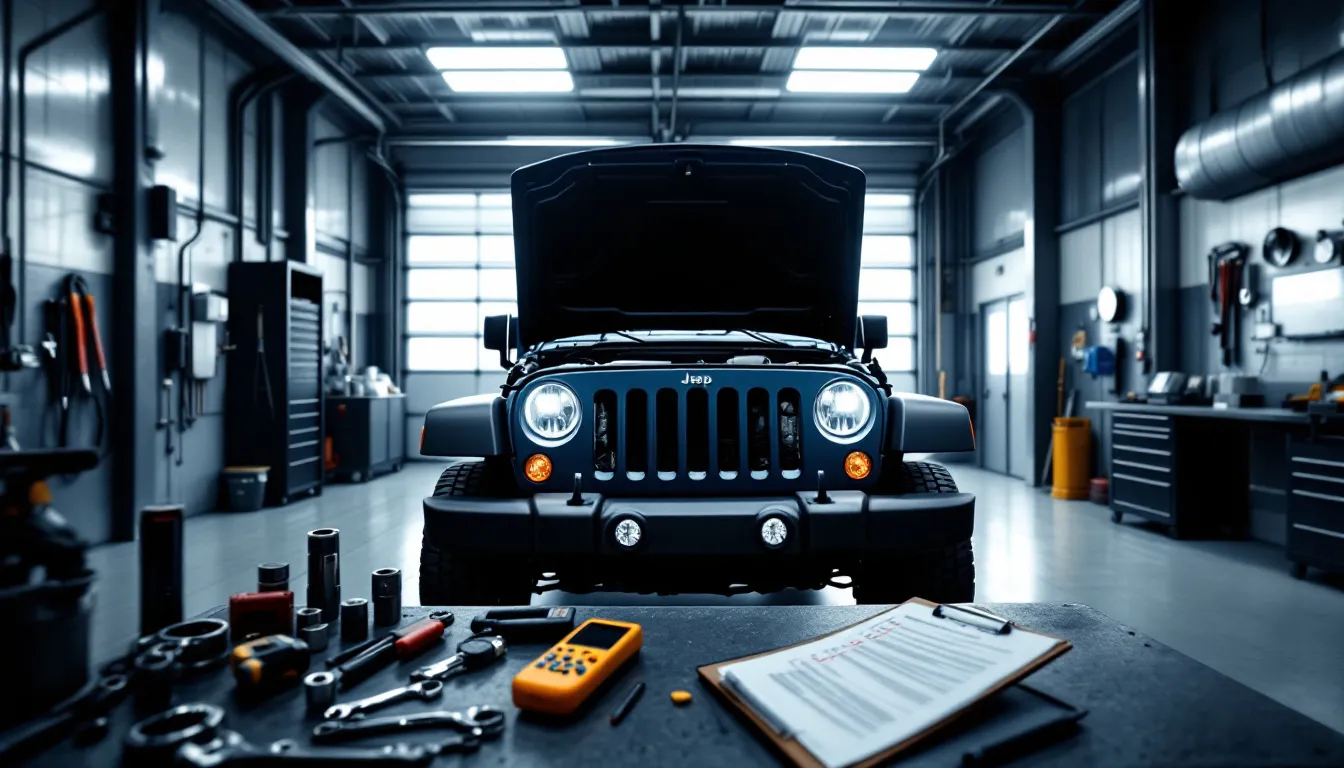
The 2018 Jeep JK maintenance schedule is a mileage-based service plan covering oil changes, fluid swaps, tire rotations, brake inspections, and drivetrain service at intervals from 3,000 to 100,000 miles. If you’re looking for a printable version, the core milestones are straightforward: 3,000–5,000 miles for oil, 7,500 miles for tire rotation and brakes, 15,000 miles for air filter and suspension checks, then 30,000, 60,000, and 100,000-mile services that focus on spark plugs, transfer case fluid, differentials, and transmission work.
For off-road use, shorten most intervals by 25–30%. The 2018 model year is the final JK production year, so parts availability is excellent and OEM specs are well-documented.
Get new guides by email
One email when we publish something worth reading. Unsubscribe anytime.
2018 Jeep JK Maintenance Schedule: Service Intervals at a Glance
The full 2018 Jeep JK service schedule runs from a 3,000-mile oil change through a 100,000-mile drivetrain refresh. Every interval below applies to both the two-door JK and the four-door JKU unless otherwise noted—the longer JKU wheelbase does not change fluid specs, but the heavier curb weight makes brake inspections slightly more critical.
The single most important callout: never skip the 60,000-mile differential fluid change, especially if the Jeep has seen water crossings.
| Service Interval (Miles) | Service Task | Fluid/Part Spec | Applies To |
|---|---|---|---|
| 3,000–5,000 | Engine oil & filter change | 5W-20 synthetic, 6 qts | All JK / JKU |
| 7,500 | Tire rotation | — | All JK / JKU |
| 7,500 | Brake inspection (pads & rotors) | — | All JK / JKU |
| 15,000 | Air filter inspect/replace | OEM or K&N-spec | All JK / JKU |
| 15,000 | Battery & charging system check | Group 34 / 78 battery | All JK / JKU |
| 15,000 | Suspension & track bar inspect | — | All JK / JKU |
| 30,000 | Spark plug replacement | Champion RC12YC or OEM equivalent | 3.8L V6 (2007–2011); 3.6L Pentastar (2012–2018) |
| 30,000 | Transfer case fluid | NV241 / NV241OR: ATF+4, 1.0 qt | All JK / JKU |
| 30,000 | Engine coolant inspect | OAT coolant (HOAT not compatible) | All JK / JKU |
| 45,000 | Brake fluid flush | DOT 3 or DOT 4 | All JK / JKU |
| 60,000 | Front & rear differential fluid | 80W-90 gear oil; Rubicon: 75W-140 synthetic | All JK / JKU |
| 60,000 | Transmission fluid (auto) | ATF+4, ~4 qts | 2007–2018 JK with 4-speed or 5-speed auto |
| 60,000 | Coolant full flush & refill | OAT coolant | All JK / JKU |
| 100,000 | Full drivetrain fluid refresh | All fluids above | All JK / JKU |
| 100,000 | Brake fluid flush (if not done at 45k) | DOT 3 or DOT 4 | All JK / JKU |
| Every 6 months | Inspect u-joints, steering linkage | — | Off-road use especially |
Use this table as your printable quick-reference. For a deeper breakdown of every interval, the complete JK maintenance schedule has model-year-specific notes for every service milestone.
Oil Changes and Fluid Specs for the 2018 Jeep JK
The 2018 Jeep JK takes 5W-20 full synthetic oil, approximately 6 quarts with filter, and the drain plug torque spec is 25 ft-lb—a detail that catches a lot of first-time DIYers off guard. I overtightened mine the first time. It’s such a small number that it feels wrong, but it exists for a reason.
The 3.6L Pentastar V6 in the 2018 JK runs clean and reliably, but it rewards consistent oil changes. Jeep’s recommended interval is 5,000 miles under normal driving conditions; drop that to 3,000–3,500 miles if you wheel regularly or drive in dusty environments. Running the Jeep on longer intervals than that, especially off-road, and you’re gambling with metal shavings.
Torque the drain plug to spec with a calibrated tool, not by feel. That $20 job becomes a much more expensive aluminum oil pan repair if you strip the threads. A torque wrench designed for precise fastener work takes the guessing out of it:

1/2 Inch Drive 90-Tooth Dual-Direction Micrometer Torque Wrench (40-300 ft-lb)
$150
Check Price on Amazon →Beyond engine oil, here are the other fluid specs you need to keep the 2018 JK running strong:
- Coolant: OAT (Organic Acid Technology) formula only. Do not mix HOAT—the 3.6L Pentastar is particular about this. Using the wrong coolant is one of the most common and costly mistakes on this engine.
- Brake fluid: DOT 3 minimum; DOT 4 is acceptable and preferred for upgraded brake systems.
- Transfer case (NV241): ATF+4, roughly 1.0 quart. Same fluid as the power steering system.
- Power steering fluid: ATF+4. The JK uses a hydraulic rack, and the fluid gets dirty over time.
Getting the oil filter off a 3.6L can be awkward—the filter sits at an angle and drips if you’re not careful. A swivel oil filter wrench makes the job dramatically cleaner and keeps oil off the engine bay:

Tires, Brakes, and Suspension: What to Inspect and When
Rotate your tires every 7,500 miles, inspect your brakes at the same interval, and check suspension components—specifically the track bar, ball joints, and tie rod ends—at every 15,000-mile service.
The 2018 JK rides on a solid front axle setup that is extremely capable off-road but sensitive to worn steering and suspension components on-road. Death wobble—a violent, high-frequency oscillation at highway speed—is the most serious consequence of neglected suspension maintenance, and it usually traces back to a worn track bar, loose track bar bracket bolts, or a failing ball joint.
I hit the death wobble at 95 km/h on the N1 highway near Beaufort West. If you haven’t experienced it, imagine the entire front axle violently oscillating side to side while you’re doing highway speed. The steering wheel rips itself out of your hands. Your first instinct is to brake—which makes it worse. I pulled over shaking. Literally shaking. My wife was in the passenger seat, baby in the back. That’s not a mechanical inconvenience—that’s a safety emergency.
The root cause turned out to be a worn track bar bushing combined with loose steering box bolts. I replaced the track bar entirely with an adjustable unit, torqued the steering box to spec, and added a heavy-duty steering stabilizer as insurance. Haven’t had a wobble since. That experience changed how I approach JK maintenance: I check the front end before every long trip now. Ball joints, track bar, steering linkage—it takes ten minutes and it could save your life.
A few specifics to act on at your regular intervals:
- Front brake pads: Most JK owners get 40,000–50,000 miles on OEM pads under street use; off-road and towing use cuts that significantly.
- Rear drums (base trims): Inspect at 15,000 miles; adjust or replace as needed.
- Wheel bearing play: Check during every tire rotation—grab the tire at 12 and 6 o’clock and wiggle. Any play means attention now, not later.
If you’re running larger rubber or considering an upgrade, the best 33-inch tires for the Jeep JK and the gear ratio guide for 35-inch and 37-inch tires are worth reading before your next service.
Spark Plugs, Air Filters, and Battery: The 30,000-Mile Checklist
At 30,000 miles, the 2018 Jeep JK needs new spark plugs, a fresh air filter if not already replaced, and a battery load test—three jobs you can knock out in a single afternoon with basic tools.
Spark plugs: The 3.6L Pentastar uses iridium-tipped plugs. For 2018 models, use NGK ILKAR7L11 or the OEM Mopar equivalent. Gap is pre-set from the factory on iridium plugs—do not re-gap iridium tips. Torque to 13 ft-lb. This is one of those jobs where patience and the right socket extensions matter. The passenger-side plugs on the JK are awkward to reach, and you need a combination of extensions and universal joints that most socket sets don’t include.
Air filter: Replace at 15,000–30,000 miles depending on environment. Desert or dusty off-road use? Inspect at every oil change. A clogged filter noticeably kills throttle response on the 3.6L, and it’s a five-minute fix that should never get deferred.
Battery: The 2018 JK takes a Group 34/78 battery. A healthy, fully charged battery reads 12.6V at rest. Anything under 12.4V warrants a load test; under 12.0V means replacement is likely overdue.
A quality digital multimeter is the right tool for battery checks and for diagnosing charging system issues:

Set the multimeter to DC voltage, touch the leads to the battery terminals, and read the resting voltage before the first start of the day. With the engine running, you should see 13.8–14.5V—that’s the alternator doing its job. Outside that range points to a charging system issue worth diagnosing before it leaves you stranded.
Essential Tools for DIY 2018 Jeep JK Maintenance
You don’t need a professional shop to maintain a 2018 JK—but you do need the right tools. I didn’t grow up wrenching on cars. Moving to Cape Town and buying a Jeep forced me to learn—partly out of interest, partly out of necessity. JK specialists are good, but they’re busy, and some jobs just aren’t worth paying shop rates for.
My first DIY job was an oil change. Sounds simple—it is simple—but I still managed to overtighten the drain plug the first time. Since then I’ve worked up to brake pads, fluid flushes, spark plugs, and basic suspension work. Each job taught me something about the JK platform. The brake caliper slides on the front axle are almost impossible to access without the right combination of extensions and universal joints. The spark plugs on the passenger side require patience.
Build your toolkit one job at a time, and start with these three core pieces:
Best Overall: 185-Piece Mechanics Hand Tool Set
A full SAE and metric socket set covering 1/4”, 3/8”, and 1/2” drive handles every fastener on the JK from drain plugs to suspension bolts. The 90-tooth ratchet is the detail that matters—more teeth means more usable swing arc in tight spaces like the JK’s engine bay.

185 Piece Mechanics Hand Tool Set - 1/4", 3/8", & 1/2" Drive | 90 Tooth | SAE & Metric
$129
Check Price on Amazon →For Precision Torquing: 1/2” Drive Torque Wrench (40–300 ft-lb)
Lug nuts (100 ft-lb), differential cover bolts, and wheel spacer hardware all need a calibrated torque wrench—not a breaker bar and a guess. The dual-direction 90-tooth design works equally well for tightening and for breaking stuck fasteners loose.
For Diagnostics: Bluetooth OBD2 Scanner
Between scheduled services, a Bluetooth OBD2 scanner lets you read and clear check engine codes, monitor live sensor data, and catch issues early—before they become expensive. It connects to your phone, works on any 1996+ vehicle including the full 2007–2018 JK range, and requires no subscription.

Bluetooth Pro OBDII Scan Tool for iPhone & Android - No Subscription Fee
$84.95
Check Price on Amazon →Adjusting the Schedule for Off-Road Use
If your 2018 JK sees regular off-road use—mud, water crossings, rock crawling, or dusty trail work—Jeep’s factory service intervals are a starting point, not a ceiling. Severe-duty use means cutting most fluid change intervals by 25–30% and inspecting suspension components twice as often.
Here’s what changes specifically:
- Engine oil: Move from 5,000 miles to 3,000–3,500 miles if you’re wheeling in dust or water.
- Differential fluids: Check for water contamination after every significant water crossing. A milky or thin fluid means a flush now, not at 60,000 miles.
- Air filter: Inspect after every dusty trip; replace when in doubt.
- U-joints and steering linkage: Check at every wash after off-road use.
In my experience, deferred maintenance on a working Jeep almost always leads to a larger repair bill. I learned that the hard way after facing a cascade of overdue services on a JK that had been used hard and maintained lightly. A $25 differential fluid change skipped twice became a much more significant axle service. Don’t be that person.
The trim level you’re running also matters. The Rubicon comes with locking differentials and a lower transfer case ratio, both of which see more stress per trail mile than a Sport or Sahara. Each drivetrain configuration demands slightly different attention—the Rubicon’s heavier-duty drivetrain can handle more abuse, but it needs more frequent fluid changes to do it reliably.
Frequently Asked Questions: 2018 Jeep JK Maintenance
Most 2018 JK owners have the same handful of questions: how often to change the oil, what fluids the Jeep needs, and whether there’s a free printable schedule they can keep in the glovebox. Here are direct answers to the questions we hear most.
Q: How often should I change the oil on a 2018 Jeep JK?
A: The 2018 Jeep JK with the 3.6L Pentastar V6 takes a 5W-20 full synthetic oil change every 5,000 miles under normal driving conditions. If you drive off-road regularly, tow frequently, or operate in dusty or extreme-temperature environments, shorten that to 3,000–3,500 miles. Always use the correct spec—5W-20—and torque the drain plug to 25 ft-lb.
Q: Is there a free PDF of the 2018 Jeep JK maintenance schedule?
A: Yes. The table in this article is formatted for easy printing or screenshot use, and the complete JK maintenance schedule PDF for all model years includes a downloadable version you can keep in the glovebox or shop.
Q: What fluids does a 2018 Jeep JK need?
A: The 2018 JK requires: 5W-20 full synthetic engine oil (6 qts with filter), OAT coolant (not HOAT), ATF+4 for the transfer case and power steering, 80W-90 gear oil for the front and rear differentials (75W-140 synthetic on the Rubicon), ATF+4 for the automatic transmission, and DOT 3 or DOT 4 brake fluid. Using the wrong coolant type is one of the most common and costly mistakes on the 3.6L Pentastar.
Q: Does the 2018 Jeep JK have a timing belt?
A: No. The 3.6L Pentastar V6 in the 2018 Jeep JK uses a timing chain, not a belt. Timing chains are designed to last the life of the engine under proper maintenance and do not require a scheduled replacement interval the way a belt does. Keep up with oil changes and the chain should not be a concern.
Q: How many miles will a 2018 Jeep JK last?
A: A well-maintained 2018 Jeep JK is commonly reported to reach 200,000 miles and beyond. The 3.6L Pentastar is a durable engine when given regular oil changes and coolant service. The weak links are typically rust on unprotected undercarriage components and deferred suspension maintenance rather than the engine or transmission. If you’re buying used, the JK Buyers Guide walks through exactly what to inspect.
Stay Ahead of Every Service Interval
Staying on top of the 2018 Jeep JK maintenance schedule comes down to three things: fresh fluids at the right intervals, proactive suspension inspection, and having the tools to handle both.
Fluids are the cheapest form of insurance on any JK—oil, differential, and coolant neglect account for most preventable mechanical failures on high-mileage examples. Suspension components, especially the track bar and ball joints, need eyes on them every 15,000 miles, more often if you wheel. And the right tools—a full socket set, a calibrated torque wrench, and an OBD2 scanner—let you catch problems between services before they escalate.
For everything in one place, the complete JK maintenance schedule PDF guide is the printable reference to keep in the glovebox. And if you’re building out your home shop, the essential tools for Jeep JK maintenance covers every tool worth owning for the full range of JK service jobs.
Mechanical integrity before cosmetic ambition. Get the fluids right, and the rest will follow.
Get the Free JK Build Planner
Complete PDF with mod checklists, gear ratios, tire sizing charts, and budget worksheets. Everything you need to plan your JK build.
No spam. Unsubscribe anytime. By subscribing, you agree to our Privacy Policy.
Allan
I'm Allan. I bought a 2014 Jeep Wrangler JKU and I research the hell out of every mod before I touch it. Everything here is tested or deeply researched on my own rig - no sponsored fluff, just honest findings.
Learn more about me →Get the JK Build Planner
Free PDF with complete build checklists, gear ratios, and tire fitment guides.
By subscribing, you agree to our Privacy Policy.
Related Articles
How to Winterize Your Jeep JK: Complete Fall Prep & Storage Guide
Affiliate disclosure: This article contains affiliate links. If you purchase through them, we may earn a commission at no extra cost to you.
Jeep JK Maintenance Schedule PDF: Complete Service Guide (All Years)
Complete JK maintenance schedule with intervals, fluid specs, and torque specs for 2007-2018 Wranglers. Severe duty intervals, DIY tips, and downloadable checklist.
2018 Jeep Wrangler JK Maintenance Schedule: Final Year Service Guide
Complete 2018 Jeep Wrangler JK maintenance schedule with severe service intervals, fluid specs, and cost breakdowns. Keep your final-year JK running strong.