Best Rock Sliders for Jeep JK: Top 7 Trail-Tested Options
Best Rock Sliders for Jeep JK: Top 7 Trail-Tested Options
Your JK’s rocker panels sit just inches from every rock, stump, and rut on the trail. Without proper protection, you’re one misaligned approach away from buckling sheet metal and expensive body repairs. Factory rockers are structural weak points—thin steel stretched over body mounts that corrode faster than you’d expect. I’ve learned to trust real trail damage reports over manufacturer marketing when evaluating protection systems.
The best rock sliders for Jeep JK combine frame-mounted strength with trail-proven geometry. You need protection that transfers impact loads to the frame, not the weak pinch seam. Rubicon models with factory rock rails offer a foundation to build on, while Sport and Sahara owners start from scratch. Before investing in sliders, understand your JK’s common body mount and rust issues—hidden corrosion makes any bolt-on armor system vulnerable.
We’ve ranked seven rock slider systems based on construction quality, mounting methodology, real-world clearance, and the critical difference between 2-door and 4-door fitment that catches too many buyers off guard.
Top 7 Rock Sliders for Jeep JK Ranked
#1: Barricade Off Road Rock Sliders (4-Door) – Best Overall Protection
The Barricade frame-mounted sliders deliver the highest impact resistance in this comparison. These aren’t decorative step bars—they’re 3-inch DOM steel tubing welded to mounting plates that bolt directly to the frame. The 4-door-specific design accounts for the 20.6-inch longer wheelbase of the JK Unlimited, distributing protection across eight mounting points instead of six.
Construction quality separates these from budget options. Continuous welds connect the tube to mounting brackets with no tack-weld shortcuts. The textured black powder coat survives rock scrapes better than glossy paint that chips on first contact. At approximately 85 pounds per side, you’ll feel the weight during installation, but that mass is what absorbs trail impacts without transferring shock to your body panels.
The integrated step provides functional access without the clearance penalty of full running boards. Step height sits 14 inches off the ground—high enough to avoid most trail obstacles while remaining usable for entry. This hybrid approach works for weekend wheelers who need both protection and practicality.
Expect professional installation to run 3-4 hours with frame access. DIY installers need jack stands, torque wrenches, and patience aligning heavy steel to factory holes. These sliders work with or without factory Rubicon rails, though you’ll remove any existing coverage for proper frame mounting.
#2: Quadratec QRC Rock Sliders (Rubicon 4-Door) – Best Rubicon Upgrade
Quadratec engineered these specifically to integrate with Rubicon factory rails rather than replace them. If you own a Rubicon versus Sport or Sahara, this matters—you’ve already got structural rails under the plastic cladding. The QRC system bolts over your existing protection, adding 2.5-inch tubular steel reinforcement that extends outward for better rock deflection.
The one-piece welded design eliminates weak points common in bolt-together systems. Single-side construction means you’re lifting 60-70 pounds of steel per side, but the weight indicates solid material thickness. Quadratec uses 0.120-inch wall tubing—noticeably thicker than the 0.095-inch walls on economy sliders that dent on first serious impact.
Installation on Rubicon models takes advantage of factory mounting points. You’re not drilling new holes or fishing for hidden frame rails. The bolt pattern aligns with existing threaded inserts, cutting installation time to 2-3 hours for experienced DIYers. Non-Rubicon owners can’t use this system—it’s Rubicon-specific by design.
Step functionality remains secondary to protection. The tube diameter creates a narrow stepping surface that works better as a debris deflector than daily entry assist. Serious rock crawlers prefer this compromise—wide flat steps catch on obstacles and reduce breakover angle.
#3: Hooke Road Rocker Guard (4-Door) – Best Budget Frame-Mount
Hooke Road delivers legitimate frame-mounted protection at a price point that undercuts competitors by $150-250. The tubular construction uses 3-inch diameter steel with mounting brackets that bolt through the frame—not the weak pinch seam. At this price, you’re getting functional armor that protects where it counts.
Build quality shows compromises that explain the cost savings. Welds are adequate but lack the aesthetic finish of premium sliders. Powder coating applies thinner than Barricade or Quadratec, meaning you’ll see wear sooner in high-abrasion areas. These cosmetic differences don’t affect core protection—the steel still deflects rocks away from your rocker panels.
The anti-slip step surface uses a diamond plate pattern that provides genuine traction. Step width measures wider than competition, making daily entry easier for passengers who aren’t wearing trail boots. This practical design works well for JKs that see mixed duty—weekend trails and weekday commutes.
Four-door-specific engineering accounts for the 116-inch wheelbase without the awkward mid-span flex you’ll see on universal-fit sliders. Six mounting points distribute load across the frame. Installation mirrors other frame-mount systems: expect 3-4 hours, two-person lift assistance, and standard hand tools plus a torque wrench for final tightening to 75 ft-lbs.
#4: Barricade Rock Sliders (2-Door) – Best 2-Door Protection
Two-door JKs need different slider geometry than Unlimited models. The 95.4-inch wheelbase changes impact angles and requires repositioned mounting points. Barricade’s 2-door sliders address this with six frame attachment points optimized for the shorter chassis—not just cropped 4-door versions.
Construction mirrors the 4-door Barricade system: 3-inch tubular steel, continuous welds, textured black powder coat. Weight per side drops to approximately 60 pounds due to shorter length. The reduced mass makes these more DIY-friendly for solo installation, though you’ll still want help aligning to frame holes.
Step integration sits slightly lower on 2-door models—around 13 inches ground clearance versus 14 on 4-door versions. This reflects the 2-door’s naturally better breakover angle and shorter wheelbase. You can afford marginally lower steps without dragging on trail obstacles.
The 2-door market gets less attention from armor manufacturers, making proven options valuable. These sliders work across 2007-2018 model years without the fitment variations that plague some universal systems. Check your JK model year changes for any production updates, though slider mounting remained consistent throughout the generation.
#5: Barricade Rubi Rails (2-Door) – Best Pinch Seam Protection
Rubi Rails take a different approach—pinch seam covers instead of frame-mounted sliders. These bolt to the body’s pinch seam (the folded metal lip where body panels meet) rather than extending to the frame. At 30 pounds per side, they’re significantly lighter than frame-mount systems and install in under 90 minutes.
The protection philosophy differs fundamentally. You’re covering the vulnerable pinch seam with 1/4-inch steel plate that prevents direct impacts from crushing the factory seam. However, severe side impacts transfer energy to the body rather than the frame. This works fine for trail rash and glancing blows but won’t save you from serious rock strikes the way frame-mounted sliders will.
Think of Rubi Rails as armor for the body damage you’ll get from brush, trail debris, and minor contact—not primary rock protection. They excel at preventing the door gap issues that develop when pinch seams bend. The direct bolt-on installation requires no frame access, making them ideal for DIYers without heavy-duty jack stands.
Two-door fitment means shorter coverage compared to 4-door models. Each rail measures approximately 60 inches versus 80-plus for Unlimited sliders. The step surface remains narrow—these aren’t running boards disguised as armor.
#6: Generic Heavy-Duty Rock Sliders (4-Door) – Best Entry-Level Option
This budget-friendly frame-mount system delivers basic protection for JK owners prioritizing function over brand names. The anti-slip step surface uses raised dimples rather than diamond plate, providing adequate traction without the weight penalty. At $177, you’re getting legitimate rock protection for less than the cost of a single body panel repair.
Construction uses lighter-gauge steel than premium sliders—you’ll notice flex under heavy impact that Barricade systems don’t show. The powder coat applies thinner and will chip sooner on serious trails. These trade-offs make sense at this price point. You’re protecting expensive body panels with steel that does the job, just not as elegantly as systems costing 2-3 times more.
Installation requires the same frame access and mounting approach as premium sliders. Four-door length demands proper spacing across mounting points—rushed installation creates stress points that accelerate wear. Budget 3-4 hours for careful alignment and torquing.
Weight per side runs approximately 55-60 pounds, making them lighter than Barricade but heavier than pinch seam covers. The textured black finish hides trail scratches better than you’d expect for economy powder coating. For JKs that see occasional trail use rather than weekly rock crawling, these deliver solid value.
#7: Kojem Door Armor Cladding (4-Door) – Best Minimalist Protection
Kojem’s skid plates represent the absolute minimum investment for rocker protection. These aren’t sliders or rails—they’re 1/8-inch powder-coated steel plates that bolt to the pinch seam and lower door frame. At 12 pounds per side, they install in under an hour with basic hand tools.
The protection level matches the price point. You’re getting coverage for trail brush, kicked-up gravel, and minor debris impacts. Serious rock contact will dent these plates, though they’ll still shield your body panels from the worst damage. Think of them as sacrificial armor that takes the hit instead of your expensive factory metal.
Four-door coverage extends along the rocker panel length without step functionality. The flat profile adds minimal width to your JK—useful for tight trail sections where wider sliders snag on obstacles. Ground clearance remains identical to stock since these mount flush against existing body lines.
Installation simplicity is the selling point. You’re bolting sheet metal to accessible mounting points—no frame access, no heavy lifting, no alignment struggles. The powder-coated steel finish accepts rattle-can touch-up paint when scratches inevitably appear. For budget-conscious buyers who need basic protection before attempting harder trails, these plates provide entry-level coverage while you save for frame-mounted sliders.
How to Choose Rock Sliders for Your JK
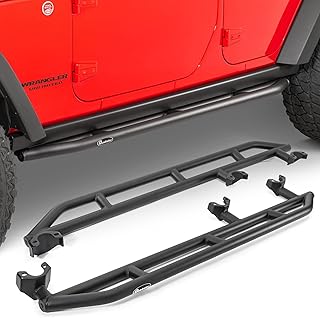
Selecting rock sliders requires matching mounting system to your specific wheeling intensity and budget. Three fundamental approaches offer different protection levels and complexity.
Frame-Mounted Sliders bolt directly to your JK’s frame rails through the body. These provide maximum protection by transferring impact loads to the strongest part of your chassis. Expect 3-inch tubular steel construction weighing 60-85 pounds per side. Frame-mount systems require accessing mounting points under the body—you’ll need jack stands and 3-4 hours installation time. Best for frequent wheelers who encounter legitimate rock obstacles. Your JK versus JL chassis differences matter here—JL frames use different mounting geometry that prevents crossover.
Pinch Seam Covers bolt to the body’s pinch seam where rocker panels fold under the vehicle. These lighter systems (25-35 pounds per side) install faster and cost less than frame mounts. Protection remains limited to the pinch seam area—severe impacts still transfer to body panels rather than frame. Best for trail-rated dirt roads and light rock gardens where you’re avoiding major contact. Rubicon factory equipment includes reinforced pinch seams that benefit from additional coverage.
Body-Mounted Plates represent minimum protection—thin steel sheets covering rocker panels against trail debris and brush. Installation takes under 90 minutes with basic tools. These won’t save you from rock strikes but prevent the constant dings and scratches that deteriorate resale value.
Material specifications reveal real protection capability. Look for 0.120-inch minimum wall thickness on tubular sliders—thinner walls dent permanently on first serious impact. DOM (drawn over mandrel) steel tubing offers superior strength over standard mild steel at similar weight. Mounting plate thickness should exceed 1/4-inch where brackets attach to frame.
Two-door versus four-door fitment isn’t negotiable—you must buy sliders designed for your specific wheelbase. Four-door JK Unlimited measures 116 inches between axle centers versus 95.4 inches for two-door models. That 20.6-inch difference changes mounting point locations and slider geometry. Universal-fit systems create stress points that crack welds or strip bolt holes.
Step functionality trades off against rock clearance. Flat step surfaces provide easier vehicle entry but extend 2-3 inches beyond tubular designs, increasing snag risk on trail obstacles. Narrow tube steps reduce breakover interference while offering minimal entry assistance. Decide which matters more for your usage—daily convenience or technical trail capability.
Installation Considerations
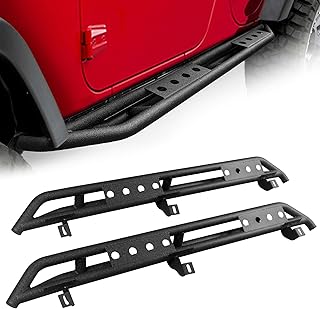
Rock slider installation demands proper frame access and realistic time expectations. You’re working under your JK with heavy steel components that require precise alignment to factory mounting holes. Budget 3-4 hours for frame-mounted systems, even with experience.
The physical challenge is real. Sliders weighing 60-85 pounds per side need two-person lifting to align with frame mounting points while you’re positioned under the vehicle. A second set of hands prevents dropped sliders and pinched fingers when locating bolt holes. Transmission jacks work better than floor jacks for supporting sliders during positioning—you can make fine adjustments without supporting full weight manually.
Frame access requires lifting your JK high enough to work comfortably underneath. Jack stands rated for 3-ton minimum provide safe support—never work under a vehicle supported only by hydraulic jacks. You’ll need 18-24 inches of clearance to reach mounting points near the frame rails. Before starting, inspect for rust around mounting locations. Hidden corrosion weakens bolt threads and compromises slider security. Your JK’s common rust issues concentrate exactly where sliders mount—body mounts, frame rails, and pinch seam areas.
Tool requirements include 3/8-inch drive socket set, torque wrench capable of 75 ft-lbs, thread locker, and anti-seize compound for mounting bolts. Some systems require drilling pilot holes—verify whether your chosen sliders need this before starting installation. Frame-mounted designs should torque to manufacturer specifications, typically 65-75 ft-lbs for main mounting bolts. Under-torquing allows movement that wallows out mounting holes. Over-torquing strips threads in the frame.
Expect fitment variation even with quality sliders. Factory tolerances and frame flex mean you’ll rarely achieve perfect alignment on first attempt. Loosely installing all mounting bolts before final torquing prevents binding. Check door operation after installation—improperly positioned sliders can interfere with door swing or create body panel contact.
Rock Slider FAQ
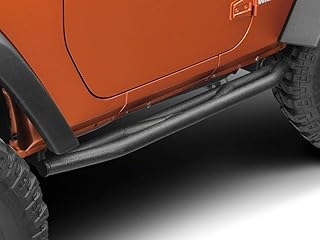
Do I need different sliders for 2-door versus 4-door JKs? Yes—wheelbase differences make this non-negotiable. Four-door JK Unlimited models measure 116 inches between axles versus 95.4 inches for two-door versions. Sliders designed for the wrong wheelbase create incorrect mounting point spacing that stresses frames and cracks welds. Always verify your specific model compatibility before purchasing.
How much weight do rock sliders add to my JK? Frame-mounted sliders add 120-170 pounds total (60-85 pounds per side) depending on construction and length. Pinch seam covers weigh 50-70 pounds total. Body-mounted plates add 20-30 pounds. This additional weight impacts fuel economy by approximately 0.2-0.4 mpg—less than you’ll lose from larger tires. See JK versus JL weight differences for context on how JK handles additional armor.
Can I install rock sliders on a Rubicon with factory rails? Yes, but approach depends on slider type. Quadratec QRC sliders bolt over factory Rubicon rails for enhanced protection. Most frame-mounted sliders require removing factory plastic-covered rails completely—they occupy the same mounting points. Verify compatibility before purchasing if you want to retain factory rails.
Do rock sliders affect my JK’s departure angle? Properly designed sliders maintain or improve departure angle by protecting the rearmost rocker panel section. Poorly designed systems with rear-extending steps reduce departure angle by 2-3 degrees. Frame-mounted sliders typically sit higher than pinch seam covers, preserving more clearance. Tubular designs clear obstacles better than flat plate systems.
Should I weld or bolt rock sliders to my frame? Bolt-on installation allows future removal and prevents irreversible frame modifications that affect resale value. Welded sliders create permanent attachment with marginally better strength but complicate replacement if damaged. Most quality bolt-on systems provide adequate protection when properly torqued—welding isn’t necessary unless you’re building an extreme rock crawler.
Final Recommendation
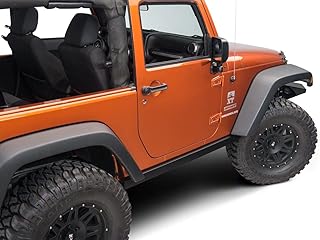
The Barricade frame-mounted sliders take top position for serious trail protection on 4-door JKs. Their combination of DOM steel construction, continuous welds, and eight-point frame mounting delivers impact resistance that justifies the $489 investment.
Rubicon owners get better value from Quadratec QRC sliders that integrate with factory rails rather than replacing them. You’re adding protection to existing structure for $399—smart economics when your JK already includes baseline armor.
Budget-conscious buyers should consider Hooke Road’s frame-mount system at $240. You’re getting legitimate protection with cosmetic compromises that matter far less than structural capability.
When I found and bought my 2014 JKU in Cape Town, adding rock sliders became my first armor upgrade after witnessing trail damage on stock rockers during my initial wheeling trips. The investment proved worthwhile on first serious contact—the slider took a hit that would’ve required body panel replacement. Choose based on your wheeling intensity, but don’t skip rocker protection entirely. Your complete JK buyer’s guide covers additional protection priorities, while soft top upgrades complement your armor investments for complete trail readiness.
Get the Free JK Build Planner
Complete PDF with mod checklists, gear ratios, tire sizing charts, and budget worksheets. Everything you need to plan your JK build.
No spam. Unsubscribe anytime. By subscribing, you agree to our Privacy Policy.
Allan
I'm Allan. I bought a 2014 Jeep Wrangler JKU and I research the hell out of every mod before I touch it. Everything here is tested or deeply researched on my own rig - no sponsored fluff, just honest findings.
Learn more about me →Get the JK Build Planner
Free PDF with complete build checklists, gear ratios, and tire fitment guides.
By subscribing, you agree to our Privacy Policy.
Related Articles
Jeep JK Buyers Guide: What to Know
I learned the hard way that enthusiasm can cloud judgment when buying a Jeep. Back in South Africa, I found what looked like a pristine JKU Sahara at a...
Jeep JK Buyers Guide: What to Look for When Buying Used (2026)
Complete used Jeep JK buying guide: inspect frame/rust, test 4WD, evaluate mods, check for death wobble, verify history. Avoid expensive mistakes with our systematic checklist.
Rigid Industries vs KC HiLiTES Light Bars for JK: Real-World Comparison
Detailed comparison of Rigid Industries and KC HiLiTES light bars for Jeep Wrangler JK. Real brightness data, mounting considerations, and which works best for your build.