Best Gear Ratio for 37 Inch Tires on Jeep JK: Complete Regearing Guide
Best Gear Ratio for 37 Inch Tires on Jeep JK: Complete Regearing Guide
FTC Disclosure: This article contains affiliate links. We may earn a commission if you click and purchase, at no additional cost to you. Learn more about our affiliate policy.
I spent four months running stock 3.73 gears with 35-inch tires on my JK. Every highway merge felt like forever. The transmission hunted for gears constantly, searching for something that wasn’t there. My Jeep felt gutless, and the heat gauge told me a story I didn’t want to read.
Then I bit the bullet and regeared to 4.56. The difference was immediate. My JK came alive again.
For 37-inch tires on a Jeep JK, you need 4.88 or 5.13 gears with automatic transmissions (42RLE or NSG370) and 4.56 or 4.88 with manual transmissions (AX15 or NV3550). These ratios restore power, prevent transmission damage, and return your Jeep to something resembling factory-like driveability after you’ve bolted on the rotational mass of 37-inch tires.
This isn’t a suggestion. It’s mechanical necessity. Running 37-inch tires on stock gears drops your effective ratio by nearly a full point. Your engine lugs. Your transmission overheats. The drivetrain works outside its design window. The right gear ratio for 37 inch tires jeep jk depends on whether you’ve got a stick shift or automatic, what kind of driving you actually do, and how serious you’re getting with the build—but the fundamental principle doesn’t change: bigger tires demand lower numerical gears.
This guide covers everything you need to make that decision with confidence. You’ll understand why regearing matters, how different ratios actually perform on the road and trail, what you’ll realistically spend, and whether you can delay the upgrade (you probably can’t). We’ll also walk through the supporting modifications that keep your 37-inch setup reliable. If you’re building your JK for 37s, understanding tire sizing fundamentals gives you important context before diving into gear ratios.
Why 37-Inch Tires Require Regearing on the JK
When you bolt 37-inch tires onto stock gears, you’re not just changing how your Jeep looks—you’re fundamentally altering how your powertrain actually works. The math is straightforward but the consequences are severe.
Most stock JKs roll on 32-inch tires (31.5 inches in actual diameter on most trims). With common factory 3.73 gears, here’s what happens when you jump to 37s: Your effective gear ratio becomes 3.73 × (32÷37) = 3.22. You’ve essentially downgraded from 3.73 to 3.22 gears without ever touching the axles. And you’ve simultaneously added 80–120 pounds of rotating mass per corner.
Here’s what that does in the real world:
Transmission overheating and failure. The 42RLE automatic in non-Rubicon JKs wasn’t designed for this. It downshifts constantly on grades, holds the torque converter locked less often, and generates heat it can’t shed. Most owners see transmission temps climb 40–60°F above normal during sustained highway driving or when you’re pushing it on the trail. You won’t feel it happening. You won’t see visible smoke. One day the transmission simply refuses to shift smoothly, and you’re looking at a $3,000–4,000 replacement. The connection between oversized tires and automatic transmission failure in JKs shows up consistently in failure reports.
Severe power loss. Your 3.6L Pentastar or 3.8L V6 has to work significantly harder to rotate heavier, taller tires. Merging onto highways becomes exhausting. Passing slower traffic requires planning and optimism. Rock crawling loses the low-end torque that lets you finesse technical obstacles. The engine simply isn’t working in its power band anymore.
Fuel economy actually gets worse. This surprises people, but it’s real. Your engine operates in inefficient RPM ranges. The transmission shifts more frequently. The whole powertrain labors constantly. Expect 2–4 MPG worse than whatever modest number you were already getting.
Engine longevity takes a hit. Constant operation under load at lower RPMs increases cylinder pressure and combustion temperatures. Your engine runs outside its sweet spot for thousands of miles. Long-term wear accelerates on pistons, rings, and bearings.
Engine braking disappears when you need it most. Descending steep grades becomes genuinely hazardous. The engine provides minimal compression braking through the drivetrain. Your brake system works overtime. Pad and rotor life shortens dramatically.
Regearing fixes all of this. It puts your engine back in its designed RPM range under load. It brings transmission temperatures back to safe operating levels. It transforms your Jeep from a struggling, overworked machine back into something you actually enjoy driving. If you’re considering running 37s temporarily while you save for regearing, monitor transmission temps closely—anything sustained above 220°F is a warning sign you’re doing damage.
Gear Ratio Comparison Chart for 37-Inch Tires
| Gear Ratio | Transmission Type | Highway RPM (70 mph) | Acceleration | Rock Crawling | Fuel Economy | Best For |
|---|---|---|---|---|---|---|
| 4.56 | Manual | ~2,400 | Good | Fair | Best | Highway commuters, mild trails, manual transmission preference |
| 4.88 | Auto or Manual | ~2,600 | Excellent | Good | Very Good | Daily drivers, mixed use, balanced performance (most popular) |
| 5.13 | Auto or Manual | ~2,800 | Excellent | Excellent | Good | Heavy rigs, serious off-roading, maximum low-end torque |
| 5.38 | Auto (extreme) | ~3,000 | Extreme | Best | Fair | Rock crawling focus, locked axles, minimal highway driving |
The 4.88 ratio is the goldilocks choice for most JK owners running 37s. It delivers nearly factory-like acceleration, keeps highway RPMs comfortable for actual cruising, and performs strongly on technical trails without feeling over-geared on pavement.
This is the sweet spot because it gives you maximum versatility without painful compromises. At 70 mph you’re running 2,600 RPM in top gear—enough to maintain momentum on moderate grades without downshifting, but not so high that wind noise and fuel consumption become ridiculous. Off-road, you keep excellent low-speed control in 4-Low while still having enough torque multiplication for technical obstacles.
The 4.56 works well for manual transmission JKs where you’re actually controlling gear selection and using the clutch to modulate power. Manual drivers can live with slightly taller effective gearing because you’re not relying on an automatic transmission’s torque converter to compensate for power loss. But automatic transmission JKs with 4.56 and 37s often feel genuinely underpowered in everyday driving—you’ll feel it every time you merge onto a highway or climb a real grade.
The 5.13 ratio shines for dedicated off-road builds, especially ones that are heavy: steel bumpers, armor plating, winches, roof racks. If your JK weighs 5,000+ pounds fully loaded and you spend more time on trails than interstates, 5.13 delivers the low-end grunt you actually need. Sure, highway RPMs increase and wind noise becomes noticeable above 65 mph, but you get back the torque multiplication that makes technical rock crawling controllable and safe.
When you regear, you need quality ring-and-pinion sets with complete installation kits for both axles. Quality gear kits are the foundation—they include everything except gear oil and labor:

Yukon Gear & Axle - Gear & Install Kit for Jeep JK non-Rubicon 4.88 Ratio
$620.00
Check Price on Amazon →Remember: that price is for ONE axle. You need front and rear sets, and both must match. Mismatched gear ratios will destroy your transfer case when you engage 4WD.
Automatic vs Manual Transmission: Different Gear Ratio Needs
Your transmission type completely changes what gear ratio you actually need. The same 37-inch tire performs dramatically differently depending on whether you’re controlling the gears yourself or depending on an automatic transmission’s programming to do the thinking.
Automatic Transmissions: Go Lower (4.88 or 5.13)
The 42RLE 4-speed automatic in 2007–2011 Sport and Sahara models has tight gear spacing and depends heavily on torque converter multiplication to mask power deficiencies. When 37-inch tires go on this transmission with stock gears, the converter stays locked less often, slips more during acceleration, and generates heat it can’t shed.
For 42RLE automatics with 37s, 4.88 is your minimum. This restores enough torque multiplication that the transmission can lock the converter at reasonable speeds and stay in gears without constantly hunting for the right ratio. The difference is immediate—shifts become crisp, part-throttle acceleration returns, and transmission temperatures drop 30–40°F under load.
The 5.13 ratio makes even more sense for automatic JKs if you’re running heavy modifications or spending real time off-road. The additional gear reduction compensates for the automatic transmission’s efficiency losses and ensures you have usable power at low speeds in 4-Low. Many serious off-roaders with automatics choose 5.13 and accept the higher highway RPMs as the cost of proper trail performance.
Critical warning about transmission temperature: The 42RLE doesn’t have a factory transmission temperature gauge. If you’re testing 37s on stock gears before committing to regearing (not recommended, but people do it), you need a way to monitor actual transmission temp. Sustained temperatures above 220°F cause clutch pack damage. Anything over 240°F rapidly degrades the fluid and seals.

A-Premium Transmission Oil Cooler Compatible with Jeep Wrangler 2012-2017
$79.99
Check Price on Amazon →The NSG370 6-speed automatic in 2012+ models (excluding Rubicon) has better gear spacing than the 42RLE but still benefits from 4.88 or 5.13 ratios with 37-inch tires. The extra gears help, but they don’t overcome the fundamental physics of rotating mass and effective ratio reduction.
Manual Transmissions: You Have More Flexibility (4.56 or 4.88)
Manual transmission JKs—the AX15 5-speed in older models and NV3550 in newer Sport/Sahara, plus the NSG370 6-speed manual—let you control power delivery directly. You pick the optimal gear for conditions, modulate torque with the clutch at low speeds, and keep the engine in its power band through corners and obstacles.
For manual transmission JKs with 37s, 4.56 often works. You’ll notice the power loss compared to stock, but you can compensate by downshifting earlier and using lower gears more aggressively. Highway driving stays comfortable with RPMs around 2,400 at 70 mph—enough to cruise efficiently without feeling like you’re constantly revving.
The 4.88 ratio delivers meaningful improvement for manual transmission drivers who want near-stock performance without constantly working the gearbox. This is the preferred choice if you daily drive your JK, regularly carry passengers or cargo, or want effortless acceleration.
Manual Rubicons with the NSG370 6-speed and 37s do exceptionally well with 4.88 gears. The six-speed transmission’s tall overdrive keeps highway RPMs reasonable while the lower ratios provide excellent trail performance. The combination of 4.88 gears, the NSG370’s ratios, and the Atlas transfer case’s 4:1 low range creates nearly the ideal setup for mixed-use JKs running 37-inch tires.
For context on which transmissions came in which model years and trims, our transmission changes by model year guide and stock gear ratios by trim level comparison cover all the details.
Real-World Performance: 4.56 vs 4.88 vs 5.13 Gears
Numbers on paper tell part of the story. Here’s how these 37 inch tire gear ratio jeep jk options actually perform when you’re driving them—on the highway, in traffic, and on the trail.
Acceleration & Daily Driving
4.56 ratio: Acceptable acceleration from stoplights but noticeably slower than stock. Manual transmission drivers can make it work through aggressive shifting. Automatic transmissions feel underpowered—you’ll often floor the throttle for modest acceleration. Passing slower traffic on two-lane roads requires planning and patience. For commuting with minimal highway demands, it’s livable but not enjoyable.
4.88 ratio: This is where your JK feels right again. Acceleration comes back to near-stock levels. Merging onto highways requires normal throttle input rather than desperate optimism. The transmission stops hunting between gears on moderate hills. You can accelerate smoothly with passengers and cargo without embarrassment. After those four months struggling on inadequate gears, regearing to 4.88 transformed my JK—suddenly it drove like I remembered it should.
5.13 ratio: Aggressive, eager acceleration that actually feels quicker than stock in many situations. The engine pulls hard from low RPMs. You reclaim all the power you lost to rotational mass and then some. For heavy builds with steel bumpers, sliders, and roof racks, this ratio compensates perfectly. The trade-off: engine noise increases noticeably above 65 mph.
Highway Cruising
4.56 ratio: Most comfortable highway experience with 37s. RPMs sit around 2,400 at 70 mph, providing relaxed cruising with minimal wind roar. Fuel economy takes less of a hit compared to numerically lower ratios. However, passing requires downshifts and long runways. Climbing extended grades means dropping a gear or two and accepting slower speeds.
4.88 ratio: The balanced choice for mixed-use JKs. You’ll run about 2,600 RPM at 70 mph—noticeably busier than 4.56 but not intrusive. You maintain momentum up moderate grades without downshifting. Passing becomes confident rather than tentative. Fuel economy drops slightly compared to 4.56, but improved engine efficiency from operating in the power band often offsets the higher RPMs.
5.13 ratio: Highway cruising becomes noticeably louder. At 2,800 RPM in top gear, engine noise and wind roar dominate. You definitely feel like you’re working harder to maintain 70 mph. Long interstate drives become fatiguing. However, climbing mountain passes transforms—you’ll pull grades in top gear that would require downshifts with taller ratios.
Off-Road & Rock Crawling
4.56 ratio: Adequate for moderate trails but lacking for technical rock crawling. In 4-Low, you have reasonable control but less torque multiplication than ideal. Steep climbs require more throttle, making smooth modulation difficult. You’ll use more clutch slip (manual) or torque converter action (automatic) to maintain precise low-speed control.
4.88 ratio: Excellent all-around off-road performance. This is the jk 37s regear sweet spot for trail driving—strong low-speed torque in 4-Low without feeling over-geared on faster dirt roads or whoops. Technical obstacles become manageable with smooth throttle control. Steep descents benefit from strong engine braking. This ratio handles everything from rutted two-tracks to moderate rock gardens confidently.
5.13 ratio: Rock crawling becomes controlled and deliberate. The combination of 5.13 gears, 37-inch tires, and 4-Low creates incredible torque multiplication for technical lines. Steep ledges require minimal throttle. You can idle up obstacles that would be impossible with taller gearing. Engine braking on descents feels secure and controllable. For dedicated trail rigs that see occasional highway miles, this is the optimal choice.
Fuel Economy Reality
Let’s be straight: no gear ratio makes your JK with 37-inch tires fuel-efficient. The increased rotational mass, larger frontal area, and heavier weight ensure worse fuel economy than stock regardless of gearing.
Proper regearing minimizes the damage, though. Stock gears with 37s might net 11–13 MPG combined because the engine constantly works outside its efficiency range. Regear to 4.88 and you’ll typically see 13–15 MPG—still terrible, but meaningfully better. The improvement comes from the engine operating in its designed RPM range where combustion is optimized, the transmission staying in higher gears more often, and reduced torque converter slip in automatics.
Quick Decision Guide
Choose 4.56 if: You have a manual transmission, do mostly highway driving, run moderate trails, want the quietest highway cruising, and prioritize fuel economy over raw performance.
Choose 4.88 if: You want the best all-around balance, daily drive your JK, run mixed highway and trail use, have an automatic transmission, or want near-stock acceleration and driveability. This is the most popular choice for a reason.
Choose 5.13 if: You have a heavy build (bumpers, armor, winches), spend more time off-road than on pavement, regularly tackle technical rock crawling, tow occasionally, or prioritize low-speed torque over highway comfort.
For context on pairing these gear ratios with quality rubber, our guide on choosing the right 37-inch tires covers tire selection—the compound and tread pattern matter nearly as much as gearing.
Dana 30 vs Dana 44: Regearing Considerations
Not all JK axles are created equal, and understanding what’s under your Jeep sometimes changes your regearing decision—sometimes dramatically.
Sport and Sahara models (2007–2018) came with a Dana 30 front axle and Dana 44 rear axle. The Dana 30 is lighter-duty with a smaller ring gear (7.2 inches) and weaker axle tubes. It’s adequate for moderate trail use with proper gearing but becomes your weak link when 37-inch tires and aggressive driving enter the equation. The Dana 44 rear is stronger with an 8.5-inch ring gear but isn’t the bulletproof unit many assume.
Rubicon models (2007–2018) feature Dana 44 axles front and rear with electronic locking differentials and thicker axle tubes. These are significantly stronger and better-suited to 37-inch tires with hard off-road use. The 5.13 factory gears in Rubicons (4.10 in earlier years) already position you well for 37s—many Rubicon owners choose 5.38 when installing 37-inch tires.
The Decision Tree for Sport/Sahara Owners
If you’re building a hardcore rock crawler with 37s on a Sport or Sahara: Seriously consider upgrading to aftermarket Dana 44 front axles or even Dana 60s before regearing stock axles. The Dana 30 front becomes your breaking point. You’ll bend tubes, break shafts, or grenade the carrier under hard use. Spending $2,000 to regear a Dana 30 that you’ll upgrade next year wastes money. Better to upgrade axles first, then regear once.
If you’re building a trail-capable daily driver with 37s: Regear your stock Dana 30/44 setup to 4.88. Add chromoly axle shafts up front for durability. Run smart lines on trails and avoid bouncing off the rev limiter on ledges. This combination works reliably for thousands of JK owners doing moderate trail use. The money saved by skipping axle upgrades can fund other critical components.
If you’re mostly pavement with occasional maintained dirt roads: Regear your stock axles with confidence. The Dana 30 front handles 37-inch tires fine under normal use. Focus your budget on regearing quality—proper carrier selection, quality bearings, and expert installation matter more than axle strength for this use case.
Preventive Maintenance During Regearing
Since both axles are already disassembled during regearing, this is the ideal time to replace wear items preventively. Axle bearings, seals, and carrier bearings all come out during the process. The additional cost is minimal compared to the labor savings, and you’ll ensure another 100,000+ miles of service life.

2pcs Rear Axle Bearing and Seal Kit Compatible with Jeep Wrangler JK/JKU 2007-2020
$77.88
Check Price on Amazon →Smart shops will recommend replacing these components as part of the regearing package. If your shop doesn’t suggest it, ask explicitly—bearing failure after regearing means paying for teardown and labor twice.
Our axle differences between JK trims guide covers all the mechanical specifics.
Cost Breakdown: What Does Regearing Actually Cost?
Regearing isn’t cheap, but understanding where the money goes helps you budget appropriately and avoid surprises. Here’s the realistic breakdown for 2026:
Ring & Pinion Sets (Both Axles)
- Front Dana 30 or 44: $300–450 per axle for quality brands (Yukon, G2, Nitro)
- Rear Dana 44: $300–450 per axle
- Budget option (unknown brands): $200–300 per axle—false economy, skip this
- Premium option (OEM or competition-grade): $500–600 per axle
Total for both axles: $600–900 for quality sets
Installation Kits
These include bearings, seals, shims, crush sleeves, and marking compound needed for proper setup:
- Master install kit (front): $150–250
- Master install kit (rear): $150–250
- Budget kits (minimal components): $80–120 each—skip these
Total for both axles: $300–500 for complete kits
Labor Costs
Regional variation matters here. Gear installation requires precision—improper backlash or bearing preload destroys expensive gears in hundreds of miles.
- Front axle labor: $400–700
- Rear axle labor: $400–700
- Both axles package pricing: $700–1,200 (shops often discount bundled work)
Experienced shops with proper setup equipment complete both axles in 6–10 hours. Backyard mechanics with limited experience often take 20+ hours and create expensive mistakes.
Total labor: $700–1,400 depending on location and shop expertise
Gear Oil
You’ll need fresh differential fluid for both axles after regearing. Don’t cheap out here—quality synthetic gear oil protects your new investment.

Valvoline FlexFill Advanced Full Synthetic 75W-90 Gear Oil 1 Quart Pouch
$15.48
Check Price on Amazon →- Front differential: 2–3 quarts
- Rear differential: 3–4 quarts
Total fluid cost: $60–100
Optional Upgrades (Done While Axles Are Apart)
- New carriers: $300–600 each (required when crossing certain ratio thresholds)
- Axle bearings and seals: $150–300 for both axles (highly recommended)
- Chromoly axle shafts (front): $500–800 (strengthens Dana 30)
- Limited-slip or locker differentials: $800–1,500 each (major upgrade opportunity)
- Chromoly U-joints: $100–200 (preventive maintenance)
Total Cost Table
| Component | Budget Build | Mid-Range Build | Premium Build |
|---|---|---|---|
| Ring & Pinion (both) | $600 | $800 | $1,100 |
| Install Kits (both) | $300 | $400 | $500 |
| Labor (both axles) | $700 | $1,000 | $1,400 |
| Gear Oil | $60 | $80 | $100 |
| Optional Upgrades | $0 | $500 | $2,000 |
| TOTAL | $1,660 | $2,780 | $5,100 |
Most JK owners spend $2,000–2,500 for quality regearing of both axles without major optional upgrades. This assumes mid-grade components and a reputable shop with off-road experience.
Shop Selection Tips
Look for shops with Jeep and off-road specialization. Differential setup requires experience and proper equipment—a shop that normally works on Corollas isn’t the right choice no matter how cheap their quote. Ask to see examples of previous regear work on JKs.
Get quotes from 2–3 shops and compare line-item breakdowns. The lowest price often means cutting corners on setup time or using budget components. The highest price doesn’t guarantee quality. Compare what’s included and ask about warranty specifics.
Ask about warranty on setup work. Reputable shops warrant their gear pattern and backlash setup for 12–24 months or 12,000–24,000 miles. If a shop won’t warranty their installation work, walk away—they don’t trust their own setup quality.
Verify they’ll check and document gear pattern. Proper setup requires marking both drive and coast sides of the ring gear teeth, then checking the contact pattern. Ask if they photograph the pattern for your records. Shops that rush past this step produce installations that fail prematurely.
Confirm break-in procedure recommendations. New gears require a specific break-in sequence (typically 500 miles with varying speeds, no sustained high-speed operation, and gear oil change after break-in). Shops should provide written instructions.
Essential Products for Your 37-Inch Tire Setup
Regearing is the foundation, but 37-inch tires demand supporting modifications to maintain safety, handling, and reliability. Here’s what you absolutely need.
Steering & Handling Upgrades
The heavier rotating mass of 37-inch tires amplifies every imperfection in your steering system. What was a minor wobble on 32-inch tires becomes violent death wobble with 37s. A dual steering stabilizer isn’t optional—it’s mandatory.
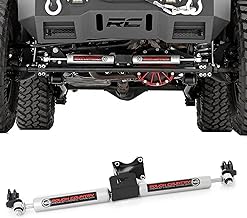
Rough Country N3 Dual Steering Stabilizer for 07-18 Jeep Wrangler JK
$149.95
Check Price on Amazon →The dual-cylinder design controls oscillations that single stabilizers can’t handle at 37-inch tire weights. You’ll also want to inspect ball joints, tie rod ends, and track bar bushings—these wear components create problems under the increased loads of oversized tires.
Lift & Suspension
Minimum 3.5-inch lift for 37s, and 4+ inches is preferable for full articulation without rubbing. The lift doesn’t just provide clearance—it repositions suspension geometry for proper control arm angles and shock travel.

Budget lift kits provide clearance but compromise ride quality and handling. Quality kits include adjustable control arms to correct caster and prevent driveline vibration. The Rough Country kit offers a value entry point, but serious builds should consider adjustable arms and premium shocks.
Wheels & Protection
Stock JK wheels lack the backspacing needed for 37-inch tires without significant rubbing. You need wheels with 4.5 inches of backspacing or less (3.5–4.0 is ideal for 37x12.50 tires). If you’re keeping stock wheels temporarily, wheel spacers become necessary.

Orion Motor Tech 5x5 Wheel Spacers Compatible with Jeep Wrangler JK 1.5"
$102.99
Check Price on Amazon →Critical spacing warning: Wheel spacers must be hub-centric (not lug-centric) and properly torqued to spec. The 1.5-inch spacers shown above provide the offset needed to prevent rubbing on control arms and frame during full compression and steering lock. Always use thread locker on spacer bolts and check torque after 50 miles.
With 37-inch tires spending time on rocks and trail obstacles, punctures become a real concern. A quality tire repair kit rides along on every trail run:

This kit handles sidewall plugs and tread repairs—critical capabilities when the nearest tire shop is 40 miles of trail away.
Transmission & Drivetrain
Even with proper regearing, the increased load of 37-inch tires generates more transmission heat than stock. An auxiliary transmission cooler becomes essential insurance, especially for automatic transmission JKs.
A-Premium Transmission Oil Cooler Compatible with Jeep Wrangler 2012-2017
$79.99
Check Price on Amazon →Mount the cooler in front of the radiator for maximum airflow. This simple addition can drop transmission operating temps 30–40°F under sustained load—the difference between a transmission lasting 150,000 miles and one that fails at 80,000.
Tire Selection
Not all 37-inch tires weigh the same or perform identically. Tire choice impacts your regearing effectiveness—heavier tires require more aggressive gear ratios, while lighter tires work better with more conservative gearing.

Atturo Trail Blade MTS M/T Mud Off-Road Light Truck Radial Tire 37X12.50R17LT
$270.50
Check Price on Amazon →Mud-terrain tires like the Atturo Trail Blade deliver aggressive traction but typically weigh 80–90 pounds per tire. All-terrain options weigh 70–80 pounds and provide better highway manners with acceptable off-road performance. Your tire selection should align with your usage pattern and the gear ratio you choose.
Our all-terrain tire options guide and detailed wheel fitment with 37-inch tires specifications cover these in depth.
When You Can Skip Regearing (And When You Absolutely Can’t)
Not everyone can drop $2,000 on regearing the same week they install 37-inch tires. Let’s be realistic about when you can delay and when you’re genuinely gambling with expensive failure.
Risk Assessment Framework
Low Risk (Acceptable Short-Term):
- 35-inch tires on 4.10 gears with manual transmission
- Light vehicle weight (minimal armor and accessories)
- Conservative driving style, mostly maintained roads
- You’re actively saving for regearing within 6 months
Medium Risk (Monitor Closely):
- 35-inch tires on 3.73 gears with automatic transmission
- 37-inch tires on 4.10 gears with manual transmission (absolute minimum)
- Mixed pavement and light trail use
- You monitor transmission temperature religiously
High Risk (Strongly Not Recommended):
- 37-inch tires on 3.73 gears with any transmission type
- Automatic transmission showing any heat warning signs
- Regular highway driving or extended trail use
- Heavy vehicle weight from armor and accessories
Unacceptable Risk (Mechanical Damage Imminent):
- 37-inch tires on 3.21 gears (2007–2011 Sahara automatic)
- Any transmission temperature readings above 220°F sustained
- Towing any load with oversized tires on stock gears
- Ignoring warning signs (slipping, delayed shifts, burning smell)
The Hard Truth
If you’re running 37-inch tires on stock 3.73 or 3.21 gears with an automatic transmission, you’re not “getting by”—you’re destroying your transmission. The damage occurs silently. Clutch packs wear prematurely. Fluid degrades from heat. The torque converter slips excessively. When failure comes, it’s sudden and catastrophic.
Transmission temperature monitoring is non-negotiable if you delay regearing. You can’t feel transmission temperature. The engine gauge tells you nothing about transmission health. Without actual temperature data, you’re flying blind while potentially inflicting $3,000–4,000 in damage to avoid a $2,000 regearing expense.
Manual transmission JKs have slightly more flexibility. You control gear selection and can compensate with aggressive shifting. But you’re still working the engine harder, burning more fuel, and sacrificing the performance you bought 37-inch tires to achieve. The longer you delay, the less you enjoy your Jeep.
If You’re Delaying for Budget Reasons
Start saving immediately. Set up a dedicated account. Put aside $200–300 per month. In 6–8 months you’ll have regearing money without financing. Meanwhile:
- Avoid extended highway drives above 65 mph
- Don’t tow anything, even light trailers
- Watch for transmission slipping or delayed engagement
- Change transmission fluid early (every 15,000 miles instead of 30,000)
- Plan your regearing date and commit to it
Don’t wait until your transmission fails. Transmission replacement plus regearing doubles your expense and leaves you without a vehicle during repairs. Prevention costs half as much as repair.
Frequently Asked Questions
Can you run 37 inch tires without regearing?
Technically yes, physically no. Your JK will move with 37-inch tires on stock gears, but you’ll destroy your transmission and suffer terrible driveability. Automatic transmissions overheat and fail within 10,000–20,000 miles of hard use. Manual transmissions fare slightly better but sacrifice significant power and fuel economy. The cost of regearing ($2,000–2,500) is far less than transmission replacement ($3,000–4,000).
What is the best gear ratio for 37 inch tires on automatic transmission?
4.88 or 5.13 gears depending on your build weight and usage. The 42RLE 4-speed automatic in 2007–2011 Sport/Sahara models desperately needs the torque multiplication from lower gears. Most owners choose 4.88 for balanced daily driving and trail performance. Go to 5.13 if you’re running heavy armor, towing occasionally, or prioritizing rock crawling over highway comfort. Avoid 4.56 on automatics with 37s—it’s insufficient.
Will regearing improve gas mileage?
Yes, but modestly. Regearing from stock 3.73 to 4.88 with 37-inch tires typically recovers 2–3 MPG compared to running 37s on stock gears. You won’t match your stock fuel economy—the increased tire weight and frontal area guarantee worse mileage than factory regardless of gearing. However, proper regearing minimizes the fuel economy hit by keeping your engine in its efficient RPM range and reducing transmission slip in automatics. Expect 13–15 MPG combined with 4.88 gears and 37s versus 11–13 MPG on stock gears.
How much does it cost to regear a Jeep JK?
$1,800–2,500 for both axles with quality components and professional installation in 2026. This includes ring-and-pinion sets ($600–800), master install kits ($300–400), labor ($700–1,200), and gear oil ($60–100). Budget builds start around $1,600 but often sacrifice quality. Premium builds with optional upgrades (carriers, bearings, chromoly shafts) run $3,000–5,000. Get quotes from 2–3 shops with Jeep specialization and compare line-item breakdowns.
Do you have to regear front and rear axles?
Yes, absolutely. Both axles must be the same gear ratio or you’ll destroy your transfer case when engaging 4WD. Mismatched gear ratios cause the front and rear axles to rotate at different speeds, creating binding that damages internal transfer case gears. The transfer case can’t compensate for ratio differences like it does for turning radius. Always regear both axles together with identical ratios. The only exception is if you never use 4WD—but at that point, why own a Jeep?
What gear ratio is best for 37s on manual transmission?
4.56 or 4.88 gears depending on your priorities. Manual transmission JKs can live with 4.56 gears and 37-inch tires if you’re willing to shift aggressively and use lower gears more often. This provides the quietest highway cruising at ~2,400 RPM in top gear at 70 mph. The 4.88 ratio offers noticeably better performance with only modest highway RPM increase (~2,600 RPM at 70 mph). Most manual transmission drivers choose 4.88 for the improved acceleration and trail torque. Go to 5.13 only for heavy builds or rock crawling focus.
Our guide to common JK transmission problems covers the technical details of transmission-specific problems that oversized tires and improper gearing exacerbate.
Final Recommendations: Choosing Your Gear Ratio
After examining the performance characteristics, costs, and real-world implications, the decision framework becomes clear:
For automatic transmission JKs with 37-inch tires: Choose 4.88 gears for daily drivers and mixed-use builds. This ratio delivers the best balance of highway comfort, acceleration, and off-road capability. You’ll recover near-stock driveability without excessive highway RPMs. Choose 5.13 gears if you’re running heavy armor, towing occasionally, or spending most weekends on technical trails.
For manual transmission JKs with 37-inch tires: Choose 4.88 gears if you want effortless performance and don’t mind slightly higher highway RPMs. Choose 4.56 gears if you prefer quieter highway cruising and have the discipline to shift aggressively for optimal power delivery. Avoid 4.56 with automatics and 5.13 with manuals unless your specific use case demands those extremes.
For Rubicon models upgrading to 37s from factory 35s: Regear from 4.10 to 4.88 or 5.13. The factory 4.10 gears work acceptably with 35s but leave noticeable power on the table with 37s. The jump to 4.88 or 5.13 transforms your Rubicon into the capable machine it should be with proper 37-inch tire support.
That four-month stretch with inadequate gears taught me an expensive lesson. The hesitation during highway merges, the constant transmission temperature anxiety, the sluggish trail performance—all of it disappeared the day I finally regeared. The transformation was immediate and dramatic. My JK came alive again. The throttle response returned. The transmission stopped hunting. Trail obstacles that required aggressive momentum suddenly became manageable with smooth power delivery.
Don’t let stock gears hold back your 37-inch tire investment. Regearing is the single most important upgrade after installing bigger tires. It’s not optional, it’s not negotiable, and it’s not worth delaying to save money. The performance, reliability, and enjoyment you gain justify every dollar spent.
Your JK deserves to perform the way it was designed—with the engine operating in its power band, the transmission shifting smoothly, and the drivetrain working within its design limits. Give it the gears it needs.
For comprehensive guidance on planning your complete wheel and tire setup including gear ratios, tire selection, and supporting modifications, see our complete wheels and tires guide. It ties together all the elements of a successful 37-inch tire build.
Get the Free JK Build Planner
Complete PDF with mod checklists, gear ratios, tire sizing charts, and budget worksheets. Everything you need to plan your JK build.
No spam. Unsubscribe anytime. By subscribing, you agree to our Privacy Policy.
Jeep JK Guide
We're JK owners who've been building, breaking, and fixing Wranglers for years. Everything here is tested on our own rigs - no sponsored fluff, just honest recommendations.
Learn more about us →Get the JK Build Planner
Free PDF with complete build checklists, gear ratios, and tire fitment guides.
By subscribing, you agree to our Privacy Policy.
Related Articles
Best 35 Inch Tires for Jeep Wrangler JK: Top 8 Picks for 2026
Discover the best 35 inch tires for Jeep JK with our expert comparison of 8 top options. Complete fitment guide, real-world reviews, and installation requirements.
Best All-Terrain Tires for Jeep Wrangler JK: 2026 Top Picks
Find the best all-terrain tires for your Jeep Wrangler JK with our expert guide. Real-world testing, honest reviews, and size recommendations for stock to 35-inch builds.
Best Tires for Jeep JK: Complete 2026 Tire Selection Guide
Find the best tires for your Jeep Wrangler JK with our expert guide. Compare all-terrain, mud-terrain, and budget options with real-world testing and fitment advice.