35-Inch Tires on a 2.5-Inch Lift Jeep JK: What Fits, What Rubs & What to Trim
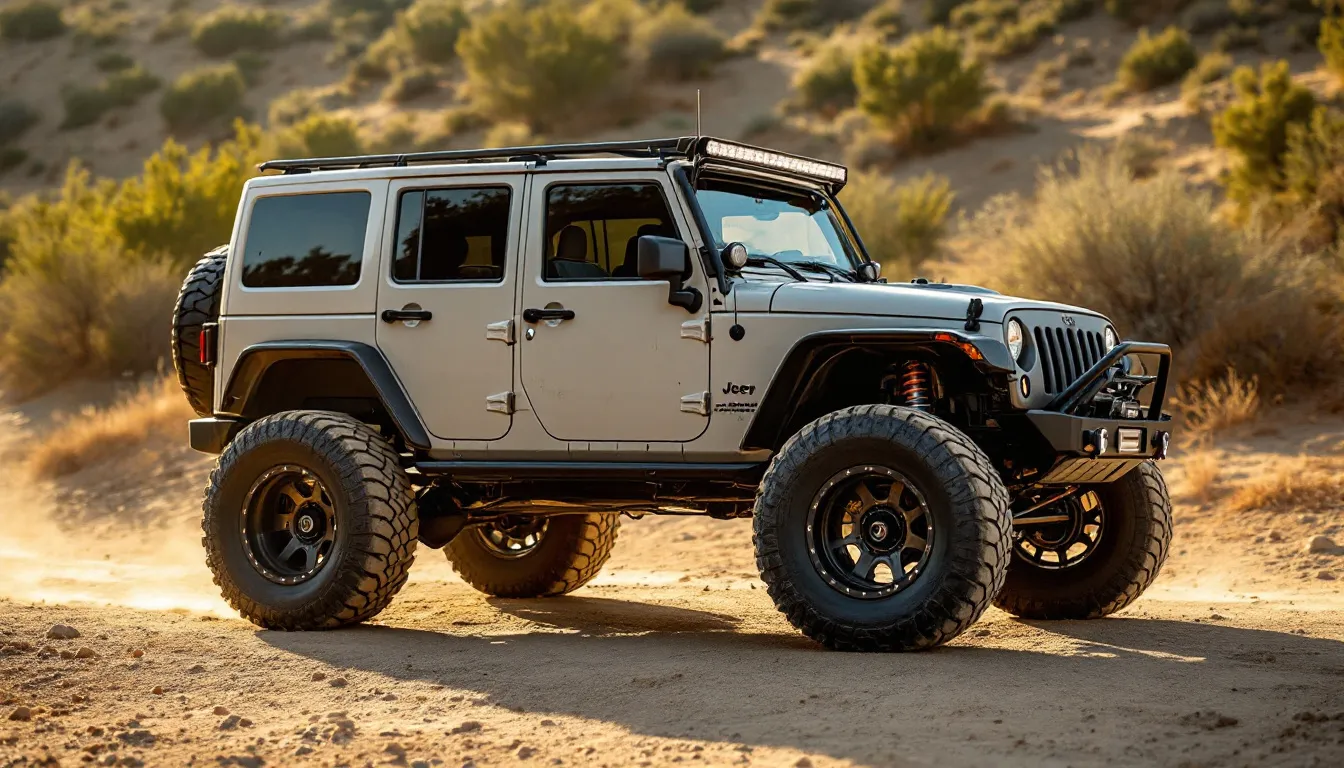
35-Inch Tires on a 2.5-Inch Lift Jeep JK: What Fits, What Rubs & What to Trim
A Jeep JK running 35-inch tires on a 2.5-inch lift is entirely possible — but it is not a plug-and-play upgrade. You will need to trim the front fender liner, choose the right wheel offset, and accept that full-lock steering will bring you into contact with plastic without that trimming. The 2.5-inch lift puts you right on the edge of what 35s demand, and whether you end up with a clean fitment or a persistent rub depends on three variables: lift quality, wheel backspacing, and how much liner work you’re willing to do.
Before going further, two common mistakes need addressing. First, many readers search for “2.5-inch lift” and “3.5-inch lift” interchangeably — they are not the same, and the extra inch makes a meaningful difference to clearance. Second, 33-inch, 35-inch, and 37-inch tires are not minor variations on the same theme: each size step requires progressively more lift, more trimming, and different regearing thresholds. For a broader look at running 35s, 37s, and 40s on a JK, or for a full overview of sizing compatibility, the JK wheels and tires fitment guide covers the complete picture.
What Size Lift Do You Actually Need for 35-Inch Tires on a JK?

A minimum of 2.5 inches of suspension lift is generally needed to fit 35-inch tires on a Jeep Wrangler JK without immediate, constant rubbing — but 3.5 inches gives you meaningful margin and is the more comfortable choice if budget allows.
The 2.5-inch threshold is widely documented across JK forums and owner communities: at that height, 35s will clear the body and fenders in a straight line, but will contact the front fender liner on full steering lock unless you trim. The JK community broadly agrees that 2.5 inches is the floor, not the ideal.
There is an important distinction between a simple leveling kit and a full suspension lift. A leveling kit raises the front of the JK to match the rear — useful for correcting the factory rake and gaining a small amount of clearance — but it is not designed to support 35-inch tires. A product like the 2.5” Lift Leveling Kit for 2007-2018 JK illustrates the concept:

That leveling kit raises ride height, but it does not change control arm geometry, does not add caster correction, and does not give you the full articulation clearance of a proper suspension lift. Many owners report that leveling kits alone result in persistent rubbing and accelerated tire wear when paired with 35s. A leveling kit works for 32s or modest 33s. For true 35-inch tires, it falls short.
A quality 2.5-inch suspension lift with caster correction is a different product category entirely. Control arm geometry matters: the factory caster angle is designed for stock tire sizes, and running larger rubber without correcting it accelerates wear on steering components. The consensus across owner communities is consistent: caster correction brackets or adjustable control arms are not optional extras. They are what separate a lift that works long-term from one that chews through tire edges and ball joints.
The 2-door JK and 4-door JKU (Unlimited) behave differently in this regard. The JKU’s longer wheelbase gives it slightly better high-speed stability on 35s but does not meaningfully change the rubbing equation at the front axle. For premium JK lift kit options, the same fundamental rules apply to both body styles.
Where 35-Inch Tires Rub on a 2.5-Inch Lift JK: Exact Locations
On a 2.5-inch lifted JK running 35-inch tires, rubbing occurs in three primary locations: the front fender liner on full steering lock, the front upper control arm bump stop area at full droop, and the rear inner fender on larger wheel offset combinations.
Here are the three rub points to know before you fit 35s:
- Front fender liner (inner plastic) — Contact on full steering lock, both left and right
- Front bump stop / lower control arm area — Contact at full suspension droop, particularly on trail obstacles
- Rear inner fender — Contact when running wheels with more aggressive negative offset, especially on JKU models
Front fender liner: This is the most commonly reported rub point. Many JK owners report that the front plastic liner — not the metal fender itself — contacts the tire sidewall when you turn to full lock. The contact is tight enough to scrape consistently, and over time it tears the liner rather than damaging the tire. This is the rub that trimming fixes most directly.
Front bump stop area: At full suspension droop, the tire can contact the front bump stop area or the lower control arm mount. This happens most often on uneven terrain and rocky trails. Many owners find this rub is less obvious on flat ground during test-fitting, which is why checking clearance with one wheel in a hole (simulating droop) matters before you commit to the setup.
Rear inner fender: This one depends heavily on wheel offset. With a neutral or slightly negative offset, many JKU owners report rear inner fender contact on larger body motions. The 2-door JK tends to show this less, partly due to its shorter wheelbase and tighter suspension geometry. If you are running wider wheels to push the tire outward, this rear contact often disappears — but that trade-off brings its own clearance considerations at the front.
For a detailed comparison of which 35-inch tire dimensions work best within these clearance constraints, see best 35-inch tire options for the JK.
Get new guides by email
One email when we publish something worth reading. Unsubscribe anytime.
What to Trim and How to Do It Without a Professional
Trimming the front fender liner on a 2.5-inch lifted JK running 35-inch tires is a straightforward job that most owners handle at home with basic tools. No body shop, no special equipment.
The standard approach used by JK owners involves removing the liner, marking the contact zone by turning the wheel to full lock and noting where the tire sits closest, then cutting the plastic with aviation snips or a rotary tool. The goal is not to remove the entire liner. You are relieving the specific area that contacts the tire sidewall on full lock.
Here is the step-by-step liner trim sequence:
- Park on level ground and turn wheels to full lock in one direction. Note where the tire sits closest to the liner. Use masking tape to mark that contact area on the plastic.
- Remove the front fender liner by undoing the plastic push-pin fasteners around its perimeter, typically 8-12 per side. The liner pulls free without tools once the pins are out.
- Lay the liner flat and mark your cut line. Add approximately 1 inch of clearance beyond the contact mark you made in step 1. This accounts for tire flex on trail and body roll at speed.
- Cut along your marked line using aviation snips for a clean edge, or a rotary cutting tool for tighter curves. File or sand any sharp edges afterward to prevent liner-to-wiring abrasion.
- Reinstall the liner and test the full lock in both directions, ideally with one wheel up on a ramp or curb to simulate droop. Confirm clearance exists.
- Repeat on the opposite side. Both sides typically need the same relief, though the contact point can be slightly different left-to-right depending on your caster setup.
This is a 1-2 hour job per side for a first-timer. The second side is faster. No painting, no body filler, no professional tools required.
One product worth understanding in this space is the Fender Gutz Delete system. Important: This product is explicitly designed for the JL and JT — it is not a direct fitment for the JK. The liner architecture and mounting points differ between generations. JK owners work with the OEM liner and trim it. There is no bolt-in Fender Gutz equivalent for the JK.
For a broader look at which JK modifications make the most sense relative to your budget, the JK mods by budget guide walks through priorities.
Wheel Offset and Backspacing: The Variable That Changes Everything

Wheel offset and backspacing determine whether your 35-inch tires rub the inner fender, clear the control arms, and sit visually flush. Getting this wrong causes rubbing that no amount of trimming will fix.
Offset describes how far the wheel’s mounting face sits inward or outward from the wheel’s centerline. A negative offset pushes the tire outward. A positive offset tucks it inward. For 35s on a 2.5-inch lifted JK, the community broadly agrees that a negative offset in the -12mm to -18mm range with a backspacing around 4.25 to 4.75 inches gives the best combination of clearance and stability.
The RockTrix RT109 fits this profile well:

The RT109 runs a -12mm offset with 4.5 inches of backspacing. Many JK owners report this spec sits in the sweet spot for 35s on a 2.5-inch lift. It clears the control arms, pushes the tire slightly outward to avoid inner fender contact, and keeps the tire from protruding so far that it catches rocks and debris on trail.
By contrast, the RockTrix RT105 runs a +12mm offset with 5.5 inches of backspacing.
That inward-tucked profile works fine for smaller tires on stock or mildly lifted JKs. On 35s with only 2.5 inches of lift, many owners report that the extra backspacing brings the tire closer to the inner fender and control arm, increasing the risk of contact at full droop. If you are running 35s, the RT105’s offset profile is not the right choice for this application.
The relationship between offset and lift brand matters, too. Different lift kits position the axle slightly differently, which changes your effective clearance at the inner fender. Wheel offset and lift kit selection are interdependent decisions. You cannot choose one in isolation. See the JK 17-inch wheel upgrade guide for a full breakdown of sizing, and best aluminum wheels for the JK for a wider field of options.
Best 2.5-Inch Lift Kits for Running 35-Inch Tires: Comparison Table

The best 2.5-inch lift kits for 35-inch tires are those that include caster correction, quality shocks rated for the increased unsprung weight, and hardware that holds alignment under real trail loads. Budget kits that skip these elements cost more in long-term wear than they save upfront.
Here is a direct comparison of the three main kits worth considering:
| Kit | Price | Includes Shocks | Caster Correction | 2-Door Fit | 4-Door JKU Fit | Best For |
|---|---|---|---|---|---|---|
| Rough Country 2.5” (67930) | ~$400 | Yes | No (optional) | ✓ | ✓ (JKU version) | Budget-first buyers |
| Quadratec Max Duty 2.5” | ~$673 | Yes (Nitro 8.0) | Partial | ✗ | ✓ | JKU 4-door owners |
| TeraFlex 1251000 2.5” | ~$968 | Yes (all 4) | Yes | ✓ | ✓ | Serious off-road use |
The first real test for understanding what matters in a lift kit comes from research across JK forums and owner groups. The consensus is consistent: adjustable control arms and caster correction are not optional extras. They are what separates a lift that works long-term from one that chews through tire edges and ball joints.
Rough Country 2.5” Lift Kit (67930)
The Rough Country kit is the entry point. It includes shocks, spring spacers, and the hardware needed for a basic 2.5-inch lift. What it does not include is caster correction as standard. If you are running 35s regularly, you will likely want to pair it with separate caster correction brackets. For mostly street use with occasional trail days, many owners find it adequate. For consistent off-road use, the missing caster correction becomes noticeable.
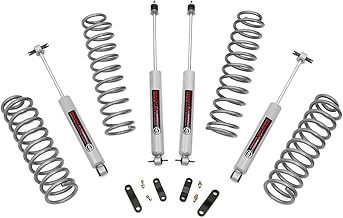
Quadratec Maximum Duty 2.5” with Nitro 8.0 Shocks
The Quadratec kit steps up to Nitro 8.0 shocks, which handle the extra unsprung weight of 35s better than the Rough Country units. It is specifically designed for the 4-door JKU and is the kit to consider if you are running an Unlimited and want a mid-range option. Note that the Quadratec literature rates it for tires up to 34 inches. 35s are right at the edge of its stated spec, which is worth knowing.

TeraFlex 1251000 2.5” Lift with All Four Shocks
The TeraFlex kit is the premium option in this bracket. All four shocks are included, the kit is designed for real trail use, and it handles the caster geometry more seriously than the budget alternatives. At nearly $1,000, it costs more. But it is built for owners who plan to run 35s on actual trails rather than just paved roads. For ICON lift kits for the JK reviewed, that review covers the top-tier bracket if you want to compare.
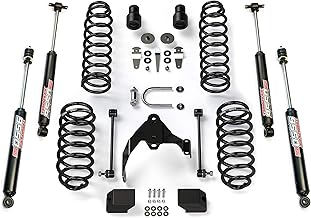
On caster correction specifically: If you buy any kit that does not include it, these drop brackets are worth having:
Body lift vs. suspension lift: A body lift raises the body off the frame but does not change suspension geometry or ground clearance under the axles. It is cheaper but does not solve the tire clearance problem the same way. Suspension lifts raise the axle travel, which is what creates the meaningful clearance for 35s. For 35-inch tires, a suspension lift is the right answer.
Manual vs. automatic differences: The lift kit itself is the same for manual and automatic JKs. The difference shows up in companion mods, specifically regearing. The automatic transmission’s torque converter behavior makes it slightly more tolerant of tire size, but not tolerant enough to avoid regearing if you plan on trail use.
Which 35-Inch Tires Actually Work Best on a Lifted JK?
The correct tire size for 35-inch tires on a 17-inch JK wheel is LT315/70R17. This is the standard fitment that most lift and wheel setups are designed around, and it is the size you should base your clearance planning on.
LT315/75R16 is the alternative for 16-inch wheel setups. Both measure close to 35 inches in overall diameter, and both are what JK owners mean when they say ”35s.”
Two tires worth knowing about in context:
The Falken Wildpeak AT3W is widely rated by JK owners as one of the best all-terrain tires available. However, the specific listing here — 235/65R17 — is not a 35-inch tire. It is a compact-SUV size, included in the product library but not relevant to a 35-inch fitment:

If you want a Wildpeak AT3W in a true 35-inch size, look for the LT315/70R17 listing specifically. The 235/65R17 shown here is not it.
The Goodyear Wrangler TrailRunner AT is another respected option, but the listing here is in LT275/65R20 — a 20-inch wheel fitment that does not match the 17-inch wheels most JK owners run:

Both of these products illustrate a common pitfall: searching for a tire brand without confirming the specific size SKU. For a complete roundup of 35-inch tires that actually fit the JK in the right sizes, see best 35-inch tires for the JK. For broader terrain-specific advice, best all-terrain tires for the JK and best rock crawling tires for the JK cover the terrain-use decision in depth.
Regearing, Spare Carriers & Other Mods You’ll Need With 35-Inch Tires

Running 35-inch tires on a JK without regearing is technically possible. Realistically, most owners find that the 3.73 factory gears become noticeably sluggish, especially on the automatic transmission where the torque converter labors more than a manual clutch does.
The JK community threshold for 35s is clear: 4.10 gears are the practical minimum; 4.56 gears are the preferred ratio if you plan to do real trail work. At 3.73 from the factory, 35s make the JK feel underpowered at low speeds, slow the highway cruising RPM, and put more heat into the automatic transmission over time.
For the automatic transmission (the NSG370 automatic paired to the 3.6L Pentastar), JK owners consistently report that 35s on 3.73s make the transmission hunt for gears on highway inclines and trail climbs. Regearing to 4.10 or 4.56 restores the power band and reduces transmission stress.
For the manual transmission (the NSG370 6-speed), the driver has more direct control over gear selection, which makes the same tire size slightly more manageable. Regearing is still the right call for trail use. The manual’s tolerance for 35s without a regear is marginally higher in everyday driving, but not on sustained climbs.
The spare tire question is one that many buyers overlook until after the lift and tires are installed. The factory spare carrier is not rated for a 35-inch tire. You need an aftermarket carrier like the Spare Tire Carrier for Wrangler JK JKU:
You can also consider the width-adjustable spare carrier model:
Both carriers are designed for the JK and JKU (2007-2018) and are rated to 37-inch tires, giving you room to grow. The width-adjustable model suits owners who want flexibility across different wheel widths.
Full 35-inch setup cost breakdown:
- 2.5-inch suspension lift kit: $400 – $970
- Four 35-inch tires (LT315/70R17): $900 – $1,400
- Aftermarket wheels (set of 5 including spare): $700 – $1,100
- Fender liner trimming (DIY): $0 – $30 in tools
- Regearing (front and rear axles, labor included): $1,200 – $2,000
- Spare tire carrier: $149 – $200
- Total estimated range: $3,350 – $5,700
For rear bumpers that include integrated spare tire carrier mounts, see JK rear bumpers with tire carrier mounts. For overall JK ownership planning, the JK buyers guide covers the full picture.
Frequently Asked Questions: 35-Inch Tires on a 2.5-Inch Lift JK
What size lift kit is needed to fit 35-inch tires on a JK Wrangler? A minimum of 2.5 inches of suspension lift is needed to fit 35-inch tires on a Jeep Wrangler JK without constant rubbing. At 2.5 inches you will still need to trim the front fender liner for full-lock clearance. A 3.5-inch lift gives more margin and is the more comfortable choice for owners who want to avoid trimming or who run the steering at full lock frequently on trails.
Can 35-inch tires be installed on a stock Jeep Wrangler without modifications? No. A stock JK does not have the clearance for 35-inch tires. The tires will rub the front fender liner at anything approaching full steering lock, and the wheel wells cannot accommodate the extra diameter without body contact during suspension travel. At minimum you need a suspension lift and liner trimming before 35s can be run safely.
What is the total cost of a 2.5-inch lift and 35-inch tire setup? Expect to spend between $3,350 and $5,700 for the full package — lift kit, four 35-inch tires, a set of five aftermarket wheels, spare carrier, and a regear. DIY trimming costs almost nothing. Regearing is the most expensive single line item if you use a shop, typically $1,200 to $2,000 for both axles including labor.
Which lift kit brands work best for JK Wranglers? Rough Country, Quadratec, TeraFlex, ICON, and Old Man Emu are the brands most frequently cited in the JK community for 2.5-inch lifts. The right brand depends on your budget and use case: Rough Country for budget-first buyers, TeraFlex and ICON for serious off-road use. Any kit you choose should include or be paired with caster correction for 35-inch tire use.
What gear ratio should be used with 35-inch tires on a JK? The JK community broadly recommends 4.10 gears as the minimum and 4.56 gears as the preferred ratio for 35-inch tires. Stock 3.73 gears leave the JK feeling sluggish, particularly at low trail speeds and on highway grades. Regearing restores the original power delivery and protects the transmission from sustained overload.
Is a body lift or suspension lift better for a JK running 35-inch tires? A suspension lift is the correct choice for 35-inch tires. A body lift raises the body off the frame but does not improve axle clearance or suspension travel — the two things that most affect tire fitment. Suspension lifts change the geometry in ways that actually create clearance for larger tires. Body lifts are better suited for owners who want to fit slightly wider tires without changing ride height.
Do 35-inch tires require regearing on a JK automatic transmission? Yes. JK owners with automatic transmissions consistently report that 35-inch tires on stock 3.73 gears cause the transmission to hunt on grades, reduce highway fuel economy noticeably, and add heat to the gearbox over time. Regearing to 4.10 or 4.56 is not optional for owners who plan on trail use or any significant highway driving.
What tire options are available for a lifted JK Wrangler? The standard 35-inch tire size for 17-inch JK wheels is LT315/70R17. For 16-inch wheels, LT315/75R16 achieves approximately the same overall diameter. Popular brands in this size include the Falken Wildpeak AT3W, BFGoodrich KO2, Nitto Ridge Grappler, and Toyo Open Country AT3, but confirm you are buying the correct size SKU, not just the brand name. See the best 35-inch tires for the JK roundup for specific fitment-verified picks.
How much lift is sufficient for running 33-inch tires? Two inches of suspension lift is generally sufficient for 33-inch tires on a JK, often with little or no fender trimming required. A leveling kit in the 1.5 to 2-inch range can also work for 33s on some JKs. For the full guide on big tire fitment across all sizes, see full guide to running big tires on a JK.
Are there differences in lift kit requirements between manual and automatic JKs? The lift kit hardware is identical for manual and automatic JKs. The difference shows up in regearing thresholds and companion mods. Manual transmission JKs are marginally more forgiving on 35s without a regear because the driver controls gear selection directly. Automatic JKs benefit more immediately from regearing because the torque converter cannot be manually managed the same way. For best tires for the Jeep Wrangler JK, the transmission question does not change which tires you choose — only how urgently you should address the gearing.
The Bottom Line: Is a 2.5-Inch Lift the Right Choice for 35-Inch Tires?
A 2.5-inch suspension lift can support 35-inch tires on a JK — but it demands trimming, careful wheel offset selection, and an honest assessment of how you use the vehicle. It is not the wrong choice. It is the minimum viable choice, and the gap between minimum and comfortable is work you will do in the driveway.
Here is a simple decision framework:
- Choose 2.5 inches if budget is the constraint, you are willing to trim the liners, and your use is mixed street and light trail
- Choose 3.5 inches if you want more margin, avoid trimming, and plan regular off-road use with 35s
- Stay at 33 inches if your lift budget is under $400 and you want clean fitment without any additional mods
The same principle that drives this site’s approach to every recommendation applies here: spec sheets tell you what a product is rated for. JK owners tell you what it actually does. Research built from real community knowledge — not marketing copy — is what actually prepares you for a modification like this.
For mod prioritization across your budget, JK mods prioritised by budget is the logical next stop. If 35-inch tires lead you toward more serious trail builds, beadlock wheels for the JK covers the wheel upgrade that often follows.
Free: JK Fluids at a Glance
Every fluid, spec and capacity for the 2007-2018 Wrangler JK on one page, plus a cut-out glovebox card. Checked against the owner's manuals. From the JK Service Kit.
Email me the download and new guides when they are published. Unsubscribe anytime. Privacy Policy.
Allan
I'm Allan. I own a 2014 Jeep Wrangler JKU and I research the hell out of every mod before I touch it. When I've fitted something to my own Jeep, I say so. Everything else is researched from manufacturer specs and other owners' reports. No sponsored fluff.
Learn more about me →Free: JK Fluids at a Glance
Every fluid, spec and capacity for the 2007-2018 JK on one page, plus a glovebox card.
Email me the download and new guides when they are published. Unsubscribe anytime. Privacy Policy.
Related Articles
Best Spare Tire Covers for Jeep JK: Fit, Material & Style Guide
A Jeep JK spare tire cover is a shaped vinyl, PVC leather, or hard plastic shell that fits over the exposed spare mounted on your rear door or swing-away...
Jeep JK Stroker Kit: 3.8L & 3.6L Engine Displacement Upgrades Explained
A jeep stroker kit swaps in a crankshaft with a longer stroke, increasing engine displacement and, most critically, low-end torque without boring out the block.
Jeep JK Regear vs Locker: Which Upgrade Comes First?
Ask ten JK owners which comes first, a regear or a locker, and you'll get the same answer from nine of them: regear first, locker second.