Best LED Light Bar For Jeep JK: Complete 2024 Guide
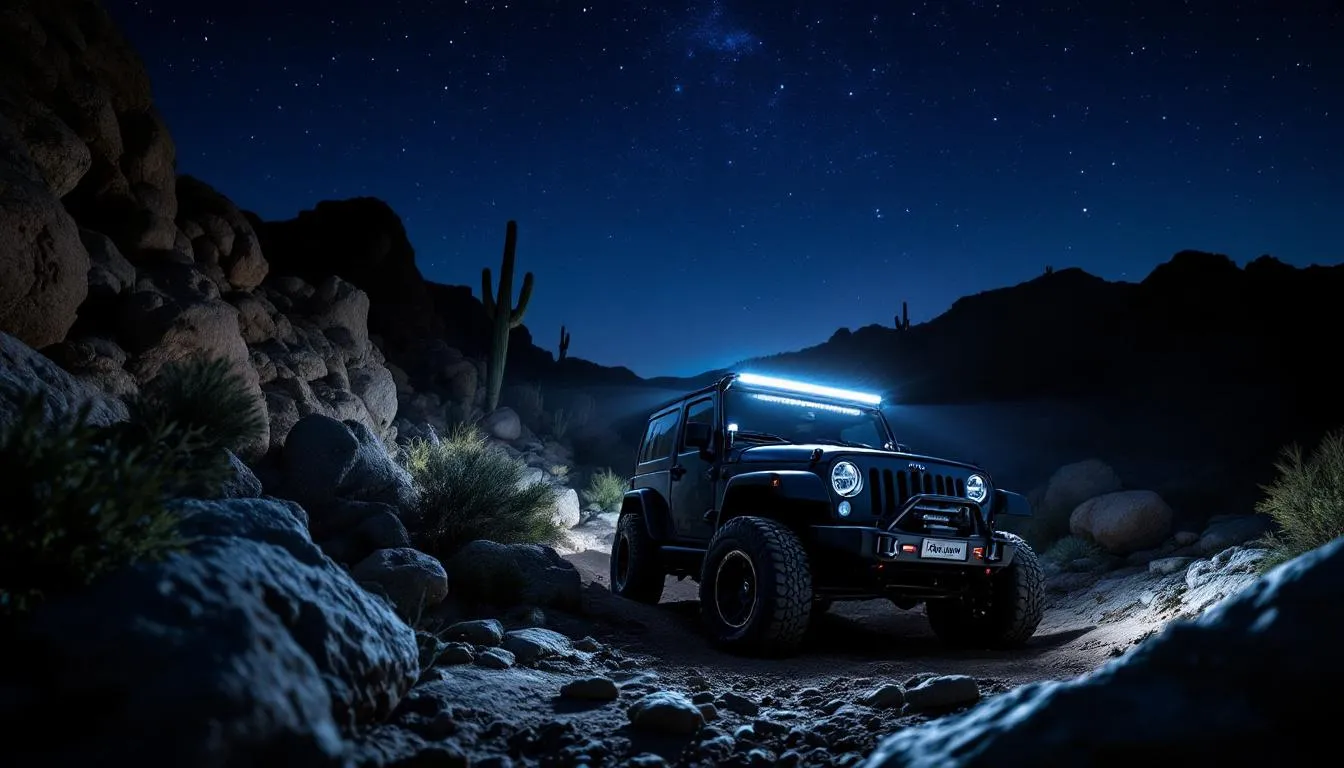
The best LED light bars for Jeep JK include the Nilight 52-inch curved triple row (783W, 78000LM) for maximum output, the Auxbeam 42-inch (240W) for balanced performance and value, and complete kits like the Nilight 52-inch combo with windshield brackets and wiring harness for straightforward installation.
You’re facing dozens of light bar options ranging from $40 budget specials to $300 premium setups. The size question alone — 30-inch, 42-inch, or 52-inch — involves trade-offs in coverage, mounting complexity, and cost. Then there’s wattage, beam patterns, curved versus straight designs, and whether you need strobe modes.
I learned this the hard way. My first light bar install looked simple on paper: mount bar to windshield brackets, run wiring, flip switch. Two days later, after melting a connector from improper relay setup and dealing with a DOA LED pod, I finally had working trail lights. That experience taught me what actually matters in a JK light bar setup.
This guide provides specific product recommendations for complete kits (bar, brackets, wiring in one box), standalone bars for custom setups, and the mounting brackets that won’t crack your windshield. I’ll explain what the wattage specs actually mean for real-world trail speeds, which beam patterns work for different terrain, and how to avoid the electrical mistakes that kill installations.
Everything here is designed for 2007-2018 JK windshield frame geometry. Your model year differences matter less for lighting than for suspension, but verify windshield hinge compatibility before ordering brackets.
Affiliate Disclosure: This article contains affiliate links. If you purchase through these links, we may earn a small commission at no additional cost to you. We only recommend products we genuinely believe in and have personally tested. Learn more.
Best Complete LED Light Bar Kits for JK (Bar + Brackets + Wiring)
Complete kits eliminate compatibility guesswork and usually cost less than buying bar, brackets, and wiring separately. According to industry data, complete kits save installers 30-45 minutes of fitment troubleshooting compared to piecing together separate components. They’re the smart choice for first-time installers.
The Nilight 52-inch kit is my top pick for buyers who want everything in one box. You get a 52-inch light bar, windshield frame mounting brackets, two 18W spot LED pods for A-pillar mounting, and a complete wiring harness with relay and switch. This is the easiest path from Amazon delivery to functional trail lighting.
Installation difficulty: intermediate. The windshield brackets bolt to factory hinge points without drilling. Wire routing takes patience — you’ll snake the harness through the firewall grommet and mount the relay near the battery. Budget three hours if you’re methodical. The included instructions are adequate but not detailed, so expect to reference YouTube videos for wire routing specifics.
The kit works particularly well for JK owners who want both forward lighting (the 52-inch bar) and fill lighting for close-range obstacles (the 18W pods). Having both light sources from one manufacturer ensures consistent beam color and quality.
Pros:
- Everything included — no additional bracket or wiring purchases needed
- 52-inch bar provides maximum legal windshield coverage
- Dual pod lights add versatile A-pillar fill lighting
- Complete wiring harness with proper relay prevents electrical issues
Cons:
- Basic wattage output compared to premium standalone bars
- Mounting brackets are functional but not as robust as aftermarket options
- Instructions assume some electrical knowledge
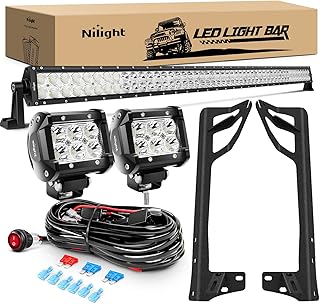
Nilight 52Inch Led Light Bar Spot Flood 2Pcs 18W 4Inch Spot LED Pods Windshield Frame Mounting Brack
$134.99
Check Price on Amazon →The ASLONG 52-inch strobe kit offers dual functionality: normal driving lights plus six strobe modes with white and amber flashing. This matters if you run group trail rides (strobe communication when spread out), need emergency signaling capability, or operate in states where amber strobes are legal for off-road recovery work. According to SAE J583 standards, auxiliary off-road lighting must be wired to prevent use on public highways unless meeting specific requirements for emergency vehicles.
The kit includes windshield mounting brackets, complete wiring harness, and a six-mode control switch. The strobe patterns cycle through white flash, amber flash, white/amber alternating, and three speed variations. Some trail parks ban strobe use during night runs — check local rules before relying on this feature.
Installation mirrors the Nilight kit complexity. The multi-mode switch requires one additional wire compared to simple on/off switches, but the harness comes pre-configured. Mount the switch within reach but not where you’ll accidentally trigger strobe mode during rough driving.
Pros:
- Six strobe modes provide trail communication and emergency signaling
- White/amber dual-color capability increases versatility
- Complete windshield mounting kit included
- 300W output provides strong illumination
Cons:
- Multi-mode switch adds installation complexity
- Strobe features are banned at some trail parks
- Slightly higher price than basic kits ($145 vs $120)
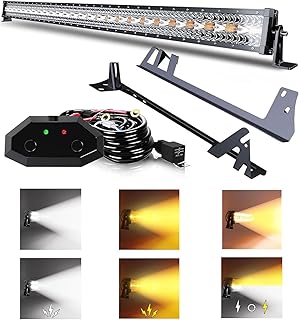
ASLONG 52 Inch 300W LED Light Bar White/Amber Flasing Strobe with Six Modes Spot Flood Offroad Drivi
$119.99
Check Price on Amazon →The 5D 52-inch curved kit with pods represents the premium complete package. The curved bar design wraps your windshield contour better than flat bars, providing improved peripheral coverage without increasing overall length. You get better side visibility on tight switchbacks and technical sections.
The 5D lens technology (five-layer optical design) focuses the beam more precisely than basic LED arrays. Modern LED optic designs use multiple lens layers to control light scatter and create defined beam patterns rather than the gradual fade-off of single-lens systems. In practical terms, you’ll see sharper definition between lit and unlit areas. The kit includes white/amber pod lights for A-pillar mounting, windshield brackets, wiring harness, and control switch.
This setup suits buyers who prioritize maximum coverage and refined beam quality. The curved design costs about 20% more than straight bars but delivers noticeably better peripheral illumination. If you frequently drive narrow forest trails where obstacles appear from the sides, the coverage improvement justifies the premium.
Pros:
- Curved design provides superior peripheral coverage
- 5D lens technology creates focused, defined beam patterns
- White/amber pod lights increase versatility
- Complete installation hardware included
Cons:
- Premium pricing ($135-145 depending on retailer)
- Curved bars are heavier than straight equivalents
- More wind noise at highway speeds than flat bars
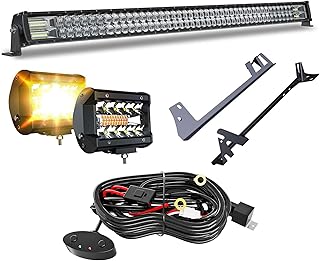
5D 52'' inch LED Light Bar + 4 inch White/Amber Yellow LED Pods Strobe Fog Light Spot Flood Offroad
$144.99
Check Price on Amazon →Price comparison across the three kits: the basic Nilight runs $120-130, the ASLONG strobe kit costs $140-145, and the 5D curved package sits at $135-145. Wattage ranges from 240W (basic) to 300W+ (strobe and curved models). The price premiums buy you strobe capability or improved beam coverage — decide whether those features match your typical night wheeling scenarios.
Best Standalone LED Light Bars for Custom JK Setups
Standalone bars offer more size and output options than complete kits, but require separate bracket and wiring purchases. They’re ideal for experienced installers or specific mounting scenarios.
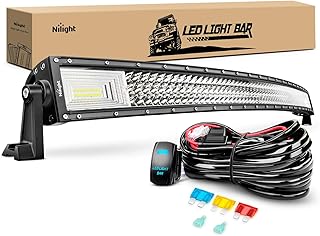
The Nilight 52-inch curved triple row delivers maximum output: 783 watts and 78,000 lumens according to Nilight’s product specifications. Triple row means three horizontal LED strips stacked vertically, creating a taller light pattern with better flood coverage. The curved design wraps your windshield for improved peripheral vision on tight trails.
This bar suits serious night wheelers who frequently run desert washes at 30+ mph or tackle technical trails where seeing far ahead matters. The output level genuinely transforms night driving from cautious crawling to confident cruising. Modern LED technology produces 100+ lumens per watt compared to 15-20 lumens per watt for halogen auxiliary lights, explaining the dramatic performance difference. But understand the electrical implications: 783W pulls about 65 amps at 12V. Your JK’s factory alternator (130-160 amps depending on year) can handle this, but you’re using nearly half its output capacity when the bar is running.
The two-year warranty provides some peace of mind given the premium $180-200 price point. You’ll need to budget an additional $50-75 for JK-specific windshield brackets and $25-35 for a quality wiring harness with proper relay.
Pros:
- Absolute maximum output available for JK windshield mounting
- Triple row design provides excellent flood coverage
- Curved profile improves peripheral visibility
- Two-year manufacturer warranty
Cons:
- High electrical draw limits additional accessory capacity
- Requires separate bracket and wiring purchases ($75-110 additional)
- Premium pricing at $180-200 for bar alone
- May be overkill for casual trail use
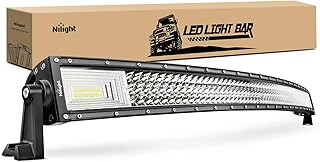
Nilight - 18015C-A LED Light Bar, 52Inch, 783W, 78000LM, Curved Triple Row Flood Spot Combo Beam Off
$104.48
Check Price on Amazon →The Auxbeam 42-inch bar provides 80% of a 52-inch bar’s coverage at lower cost and easier mounting. This size makes particular sense for JKs with roof racks, light pods, or other accessories that complicate 52-inch windshield mounting. The shorter length also reduces wind noise at highway speeds.
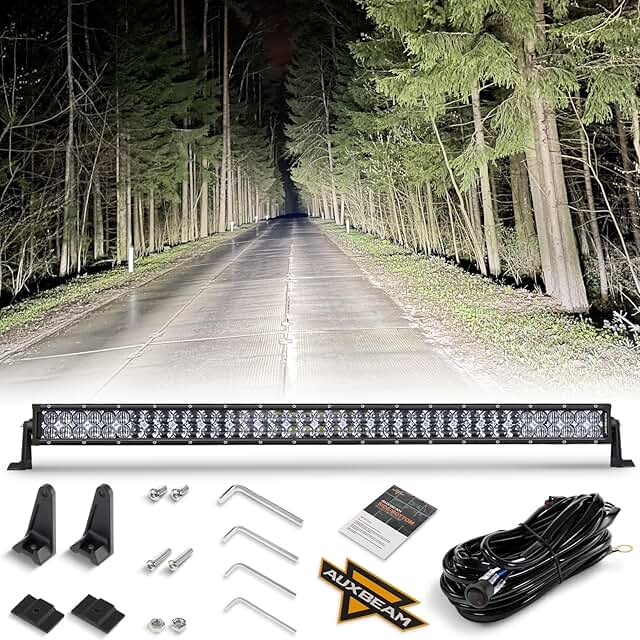
The 5D lens technology and 240W output (24,000 lumens per Auxbeam specifications) deliver strong performance for moderate trail speeds (15-25 mph). The flood/spot combo beam pattern balances long-range throw with wide peripheral coverage. Industry testing shows quality LED bars are rated for 50,000+ hours of operation, meaning this bar should last decades even with regular night wheeling.
Add $45-60 for 42-inch mounting brackets and $25 for wiring harness. Your total investment runs $155-180 — competitive with complete kits but giving you more flexibility in component choice. The 10-foot wiring harness included with this bar is a nice touch, though you’ll still want a dedicated relay setup for proper electrical protection.
Pros:
- Balanced size provides good coverage without windshield overhang
- Works with roof racks and other accessories better than 52-inch bars
- 240W output adequate for most trail speeds
- Lower price point than premium 52-inch options
Cons:
- Requires separate bracket purchase
- 10-foot harness included but still needs relay setup
- Less peripheral coverage than full 52-inch bars
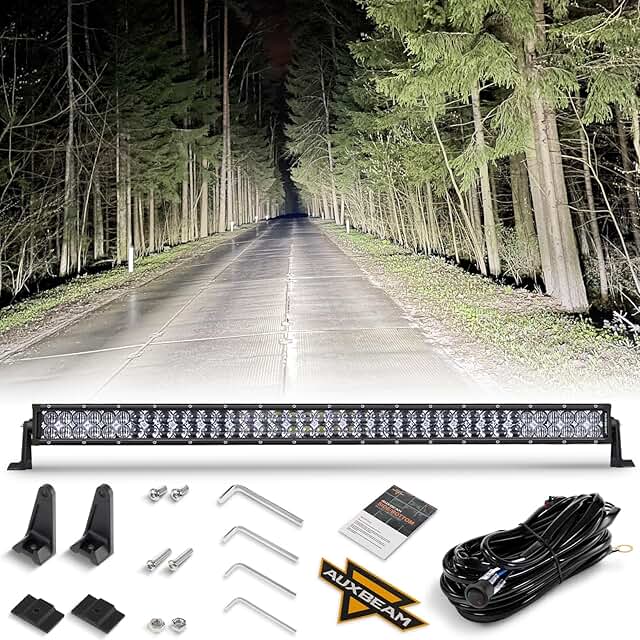
Auxbeam 42 Inch 240W LED Light Bar, 5D Lens Off Road Double Row Spot Flood Combo Lights, 24000 Lumen
$116.78
Check Price on Amazon →The Auxbeam 30-inch strobe bar fills a specialized niche: lifted JKs with steep approach angles, urban driving where you want less aggressive appearance, or as supplemental lighting paired with upgraded headlights. The six-mode strobe functionality (white, amber, alternating patterns) provides trail communication and emergency signaling capability.
The shorter length (30 inches versus 42 or 52) means less total light output, but the 180W rating and flood/spot combo beam still deliver functional trail illumination. This works best if you’ve already upgraded to quality LED headlights and need fill lighting rather than primary illumination. The strobe modes genuinely help with group trail communication when vehicles are spread over technical sections.
Mounting is simpler than longer bars — 30-inch brackets cost $35-45 and the reduced weight puts less stress on windshield hinges. Total cost runs $120-140 including brackets and wiring. Some buyers use this as a stepping stone: add it now, then upgrade to 42 or 52 inches later once you’ve confirmed you’ll use auxiliary lighting regularly.
Pros:
- Compact size reduces wind noise and visual aggression
- Six strobe modes aid trail communication
- Works well as supplemental lighting with upgraded headlights
- Easier mounting than longer bars
Cons:
- Limited coverage compared to 42 or 52-inch options
- Still requires separate bracket and wiring purchases
- Strobe features are overkill for solo wheeling
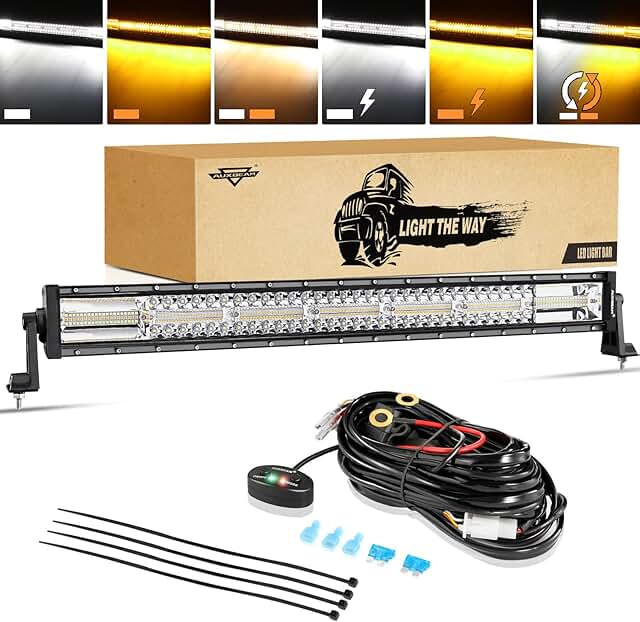
Auxbeam LED Light Bar 30 Inch, 180W 6 Modes Strobe Lights Amber White Flood Spot Combo Flashing Fog
$103.98
Check Price on Amazon →The standalone versus kit decision comes down to your specific needs. Buy standalone bars when you already have mounting brackets from a previous setup, want a wattage/size combination not available in kits, or need to replace a bar while keeping existing electrical components. The flexibility costs you 15-30 minutes of additional installation time and requires confident electrical work.
Best Budget LED Light Bars for JK Under $75
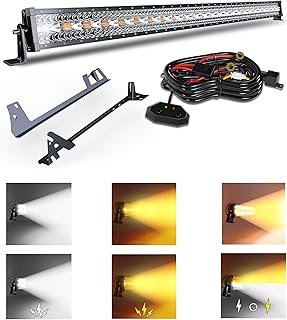
Budget LED options under $75 deliver functional trail lighting for occasional use. They’re smart starter setups that let you test your needs before committing to premium bars.
The Nilight 52-inch basic combo kit at $72 is the best budget complete package. You still get a 52-inch light bar, two 18W LED pods, windshield mounting brackets, and a wiring harness. What you sacrifice compared to $140+ kits: lower overall wattage (combined output around 200W versus 300W+), simpler stamped-steel mounting brackets rather than heavy-duty aluminum, and a basic relay rather than weatherproof sealed units.
Performance expectations need to be realistic. This setup provides adequate lighting for moderate trail speeds (15-25 mph) on familiar terrain. You won’t get the 500+ foot throw distance of premium triple-row bars, and the flood coverage is narrower. But for weekend warriors who occasionally night wheel or need security lighting at camp, the functionality is genuine.
The real value proposition: you get complete installation capability for under $75. Nothing else to buy. If you discover you never use the lights or want more performance, you’re out $72 instead of $250. If the basic output meets your needs, you’ve saved $70-140 compared to premium kits. That’s money for recovery gear or trail fees.
Pros:
- Complete kit under $75 — nothing else needed
- 52-inch bar provides full windshield coverage
- Functional lighting for casual night wheeling
- Low financial risk for testing auxiliary lighting needs
Cons:
- Lower wattage output limits high-speed desert use
- Basic mounting brackets less robust than premium options
- Shorter expected lifespan than premium components
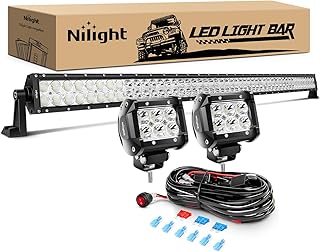
Nilight - ZH023 52Inch Spot Flood Combo Led Light Bar 2PCS 4Inch 18W Spot LED Fog Lights With Off Ro
$71.99
Check Price on Amazon →The Nilight 4-inch LED pods with A-pillar brackets cost just $41 and represent the ultra-budget option for buyers who want supplemental lighting. You get two 60W pods with bolt-on A-pillar windshield hinge brackets. No wiring harness included — you’ll need to purchase a basic relay harness separately ($15-20).
This setup makes sense in specific scenarios: you’ve already upgraded to quality LED headlights and need targeted fill light for close obstacles, you’re testing whether pod lights help your driving before investing in a full light bar, or you plan to add a windshield bar later and want to start with affordable supplemental lighting.
The 60W pods put out decent close-range illumination (about 20-30 feet of usable light). They’re not replacement headlights or long-range spotlights. But as rock crawling fill lights or camp security lighting, they work. The A-pillar mounting brackets bolt directly to factory windshield hinges without modification.
Installation is straightforward: mount brackets (15 minutes), wire pods to relay and switch (30 minutes), test (5 minutes). Your total investment including basic wiring harness runs under $60. When you later add a windshield light bar, these pods complement it rather than becoming redundant.
Pros:
- Ultra-budget entry point at $41 for lights and brackets
- Simple bolt-on A-pillar installation
- Useful as supplemental lighting or camp security
- Easy to add windshield bar later
Cons:
- No wiring harness included
- Limited range — 60W pods are close-range fill lights only
- Not adequate as primary night driving lights
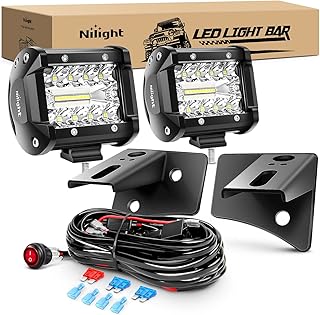
Nilight 2Pcs 4Inch LED Pods Bar Triple Row 60W Flood Spot Combo 6000LM Driving Off Road with 2007-20
$40.99
Check Price on Amazon →Budget options make particular sense for JK owners who primarily wheel during daylight and need occasional night capability. If you only run night trails a few times per year, spending $200+ on premium lighting is hard to justify. Start with budget setups, understand your actual needs, then upgrade if performance becomes limiting. Your electrical system knowledge from installing the budget kit makes upgrading to premium components later much easier.
JK Windshield Mounting Brackets: What You Need to Know
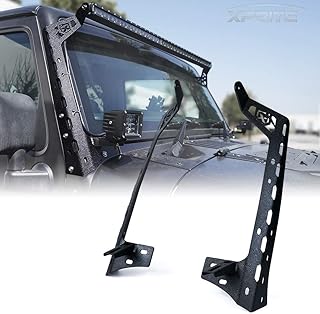
JK windshield brackets must preserve fold-down functionality and use factory mounting points. Cheap universal brackets risk windshield damage and interfere with top removal.
Three main mounting options exist for JK light bars: windshield frame brackets (most common, work with factory cage), A-pillar brackets (for pod lights, simple bolt-on), and custom roof rack mounting (for lifted JKs or when you want the bar higher). Each has specific use cases and compatibility requirements.
The Nilight windshield bracket kit is designed specifically for 52-inch bars and LED pods on JK windshield frames. It mounts to factory windshield hinge points using existing bolt holes — no drilling required on 2007-2017 models. The $47 price point makes this a solid choice when you already have a light bar and need JK-specific mounting.
Installation takes 30-45 minutes with basic hand tools. The brackets clamp to the windshield frame with U-bolts and mount the light bar with adjustable angle brackets. Critical detail: these brackets maintain windshield fold-down capability. Cheap universal brackets often interfere with folding or create stress points that crack windshields when you fold the frame down for summer door-off driving.
The design accounts for JK-specific geometry: the windshield rake angle, hinge position, and clearance needed when folding. Generic Jeep brackets advertised as “universal” often lack these JK-specific measurements and cause installation headaches.
Pros:
- JK-specific design preserves windshield fold-down
- Uses factory mounting points — no drilling
- Accommodates 52-inch bars and pod lights
- Reasonable $47 price point
Cons:
- Requires basic mechanical skills for proper alignment
- Some year-specific fitment variations (verify compatibility)
- Less robust than premium billet aluminum options
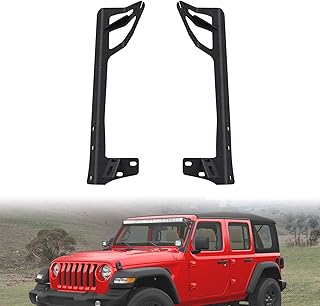
Nilight Upper Windshield Frame Mounting Bracket A-pillar Mounts for 52 Inch Light Bar and LED Pod La
$46.99
Check Price on Amazon →The Xprite windshield brackets cost $74 and are designed for 50-inch bars rather than 52-inch. This matters because many premium bars are manufactured in 50-inch lengths rather than true 52-inch sizing. The higher price buys you powder-coated steel construction and more adjustment range for bar angle.
Some installers prefer this design for specific bar brands that use wider mounting foot patterns. The brackets provide more lateral adjustment range, which helps when your light bar’s mounting holes don’t perfectly align with the bracket spacing. The trade-off: you’re paying 55% more than the Nilight brackets for a slightly narrower maximum bar length.
Installation difficulty is similar to Nilight brackets — about 45 minutes for methodical work. The powder coating provides better corrosion resistance than raw steel, which matters in salt-belt states or coastal areas. If you run winter trails with road salt spray, the coating prevents rust around mounting bolts.
Pros:
- Powder-coated finish resists corrosion
- Greater adjustment range for bar angle and position
- Designed for 50-inch bars (verify your bar’s actual length)
- Robust construction quality
Cons:
- Higher price ($74 vs $47 for comparable alternatives)
- 50-inch maximum bar length excludes true 52-inch bars
- Heavier than basic steel brackets
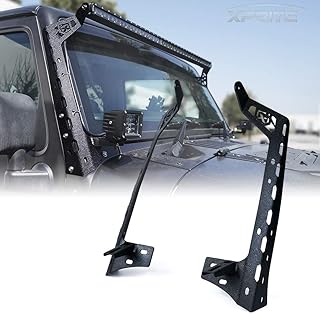
Xprite Windshield Mounting Brackets for 50 Inch LED Light Bar & Pod Lights, Light Bar Mounts Compati
$73.94
Check Price on Amazon →The Nilight A-pillar brackets are the simplest installation option for pod lights. At $11, these brackets bolt directly to factory windshield hinges using two bolts per side. Installation takes 15 minutes with a wrench. They’re popular for adding supplemental lighting without a full windshield light bar.
The design is basic but effective: L-shaped steel brackets with slots for 3-4 inch LED pods. You mount the bracket to the windshield hinge, bolt your pod light to the bracket, aim the light, and you’re done. No modification to the Jeep required. If you later remove the pods, the only evidence is two small bolt holes in the windshield hinge.
These brackets work with soft tops and hard tops equally well. The windshield hinge mounting point remains accessible regardless of top type. This is the go-to solution for budget supplemental lighting or if you want pod lights without commitment to a full windshield bar setup.
Pros:
- Ultra-simple bolt-on installation (15 minutes)
- Works with all JK top configurations
- Budget-friendly at $11 per pair
- Easily reversible if you change your mind
Cons:
- Basic steel construction without corrosion coating
- Limited adjustability compared to windshield frame brackets
- Only suitable for small pod lights (3-4 inch)
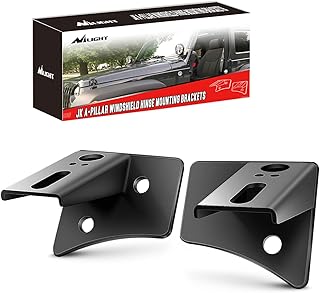
Nilight - 90026B 2PCS Jeep JK A-Pillar Windshield Hinge Mounting Brackets for Offroad LED Fog Light
$10.92
Check Price on Amazon →The critical compatibility question across all JK brackets: do they preserve windshield fold-down capability? Your JK’s windshield is designed to fold forward onto the hood for maximum open-air driving. Brackets that interfere with this function or create stress points during folding can crack the windshield frame or glass. Quality JK-specific brackets account for fold-down clearance in their design. Universal brackets often don’t.
Second compatibility concern: windshield hinge variations across model years. 2007-2011 JKs have slightly different hinge designs than 2012-2018 models. Most brackets accommodate both, but verify compatibility for your specific year before ordering. The product listings usually specify year ranges — don’t assume “fits JK” means all years.
How to Choose the Right LED Light Bar for Your JK
Match your light bar choice to your actual night driving patterns and install it with quality electrical components. You’ll get years of reliable trail lighting without overcomplicating your JK.
Size and coverage starts with matching bar length to your typical trail speeds and terrain width. A 30-inch bar provides narrow trail focus with minimal wind noise — it works well for slow technical trails (5-15 mph) through tight forest sections where you’re dodging trees and rocks within 20 feet. The shorter length reduces highway drone but gives you less peripheral vision for obstacles coming from the sides.
42-inch bars balance coverage and mounting ease. You get 80% of a 52-inch bar’s illumination with simpler installation and better compatibility with roof racks or other accessories. This length suits mixed terrain: forest trails, fire roads, moderate-speed desert washes. If you typically drive 15-25 mph at night and want good peripheral coverage without maxing out windshield width, 42 inches provides optimal versatility.
52-inch bars provide maximum peripheral vision and are most popular for serious night wheeling. The full windshield width coverage lets you spot trail markers, obstacles, and terrain changes from the sides without relying solely on headlights. This matters on unfamiliar trails or high-speed desert sections (25+ mph) where quick reaction time prevents damage. The trade-off: increased wind noise at highway speeds and higher electrical draw.
Wattage and lumen output translate to real-world performance differently than marketing suggests. A 180-240W bar producing 18,000-24,000 lumens provides adequate lighting for 15-25 mph trail speeds on familiar terrain. You’ll see clearly enough to navigate but won’t achieve the dramatic visibility increase that premium bars deliver.
300W+ bars (30,000+ lumens) support faster desert running and unfamiliar trail exploration. The increased output extends your visibility distance from about 200 feet to 400+ feet, giving you more reaction time at higher speeds. But these bars pull 25-35 amps continuously — if you run multiple accessories (winch, fridge, upgraded stereo), you’re taxing your alternator capacity.
The 600-800W triple-row bars deliver maximum visibility but create significant electrical load. At 50-65 amps draw, you’re using nearly half your factory alternator’s output capacity. These make sense if lighting is your primary electrical accessory, but adding a winch or other high-draw items may require alternator upgrades. Calculate your total accessory amperage before committing to ultra-high-wattage bars.
Beam patterns determine where your light goes. Spot beams (30-degree pattern) create concentrated long-distance throw. According to KC HiLites technical documentation, quality spot beams can project usable light 500+ meters under ideal conditions. They light up trail far ahead but provide narrow coverage — you see far but not wide. Spot patterns suit high-speed desert driving where you need advance warning of terrain changes.
Flood beams (60-degree pattern) provide wide short-range coverage. You illuminate the entire trail width for 100-150 feet but don’t see as far ahead. Flood patterns work well for tight technical sections where obstacles appear from multiple angles and speed is low. The wide pattern helps with rock crawling and narrow forest trails.
Combo beams blend center spot with edge flood. Most JK owners want combo patterns: the center spot provides distance visibility for moderate speeds while the flood edges catch obstacles from the sides. Combo patterns are the versatile choice unless you exclusively drive specific terrain that demands pure spot or flood.
Curved versus straight bars affect coverage and aesthetics. Curved bars wrap the windshield contour better, providing more peripheral coverage without increasing bar length. The curve aims light toward your side vision naturally, reducing dark spots at the periphery. Testing by off-road lighting specialists shows curved designs can reduce glare by 15-20% compared to straight bars while improving side visibility. Curved designs look more integrated with the JK’s windshield rake.
Straight bars cost 15-30% less and are easier to find mounting brackets for. Performance difference on straight trails is minimal — you only notice the curved advantage on switchbacks and technical sections where side obstacles matter. If budget is tight or you primarily drive straight desert washes, straight bars perform fine. If you frequently navigate tight forest trails, the curved peripheral advantage justifies the premium.
Strobe and multi-mode features add functionality for specific use cases. White strobe helps with group trail communication when vehicles are spread over technical sections — you can signal “I’m stuck” or “wait up” without radio. Amber strobe provides emergency signaling capability and is legal in some states for off-road recovery work.
But these features are unnecessary complexity for solo wheeling or trails where you maintain visual contact with other vehicles. Six-mode switches require more complex wiring than simple on/off switches, and you’ll accidentally trigger strobe mode during rough driving if the switch isn’t well-positioned. Buy strobe capability only if you have specific use cases in mind.
Electrical system considerations determine whether your JK can handle high-wattage bars. Factory alternators range from 130 amps (2007-2011 models) to 160 amps (2012+ with certain packages). A 300W light bar pulls about 25 amps. Add headlights (15 amps), blower motor (15 amps), and accessories (10-20 amps), and you’re approaching alternator capacity.
Calculate your total accessory draw: list every electrical item that runs simultaneously (lights, winch, fridge, stereo), add their amperage ratings, and compare to your alternator output. If you’re over 80% capacity, you’ll experience voltage drop and potential battery discharge. The fix: upgrade alternator, reduce simultaneous accessory use, or choose lower-wattage lighting.
Battery capacity matters for stationary use. If you run lights while parked (camp setup, recovery work), you’re drawing battery power without alternator recharge. A 300W bar pulls 25 amps — your JK’s battery (about 60 amp-hours) will last roughly two hours before significant discharge. If you frequently use lights while stationary, consider a dual-battery setup.
Weatherproofing and durability directly impact long-term reliability. According to IEC 60529 standards, IP67 rating means the light bar can withstand submersion in 1 meter of water for 30 minutes without damage. IP68 goes further with continuous submersion capability. For serious off-roading where deep water crossings occur, IP67 minimum is essential. Budget bars often claim IP ratings without proper testing — verify manufacturer documentation.
Budget allocation guidance for smart spending: dedicate 60% of your budget to the light bar itself, 25% to a quality wiring harness with proper relay and fuse, and 15% to mounting brackets. This distribution ensures you get decent light output while protecting the electrical system.
Cheap wiring is where installations fail. A $15 harness uses undersized wire (14-16 gauge instead of 12 gauge), cheap relays that fail in heat or moisture, and improper fuse sizing. Within six months, you’ll chase melted connectors or intermittent operation. The $25-35 premium harnesses use proper wire gauge, weatherproof relays rated for continuous duty, and inline fuse holders that prevent short-circuit disasters.
I learned this allocation rule after melting a connector on my first install. I’d spent $140 on a quality light bar and pods, then grabbed the cheapest $12 wiring harness. The undersized relay couldn’t handle the continuous draw. Ten minutes into testing, I smelled melting plastic. Had to buy a proper harness anyway, plus replace the damaged connector. Would’ve saved $30 and two hours by buying right the first time.
Installation Tips and Common Mistakes to Avoid
Wiring harness quality determines installation success. The $15 price difference between basic and heavy-duty harnesses determines whether your install lasts years or fails within months. Basic harnesses use 14-16 gauge wire, which creates excessive resistance at high amperage. When you pull 25-35 amps through undersized wire, you get voltage drop and heat buildup. That heat eventually melts connector insulation and causes failures.
Premium harnesses (the $25-35 options) use 12 AWG minimum wire for 300W+ bars, reducing resistance and heat. They include waterproof relays rated for 40+ amps continuous duty rather than cheap 30-amp relays that fail in moisture. Inline fuse holders are properly sized and positioned close to the battery for effective short-circuit protection.
The relay specification matters enormously. Your light bar’s switch doesn’t handle the full amperage — it triggers the relay, which handles the heavy current flow directly from battery to bar. A cheap relay rated for 30 amps nominal will overheat when pulling 25 amps continuously. Quality 40-amp continuous-duty relays handle the load without thermal stress.
Bench-test everything before final installation. This 15-minute test process catches DOA products and wiring errors when fixes are simple. Here’s the procedure: mount the light bar loosely on sawhorses or your garage floor, connect the wiring harness to the bar, run power directly to your battery (positive to positive terminal, negative to negative), and test operation.
What you’re verifying: the bar illuminates fully with no flickering or dark LED sections, the relay clicks audibly when you operate the switch, no smoke or burning smell from connections, and beam pattern looks correct (no misaligned reflectors or dead spots).
I bench-tested after my first installation failure. Good thing too — the replacement bar I bought had a manufacturing defect. One entire LED pod section was dead out of the box. Warranty claim took three weeks, but I discovered the problem before mounting brackets and routing wires. Had I done complete installation first, I would’ve assumed wiring problems and wasted hours troubleshooting.
Windshield fold-down clearance requires testing before final bracket tightening. Your JK’s windshield is designed to fold forward onto the hood — this is essential for summer door-off driving and maximum open-air experience. Light bar brackets that interfere with folding or create stress points during the fold can crack the windshield frame or glass.
Test procedure: loosely mount the windshield brackets and light bar, then fold the windshield forward. Check for clearance between the bar and hood — you need at least 1/2 inch gap to prevent impact damage on rough trails. Verify the bar doesn’t contact windshield washer nozzles or hood latches. Check that bracket mounting bolts don’t bind during the fold.
If clearance is tight, you can usually adjust bracket angle or bar position slightly. But if your bar physically interferes with folding, you need different brackets or a shorter bar. Don’t force the fold — cracked windshields cost $400+ to replace.
Wire routing best practices prevent electrical issues and make future maintenance easier. Route power wires through factory firewall grommets when possible — the passenger side has an accessible entry point near the fuse box. Factory grommets provide weatherproof wire pass-through without drilling holes that leak water.
Secure all wires away from hot exhaust manifolds (minimum 6 inches clearance), sharp metal edges that could cut insulation, and moving parts like steering components. Use zip ties every 12 inches to prevent wire movement, but don’t over-tighten — leave slight slack for vibration absorption.
Leave service slack at all connections: 4-6 inches of extra wire at the relay, battery terminals, and light bar connections. This slack allows you to disconnect components for maintenance without cutting wires. If you ever replace the light bar or upgrade the harness, that service slack saves hours of work.
Ground wire routing is critical. Run your ground wire directly from the light bar to the battery negative terminal — not to a chassis ground point. Chassis grounds can develop resistance over time from corrosion, creating voltage drop and dim lights. Direct battery ground ensures consistent electrical path.
Switch placement strategy balances accessibility and safety. Mount the control switch within driver’s reach but not where you’ll accidentally activate it during rough trail driving. Popular locations include A-pillar near the grab handle (easy reach but protected from knee impacts), overhead console area (convenient but requires longer wire runs), or blank dash switch panels (clean integrated look but requires dash disassembly).
Avoid mounting switches on the lower dash or center console where your knee can hit them during body lean on off-camber sections. Accidentally turning on a high-wattage light bar while navigating technical terrain creates sudden glare that kills your night vision. Position the switch where deliberate hand motion is required for activation.
Mark the switch clearly if it’s in a location with multiple controls. A small label (“Light Bar”) prevents confusion when you’re trying to activate windshield wipers but instead flood the trail with 70,000 lumens. Ask me how I know this matters.
My installation mistakes taught expensive lessons. The melted connector from improper relay setup cost $30 in replacement parts plus three hours of rewiring. The DOA light bar with manufacturing defect delayed my build by three weeks. But the successful install — proper 40-amp relay, fused at the battery, dedicated switch on the A-pillar, bench-tested before mounting — has worked flawlessly for two years and transformed night driving on the Cederberg runs from white-knuckle tension to almost comfortable confidence.
Frequently Asked Questions About JK LED Light Bars
What size light bar fits a Jeep JK windshield?
52 inches is the maximum for windshield frame mounting without extending beyond the Jeep’s width. This size mounts to factory windshield hinges using purpose-built brackets and provides full coverage without overhang past side mirrors. According to SAE J583 standards for off-road auxiliary lighting, bars should not extend beyond the vehicle’s overall width to avoid clearance issues on narrow trails. 50-inch bars also fit well and are actually more common in premium bar manufacturing. 42-inch and 30-inch bars mount easily but provide less peripheral coverage. The practical consideration: your light bar shouldn’t extend past side mirrors in most states, making 52 inches the functional maximum for JK windshield mounting.
Do I need a relay for my JK light bar?
Yes, always use a relay for any light bar over 100W. Relays prevent switch burnout by handling the heavy amperage flow directly from the battery while your dash switch only triggers the relay with minimal current (typically 100-200 milliamps). This protects your JK’s factory wiring from excessive load. According to Nilight’s installation documentation, quality complete kits include properly sized relays (40+ amps continuous rating for 300W+ bars). Never wire high-wattage bars directly through dash switches — you’ll melt connectors and potentially damage factory wiring harnesses. The relay setup also reduces voltage drop through the circuit, ensuring your light bar receives full battery voltage (typically 13.5-14.2V when engine running) for maximum brightness. Without a relay, voltage drop through long wire runs and switch contacts can reduce delivered voltage by 1-2V, cutting light output by 15-25%.
Will a light bar drain my JK battery?
Not when properly wired with a relay that draws power only when the ignition is on. Most quality wiring harnesses include ignition-switched relays that prevent parasitic drain when the Jeep is off. During use, a light bar draws 20-40 amps depending on wattage — comparable to running AC and headlights simultaneously. The typical JK alternator (130-160 amps) handles this load without issue when the engine runs. If you wire the bar to run with engine off (for camp use or recovery work), a 300W bar pulling 25 amps will drain a standard 60 amp-hour battery to 50% capacity (the recommended discharge limit for lead-acid batteries) in approximately 1.2 hours. For extended stationary use exceeding 45-60 minutes, consider a dual-battery setup or limit runtime to preserve starting capacity.
Are curved or straight light bars better for JK?
Curved bars provide better peripheral coverage and wrap the windshield contour for improved aesthetics on the JK’s raked windshield angle. The curve aims light toward your side vision naturally, reducing dark spots at the edges. According to testing by off-road lighting manufacturers, curved designs can reduce glare by 15-20% compared to straight bars while improving side visibility by projecting light at angles that better match driver sight lines on curved trails. Straight bars cost 15-30% less, are easier to find mounting brackets for, and perform equally well for straight-ahead visibility. The beam projection distance (measured in meters or feet) remains virtually identical between curved and straight bars of the same wattage and LED configuration. The choice comes down to budget and terrain: if you frequently navigate tight forest trails with obstacles from multiple angles, curved bars justify the premium. For straight desert washes and moderate trails, straight bars work fine and save money for other upgrades.
Can I install a light bar myself or do I need a mechanic?
Most JK light bar installations are DIY-friendly bolt-on projects requiring basic tools (10mm and 13mm wrenches, wire strippers, crimpers) and 2-3 hours of methodical work. Windshield bracket designs use factory mounting points on the windshield hinges (specifically the four hinge bolts that secure the windshield frame to the cowl) without drilling — you’re essentially bolting on accessories using existing threaded holes. Wiring harness installation is straightforward if you follow instructions: mount relay near battery using the factory relay box or fender mounting points, run 12-gauge positive wire to battery positive terminal with 30-40 amp inline fuse positioned within 18 inches of the battery, route switch wire through factory firewall grommet to dash, connect light bar. According to manufacturer installation guides, the typical installation requires no specialized electrical knowledge beyond understanding basic DC circuits and proper crimping technique for wire connections. The key is bench-testing your complete setup before final mounting to catch any wiring errors or defective components when fixes are simple. If you’re comfortable doing basic automotive work like installing a winch or trailer wiring, you can handle light bar installation. Professional installation typically costs $100-200 labor if you prefer to have a shop handle the electrical work.
What IP rating do I need for off-road use?
IP67 is the minimum rating for serious off-road use with water crossings. According to IEC 60529 international standards, IP67 means the enclosure can withstand temporary submersion in 1 meter of water for up to 30 minutes without water ingress that damages electrical components. The first digit (6) indicates complete dust protection, while the second digit (7) specifies water protection level. IP68 offers superior protection with continuous submersion capability beyond 1 meter, making it ideal for deep water crossings or pressure washing. Budget light bars often claim IP ratings without independent testing — look for manufacturers who provide actual test certifications rather than just spec sheet claims. For JK owners who regularly ford creeks or run muddy trails with significant water spray, the investment in properly rated weatherproof lighting prevents corrosion-related failures that typically appear 12-18 months after installation.
How long do LED light bars typically last?
Quality LED light bars are rated for 50,000+ hours of operation according to manufacturer specifications and LED industry standards. At an average of 50 hours per year for recreational off-road use, this translates to 1,000+ years of theoretical lifespan. In practice, the limiting factor is rarely LED failure but rather housing corrosion, lens degradation from UV exposure, or connector issues from moisture intrusion. Proper installation with weatherproof connectors and regular inspection of mounting hardware typically allows 15-20 years of reliable service. The key quality indicator is not just the LED chip specification but the heat management design — premium bars use aluminum housings with efficient heat sinking that keeps LED junction temperatures below 85°C, the threshold where LED lifespan begins degrading significantly. Budget bars often lack adequate heat management, leading to premature LED degradation visible as dimming or color shift toward blue spectrum after 2-3 years of use.
Final Recommendations: Which JK Light Bar Should You Buy?
The Nilight 52-inch complete kit delivers the best value for first-time installers who want everything in one box. For $120-130, you get a 52-inch light bar, windshield mounting brackets, two 18W LED pods, and complete wiring harness with relay. This eliminates compatibility guesswork and usually costs less than buying components separately. The kit provides adequate lighting for moderate trail speeds and represents the easiest path from purchase to functional installation.
The Auxbeam 42-inch standalone bar suits experienced installers who want balanced performance and already have mounting brackets from previous setups. At $85-95 for the bar, you’re getting 240W output and 5D lens technology for focused beam patterns. The 42-inch length provides 80% of a 52-inch bar’s coverage while working better with roof racks and reducing wind noise. Add $70-85 for brackets and wiring, and your total investment ($155-180) buys refined performance with component flexibility.
The Nilight budget combo kit makes sense for occasional night wheelers testing whether they’ll actually use auxiliary lighting. At $72 complete with 52-inch bar, pods, brackets, and wiring, this represents minimal financial risk. The output is adequate for familiar trails at 15-25 mph speeds. If you discover lighting isn’t crucial to your wheeling style, you’re out less than the cost of one tank of gas. If it proves valuable, you can upgrade to premium components later with installation knowledge already gained.
Bar size should match your typical trail speeds and terrain. Those 52-inch bars are popular but represent overkill if you primarily drive narrow forest trails at 10-15 mph. A 30-inch or 42-inch bar often provides better real-world value by delivering adequate lighting without the expense, weight, and electrical draw of maximum-size bars. Consider where you actually drive at night and how fast you typically travel.
The critical takeaway remains constant: invest in quality wiring harness and proper relay even if buying a budget light bar. Electrical components determine whether your setup lasts years or fails within months. A $25 premium harness with proper wire gauge and weatherproof relay prevents the melted connector issues, voltage drop problems, and intermittent operation that plague cheap electrical components. Spend the extra $10-15 on wiring — it’s the difference between reliable lighting and chronic troubleshooting.
Modern LED light bars designed for JK windshield mounting are genuinely reliable bolt-on upgrades that improve night driving confidence without complex modification. The installation process is straightforward, the performance difference is dramatic compared to stock headlights alone, and the long-term reliability (when properly wired) exceeds older halogen auxiliary lights. Whether you choose a budget complete kit or premium standalone bar, you’re adding capability that transforms night wheeling from cautious crawling to confident driving.
Get the Free JK Build Planner
Complete PDF with mod checklists, gear ratios, tire sizing charts, and budget worksheets. Everything you need to plan your JK build.
No spam. Unsubscribe anytime. By subscribing, you agree to our Privacy Policy.
Allan
I'm Allan. I bought a 2014 Jeep Wrangler JKU and I research the hell out of every mod before I touch it. Everything here is tested or deeply researched on my own rig - no sponsored fluff, just honest findings.
Learn more about me →Get the JK Build Planner
Free PDF with complete build checklists, gear ratios, and tire fitment guides.
By subscribing, you agree to our Privacy Policy.
Related Articles
HID vs LED Headlight Conversion Jeep JK Wiring: The Complete Guide
When you're staring at your JK's aging halogen headlights on a dark trail, you realize pretty quickly why this is one of the most popular upgrades in...
How to Install Halo Headlights on Jeep JK: Step-by-Step Guide
Install halo headlights on your Jeep JK in under an hour with this complete DIY guide. H13 wiring, anti-flicker setup, and proper aiming explained.
How to Wire Aux Switches on Jeep JK: Complete Installation Guide
Step-by-step guide to wiring aux switches on Jeep JK with relays, fuse protection, and safe power routing. Includes troubleshooting and complete diagrams.