JK Recovery Gear Checklist: What Every Trail Rider Needs
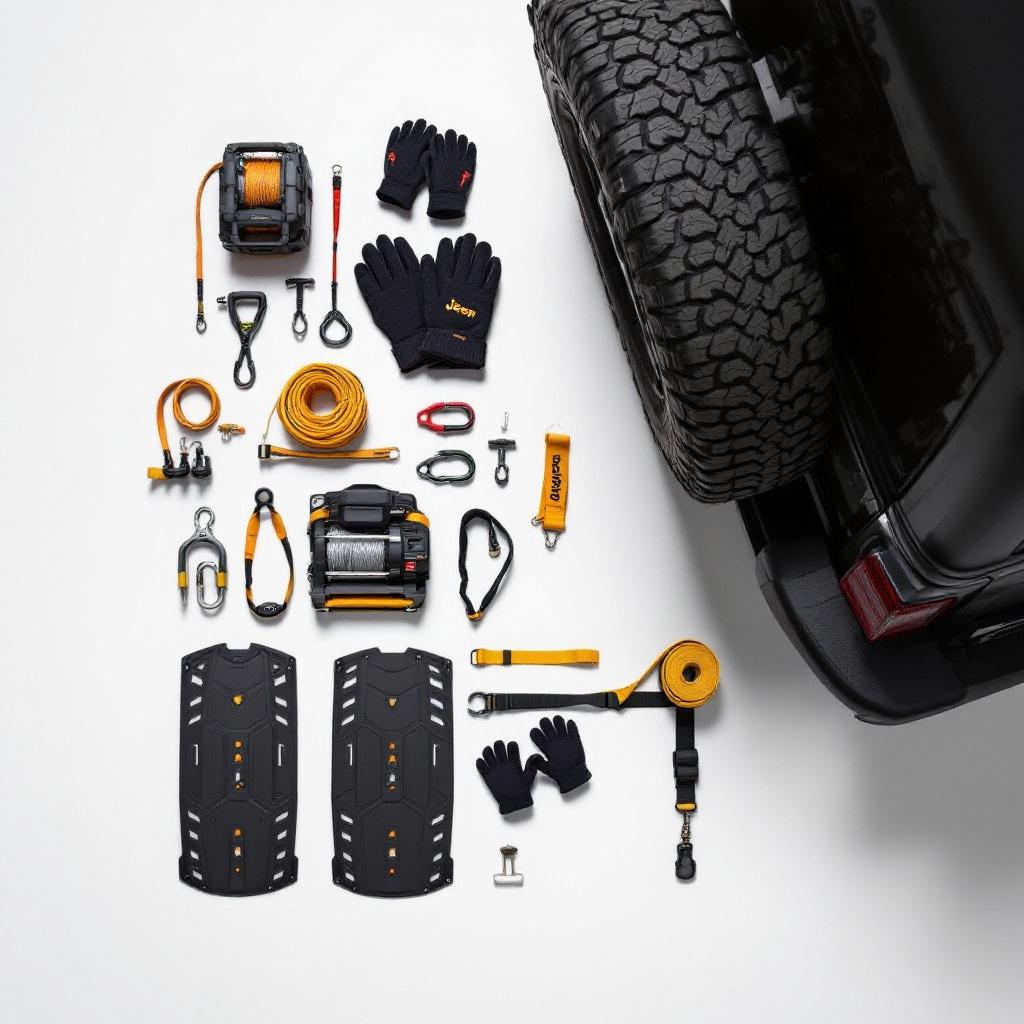
When your JK is buried to the axles in mud or high-centered on a rock, recovery gear is the difference between a quick extraction and an expensive tow. The right equipment—and knowing how to use it—can save your trail day and potentially your life.
This guide covers everything you need for safe, effective JK recovery, from the absolute essentials to the complete kit for remote trail adventures.
The Essential Recovery Kit
Every JK that leaves pavement should carry these basics. This kit handles 80% of trail situations and costs under $200.
Recovery Strap (Kinetic Rope)
The foundation of any recovery kit. A kinetic recovery strap stretches under load, storing energy that helps “snatch” stuck vehicles free with less stress on both vehicles. For a deep dive on rope selection, see our JK Kinetic Rope Guide.
What to look for:
- Length: 20-30 feet (20 ft minimum, 30 ft preferred)
- Width: 3 inches for JK use
- Breaking strength: 30,000+ lbs
- Stretch: 20-30% elongation
Never use:
- Tow straps (no stretch = shock loading)
- Chains (no give, can break and become projectiles)
- Ropes not rated for recovery use
| Strap Type | Stretch | Use Case | Safe for Snatch? |
|---|---|---|---|
| Kinetic recovery strap | 20-30% | Pulling stuck vehicles | ✅ Yes |
| Tow strap | 2-5% | Towing disabled vehicles slowly | ❌ No |
| Chain | 0% | Towing only, never recovery | ❌ No |
Pros:
- Most versatile recovery tool—works in mud, sand, snow, and rock
- Stored energy reduces stress on both vehicles compared to rigid tow straps
- Lightweight and compact—easy to store in any JK
- No anchor point needed (just a second vehicle)
Cons:
- Requires a second vehicle for use (can’t self-recover)
- Must be properly rated—undersized straps can snap under load
- Stretch can be dangerous if connections fail (always use a line damper)
- Degrades over time with UV exposure and moisture—inspect before every use
D-Ring Shackles
Connect your recovery strap to vehicle recovery points. Always use rated recovery shackles—not hardware store bow shackles. We cover the top options in our Best D-Ring Shackles for JK guide.
Specifications for JK:
- Size: 3/4-inch
- WLL: 4.75 tons (9,500 lbs) minimum
- Breaking strength: 28,500+ lbs
- Material: Forged steel, not cast
Quantity: Minimum 2, ideally 4 (allows for more recovery configurations)
Safety note: Finger-tighten the pin, then back off 1/4 turn. Over-tightening makes removal difficult; under-tightening allows the pin to unscrew during recovery.
Work Gloves
Handling recovery straps, cables, and chains can shred unprotected hands. Quality work gloves are cheap insurance.
Look for:
- Leather palms (synthetic tears easily)
- Reinforced fingertips
- Snug fit (loose gloves catch on hardware)
Basic Tool Kit
Not recovery-specific, but essential for trail repairs that prevent needing recovery in the first place. See our complete JK Trail Tool Kit guide for the full recommended list.
Minimum contents:
- Socket set (metric and standard)
- Adjustable wrench
- Pliers and wire cutters
- Screwdrivers (flat and Phillips)
- Electrical tape and zip ties
- JB Weld or epoxy
- Spare fuses
Get new guides by email
One email when we publish something worth reading. Unsubscribe anytime.
The Complete Recovery Kit
For serious trail use, remote areas, or wheeling without a group, expand your kit with these items.
Tree Saver Strap
Protects trees when using them as winch anchors. Also extends your winch line reach and prevents bark damage that kills trees (and gets trails closed).
Specifications:
- Length: 6-10 feet
- Width: 3-4 inches
- Breaking strength: 30,000+ lbs
- Material: Nylon or polyester webbing
Proper use: Wrap around tree trunk low (under 3 feet), connect both ends to your shackle. Never wrap your winch line directly around a tree.
Snatch Block
A pulley that redirects your winch line and doubles pulling power. Essential for serious winching.
Benefits:
- Doubles winch pulling capacity
- Allows angle pulls when straight pull isn’t possible
- Reduces load on winch motor (extends duty cycle)
- Creates mechanical advantage for difficult extractions
What to look for:
- Rating: 8-ton minimum for JK use
- Quality bearings (smooth rotation)
- Wide enough for your rope diameter
Traction Boards
When you’re stuck in sand, mud, or snow, traction boards provide a surface for your tires to grip. Often faster than winching and work without an anchor point. For detailed reviews, see our Best Traction Boards for JK comparison.
How they work: Place under spinning tires to provide traction. The textured surface grips both tire and ground, allowing you to drive out of the stuck situation.
Pros:
- No anchor point or second vehicle needed—true self-recovery tool
- Works in sand, mud, snow, and loose gravel where winching may not
- Lightweight and stackable—easy to mount on roof rack or carry inside
- Reusable hundreds of times with proper care
Cons:
- Premium boards (MAXTRAX) are expensive at $300+ per pair
- Can crack or break under extreme loads or in very cold temperatures
- Require getting out of the vehicle and positioning under tires
- Less effective on steep inclines where vehicle slides off the boards
Comparison:
| Brand | Price/Pair | Weight | Warranty | Best For | Link |
|---|---|---|---|---|---|
| MAXTRAX MKII | $300-350 | 8 lbs each | Lifetime | Serious off-roaders, frequent use | Check Price |
| X-Bull Gen 3 | $100-130 | 5.6 lbs each | 12 months | Occasional use, budget builds | Check Price |
| BUNKER INDUST | $80-120 | 6 lbs each | 1 year | Budget option, emergency use |


Winch Line Damper
If your winch line breaks under tension, a damper absorbs energy and drops the line instead of letting it whip. Essential safety gear for any winching operation.
Options:
- Damper bag: Weighted bag draped over the line
- Damper blanket: Heavy blanket placed over the line
- Floor mat: Works in a pinch (better than nothing)
Proper use: Place damper at the midpoint of the loaded cable. Use multiple dampers for long cable runs.
Hi-Lift Jack
The versatile “farm jack” can lift, spread, clamp, and winch. Essential tool for serious off-roaders, but requires training to use safely. Our JK Hi-Lift Jack Guide covers everything you need to know.
Uses:
- Lifting stuck vehicles
- Changing tires on uneven terrain
- Winching short distances without electric winch
- Spreading or clamping
Pros:
- Incredibly versatile—lift, winch, spread, and clamp with one tool
- Can lift a JK high enough to change tires on uneven terrain
- Works as a manual winch when no electric winch is available
- Built to last decades with minimal maintenance
Cons:
- Dangerous if misused—responsible for more trail injuries than any other tool
- Heavy at 25-30 lbs for a 48-inch model
- Requires solid, level footing and a base plate for soft ground
- Cannot be used safely with factory JK bumpers—needs aftermarket bumper or jack point
Safety warnings:
- Hi-lifts are dangerous if misused—get training
- Always use on solid, level footing
- Never work under a vehicle supported only by a hi-lift
- Carry a base plate for soft ground
Shovel
Sometimes the best recovery is digging yourself out. A quality folding shovel handles trail obstacles and campsite prep.
Look for:
- Folding design (stores easily)
- Steel blade (not aluminum)
- Serrated edge (cuts roots)
- D-handle or telescoping handle
Complete Recovery Kits
If you prefer one-stop shopping, these kits include most essential gear in a convenient package.
GearAmerica 25-Ton Recovery Kit
The most comprehensive kit available. Includes everything for serious recovery operations.
Kit includes:
- 25-ton snatch strap
- Tree saver strap
- Mega snatch block (50,000 lb MBS)
- D-ring shackles (68,000 lb MBS)
- Winch line damper bag
- Heavy-duty gloves
- Storage bag
Pros:
- Everything you need in one purchase—no hunting for individual components
- 25-ton rating handles even the heaviest JK recovery scenarios
- Lifetime warranty from GearAmerica backs every component
- Organized storage bag keeps gear accessible and protected
Cons:
- Premium price point at $250-300 for the complete kit
- Some experienced users prefer selecting individual components for higher specs
- Storage bag is bulky—takes significant cargo space in a JK
- Snatch block is overkill for most basic trail recoveries

GearAmerica 9-Ton Recovery Kit
Great starter kit for most JK recovery situations. Well-organized bag keeps gear accessible.
Kit includes:
- 9-ton recovery strap
- Tree saver strap
- Snatch block pulley
- D-ring shackles
- Winch line damper
- Gloves
- Organized storage bag
Communication & Safety Gear
Recovery gear gets you unstuck. Communication gear gets you help when recovery isn’t enough.
CB Radio
Still the standard for trail communication. Works anywhere, no cell service required.
Recommendation: See our Best JK CB Radio Guide for detailed recommendations.
GMRS/FRS Radios
Handheld radios for group communication. Better audio quality than CB, but shorter range.
When to use: Trail rides with a group, camp-to-trail communication.
Satellite Communicator
For remote areas without cell service. Can send GPS location and emergency messages.
Popular options:
- Garmin inReach (subscription required)
- SPOT devices
- Zoleo
First Aid Kit
Injuries happen during recovery operations. A quality first aid kit is non-negotiable. Check our Best JK First Aid Kit picks for trail-ready options. You should also carry a fire extinguisher for engine bay fires and trail emergencies.
Should include:
- Bandages and gauze
- Antiseptic
- Pain relievers
- Emergency blanket
- Any personal medications
Recovery Point Requirements
All your gear is useless without proper attachment points on your JK.
Factory Recovery Points
The JK has factory tow hooks, but they’re designed for flat-towing—not trail recovery. Their position and angle aren’t ideal for typical recovery scenarios.
Aftermarket Options
Front recovery points:
- Aftermarket bumpers with D-ring mounts (best option)
- Bolt-on recovery point brackets
- Bumper-integrated winch plates
Rear recovery points:
- Aftermarket rear bumpers with D-ring mounts
- Hitch-mounted recovery points (acceptable for lighter pulls)
- Frame-mounted shackle brackets
For bumper options with integrated recovery points, see our Best JK Front Bumpers and Best JK Rear Bumpers guides.
Storage Solutions
Recovery gear needs to be accessible, organized, and protected from the elements.
Where to Store Recovery Gear
| Location | Pros | Cons |
|---|---|---|
| Rear cargo area | Easy access, large capacity | Takes cargo space |
| Under rear seat | Hidden, secure | Limited space |
| Roof rack | Frees interior space | Adds height, weather exposure |
| Recovery bag on roll bar | Quick access, visible | Limited capacity |
| Tailgate storage | Easy access | Requires mount system |
Organization Tips
- Use a dedicated recovery bag — Keeps everything together and protects gear
- Store frequently used items on top — Shackles and gloves should be instantly accessible
- Keep straps clean and dry — Dirt and moisture weaken webbing
- Inspect before each trip — Check for fraying, rust, and damaged hardware
Recovery Gear Checklist by Budget
Budget Build ($150-250)
- Recovery strap (20 ft, 30,000 lb)
- D-ring shackles (2)
- Work gloves
- Tow strap (for disabled vehicle towing)
- Basic tool kit
Standard Build ($400-600)
Everything above, plus:
- Tree saver strap
- Snatch block
- Traction boards (X-Bull or similar)
- Winch line damper
- Folding shovel
- Recovery bag
Complete Build ($800-1,200)
Everything above, plus:
- MAXTRAX premium traction boards
- Hi-lift jack with base plate
- Soft shackles
- Synthetic rope extension
- CB radio
- First aid kit
- Satellite communicator
- Portable air compressor for re-inflating tires after airing down
- Tire deflators for consistent, hands-free air-down
Safety Rules for Vehicle Recovery
Recovery operations can be dangerous. Follow these rules to protect yourself and others.
Before Any Recovery
- Assess the situation — Is recovery safe and feasible?
- Clear bystanders — No one in the line of fire
- Inspect gear — Check for damage before use
- Plan your approach — Know what you’re doing before you start
- Communicate clearly — Use hand signals, agree on commands
During Recovery
- Never stand in line with tension — Straps and cables can break
- Use a line damper — Always, every time
- Take your time — Rushing causes accidents
- Stop if something seems wrong — Reassess the situation
After Recovery
- Inspect gear for damage — Replace anything compromised
- Clean and dry straps — Before storage
- Document what worked — Learn from each recovery
Related Articles
- Best Winches for Jeep JK — Complete winch buying guide
- JK Winch Installation Guide — Wiring and mounting
- Best JK Front Bumpers — Bumpers with recovery points
- Best JK CB Radio — Trail communication options
Final Thoughts
Building a proper recovery kit isn’t about buying the most expensive gear—it’s about having the right tools and knowing how to use them. Start with the essentials, practice recovery techniques in safe situations, and expand your kit as you gain experience.
Remember: the best recovery is the one you don’t need. Drive within your limits, know your JK’s capabilities, and always wheel with a plan for getting home. Proper maintenance and running the right all-terrain tires go a long way toward keeping you out of trouble in the first place. And if you’re still shopping for your JK, our JK Buyer’s Guide helps you pick the right platform for your off-road goals.
Related Guides
Explore more JK upgrade guides to complement your build:
- Armor & Protection Guide — our complete armor and protection overview
- Best JK Skid Plates — underbody protection options
- Rock Sliders vs Rocker Guards — side protection comparison
- Best JK Fender Flares — fender flare options for larger tires
- Best JK Steering Stabilizer — steering stabilizer options after lift
- Best All-Terrain Tires — tire choices for off-road capability
Free: JK Fluids at a Glance
Every fluid, spec and capacity for the 2007-2018 Wrangler JK on one page, plus a cut-out glovebox card. Checked against the owner's manuals. From the JK Service Kit.
Email me the download and new guides when they are published. Unsubscribe anytime. Privacy Policy.
Frequently Asked Questions
What recovery gear should I carry in my Jeep JK?
At minimum, carry a recovery strap (20-30 ft, 20,000+ lb rated), two D-ring shackles, work gloves, and a basic tool kit. For more serious trail use, add a snatch block, tree saver strap, traction boards, hi-lift jack, and a line damper. If you have a winch, carry synthetic rope extension, soft shackles, and a winch damper blanket.
What's the difference between a tow strap and a recovery strap?
A tow strap has minimal stretch and is designed for towing disabled vehicles at slow speeds. A recovery strap (kinetic rope) stretches 20-30% under load, storing energy that helps 'snatch' a stuck vehicle free. Never use a tow strap for snatch recoveries—the sudden load can break it and send hardware flying. Always use a purpose-built kinetic recovery strap.
Are cheap traction boards worth buying?
Budget traction boards like X-Bull ($100-120/pair) work well for occasional use and 'just in case' scenarios. They handle most recovery situations fine. Premium MAXTRAX ($300+/pair) are worth it if you wheel frequently in sand or mud, need extreme durability, or want the lifetime warranty. For most JK owners, mid-range boards offer the best value.
Do I need a winch if I have recovery straps?
Recovery straps work great when another vehicle is available to pull you out. A winch lets you self-recover when wheeling alone or when no anchor vehicle is positioned correctly. For remote trails or solo wheeling, a winch is essential. For group trail rides on moderate terrain, quality recovery straps may be sufficient.
What size D-ring shackles do I need for JK recovery?
3/4-inch D-ring shackles with a Working Load Limit (WLL) of 4.75 tons (9,500 lbs) are standard for JK recovery. This provides adequate margin for most recovery scenarios. Always check the WLL rating, not just physical size. Avoid cheap imported shackles—stick with brands like Rhino USA, GearAmerica, or Smittybilt.
What's a snatch block and do I need one?
A snatch block is a pulley that redirects your winch line. Running the cable through a snatch block and back to an anchor effectively doubles your winch's pulling power (at half the line speed). It also lets you pull at angles when a straight pull isn't possible. Essential for serious winching—worth the $50-100 investment.
Allan
I'm Allan. I own a 2014 Jeep Wrangler JKU and I research the hell out of every mod before I touch it. When I've fitted something to my own Jeep, I say so. Everything else is researched from manufacturer specs and other owners' reports. No sponsored fluff.
Learn more about me →Free: JK Fluids at a Glance
Every fluid, spec and capacity for the 2007-2018 JK on one page, plus a glovebox card.
Email me the download and new guides when they are published. Unsubscribe anytime. Privacy Policy.
Related Articles
Best JK Rocker Panel & Body Armor: Complete Protection Kits Ranked
JK body armor is any aftermarket steel or aluminum protection — rocker guards, rock sliders, skid plates, or tube fenders — bolted to a 2007–2018 Jeep...
Jeep JK Rock Sliders vs Side Steps: Protection, Looks & Which One You Actually Need
Rock sliders are heavy-gauge steel (or aluminum) tubes or plates that bolt or weld to your Jeep's frame, sitting flush along the rocker panels to...
Best Jeep JK Front Bumpers with Winch Mounts: Full-Width vs Stubby Compared
A Jeep JK front bumper with winch mount is a steel or aluminum replacement for your factory plastic fascia that bolts solid protection, integrated...