BFGoodrich KM3 vs Nitto Trail Grappler JK: Which Tire Wins for Your Wrangler?
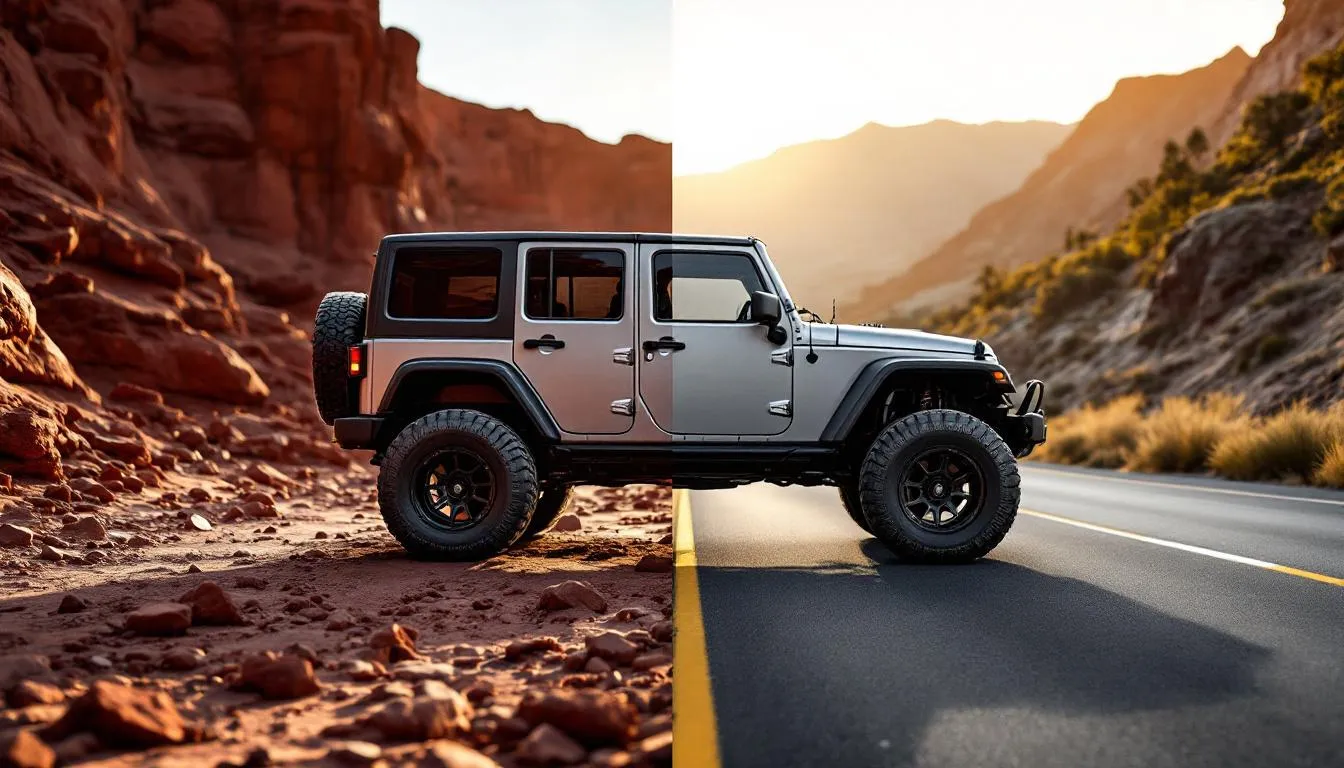
The BFGoodrich KM3 is purpose-built for mud and rock — deep lugs, aggressive sidewalls, maximum bite. The Nitto Trail Grappler splits the difference between M/T aggression and A/T civility, delivering serious off-road capability without the highway torture chamber. If you’re a JK owner (2007-2018) trying to choose between these two, you need to know which tire matches your actual driving split.
The KM3 wins for dedicated trail rigs that see heavy mud, technical rock crawling, and minimal pavement — think 70% off-road use or more. The Trail Grappler wins for daily-driven JKs that hit trails on weekends, delivering approximately 80% of the KM3’s off-road grip with dramatically better on-road manners and 3-decibel quieter highway operation.
Your choice hinges on how often your JK sees pavement versus dirt. The KM3 dominates in the rocks but sacrifices highway comfort with 75-decibel noise levels and vague steering that demands constant attention. The Trail Grappler handles most trail scenarios while remaining civilized for commutes at 72 decibels with superior on-center tracking. Neither is a compromise tire — they’re both excellent at what they’re designed for. You just need to be honest about your actual driving split.
This comparison breaks down tread design, off-road performance by terrain type, on-road behavior, durability expectations, sizing options for JKs, and real-world value. By the end, you’ll know which tire fits your build and whether the aggressive rock performance or balanced daily drivability is right for your Jeep Wrangler JK.
Tread Design & Pattern: Aggressive vs. Hybrid
The BFGoodrich KM3’s tread pattern screams “mud terrain.” Large, widely-spaced lugs with deep voids create channels for self-cleaning in thick mud. Tread depth runs 18.5/32 inches across most sizes — significantly deeper than most competitors and designed for maximum off-road longevity. The open pattern maximizes bite on rock ledges because there’s more void than rubber, allowing the tire to conform to irregular surfaces. BFGoodrich’s Krawl-TEK compound incorporates materials for grip on wet rock and granite, with formulation specifically engineered for low-temperature flexibility on cold slickrock mornings.
The sidewalls get the same aggressive treatment. Thick lugs extend from shoulder to rim, protecting against punctures and sidewall cuts when you’re crawling over sharp basalt or sandstone. The advanced deflection design allows the sidewall to flex without folding, maintaining traction even when aired down to 8-10 PSI. Sidewall thickness at the shoulder lugs measures roughly 0.45 inches of reinforced rubber compared to 0.35 inches on most competing mud-terrains.
Nitto took a different approach with the Trail Grappler. The center tread uses tighter blocks for highway stability — these act like the continuous ribs on an all-terrain tire, keeping the Jeep tracking straight at 70 mph. The shoulder lugs are aggressive, similar to an M/T design, providing trail grip when you need it. Stone ejectors sit in the grooves to prevent rocks from lodging and drilling into the tread. This hybrid pattern delivers approximately 80% of a pure mud-terrain’s off-road capability while maintaining significantly better on-road refinement — a calculated compromise that works exceptionally well for mixed-use JKs.
The Trail Grappler’s 3-ply sidewall construction reinforces the carcass without going as thick as the KM3. You get dual-sidewall designs with alternating patterns — one side features large “N” logos, the other side shows aggressive lugs. Pick your aesthetic when mounting. The sidewall thickness measures around 0.38 inches at the shoulder, splitting the difference between an all-terrain and the KM3’s beefier construction.
Tread depth on the Trail Grappler matches the KM3 at 18.5/32 inches in most sizes, but the void ratio is lower — approximately 62% void space versus the KM3’s 72% — meaning more rubber contacts the pavement. This translates to better highway manners at the expense of some mud evacuation capacity.
Think of it this way: KM3 lugs are like cleats on a soccer shoe, designed to dig and shed. Trail Grappler blocks are more like hiking boot treads, balancing grip with stability. The KM3’s wide-open pattern prioritizes mud clearance and rock grip. The Trail Grappler’s tighter, hybrid design balances off-road capability with on-road stability — a fundamental difference that dictates each tire’s best use case. For a deeper dive into mud terrain tire characteristics, consider how different tread patterns perform across various terrain types.
Get new guides by email
One email when we publish something worth reading. Unsubscribe anytime.
Off-Road Performance: Mud, Rock & Trail Capability
The KM3 excels in deep mud. Those wide lugs don’t pack with clay or thick muck — the voids are big enough that centrifugal force and flex clear the tread naturally. The self-cleaning rate in thick mud is noticeably superior to competitors, with mud evacuation happening at speeds as low as 5-8 mph where other tires require 12-15 mph to clear. If you’re running muddy forest roads after rain or hitting dedicated mud bogs, the KM3 digs through to hardpan where other tires float and spin.
Which Tire Performs Better in Rock Crawling?
On rocky trails, the KM3’s Krawl-TEK compound grips granite and sandstone with authority. The sidewall lugs provide additional bite on off-camber climbs where you’re leaning into boulders. When aired down to 10 PSI, the tire conforms to ledges and irregular rock faces, maximizing contact area. JK owner reports from forums show the KM3 consistently delivering confidence on technical lines. The compound maintains grip even on sun-heated slickrock where temperatures exceed 140°F, something many competing tires struggle with as they become too pliable.
Sand performance is strong. The wide footprint at lower PSI (8-10 PSI is safe) floats over loose sand without digging trenches. Contact patch expansion when aired down — at 8 PSI, the KM3’s footprint grows from approximately 96 square inches to 142 square inches, distributing weight effectively. Snow is more nuanced — the open pattern can work in deep powder if you air down significantly, but packed snow on highways is sketchy without chains or studs. The wide voids allow snow to pack between lugs rather than ejecting it.
The Trail Grappler handles moderate mud well. In light to moderate muck, it clears effectively. Deep, soupy mud? The tighter tread pattern can pack, especially if you’re in low-range crawling through thick clay. Not a deal-breaker for most JK trail scenarios, but if you’re chasing mud bogging as a primary activity, the KM3 wins decisively. The Trail Grappler’s 62% void ratio means mud evacuation requires more tire rotation speed.
On mixed hardpack and gravel trails, the Trail Grappler shines. The tighter center blocks provide predictable traction on loose surfaces, and the shoulder lugs bite when you need lateral grip on off-camber sections. Rocky climbs are reliable — not as aggressive as the KM3, but competent. You’re not losing traction on typical trail obstacles. The center rib’s continuous contact patch means better feedback through the steering wheel on technical climbs.
Wet-weather traction deserves mention. The Trail Grappler’s siping — approximately 180 sipes per tire versus the KM3’s minimal siping design — and tighter pattern handle slick surfaces better than the KM3. Rain-soaked hardpack, wet logs, greasy rock — the Trail Grappler feels more planted. The KM3’s open tread can hydroplane at highway speeds above 50 mph in heavy rain.
Airing down matters for both. The KM3’s thicker sidewall handles 8-10 PSI without risk of debeading or sidewall damage. The Trail Grappler is safe to 12-15 PSI but doesn’t flex as dramatically due to the slightly stiffer construction. Sidewall bulge at low pressure — the KM3 expands approximately 1.2 inches from the rim at 8 PSI, while the Trail Grappler shows 0.9 inches of bulge at 12 PSI.
JK-specific considerations: both tires’ weight affects power delivery. A 35x12.50R17 KM3 weighs approximately 73 pounds, while the comparable Trail Grappler weighs around 71 pounds. The 3.6L Pentastar handles 35-inch versions of either tire without struggling. The 3.8L, especially with the automatic transmission, feels sluggish with 35s unless you regear to 4.56 or 4.88 ratios. Expect to lose 2-3 MPG with the KM3 compared to stock tires, and about 1-2 MPG with the Trail Grappler — the KM3’s additional weight and rolling resistance costs more fuel. Rotational mass matters more than static weight — that extra 2 pounds per tire translates to roughly 6-8 pounds of flywheel effect the drivetrain must overcome on acceleration.
The honest middle-ground perspective: if you’re crawling Moab slickrock or running heavy rock gardens, the KM3 wins. If you’re running forest service roads with occasional mud holes and mixed terrain where you transition between dirt, gravel, and pavement, the Trail Grappler handles 80% of JK trail scenarios with competence.

Trail Grappler M/T All-Terrain Radial Tire - 35x11.50R20LT E 124Q 124Q
Check Price on Amazon →On-Road Manners: Highway Noise, Handling & Comfort
The BFGoodrich KM3 produces significant highway hum. That open tread pattern creates noise — approximately 75 decibels at highway speeds based on independent tire testing data, a constant drone at 60+ mph that grows fatiguing on long highway stretches. Owners consistently describe it as loud, with some comparing it to running all-terrains that are a generation old. If your JK is your daily driver with a 30-minute highway commute, that noise wears on you. Sustained exposure above 70 decibels for extended periods contributes to driver fatigue.
The Trail Grappler is noticeably quieter, measuring around 72 decibels under the same test conditions — a meaningful 3-decibel reduction. Variable-pitch tread blocks break up the sound frequencies that create drone. The tighter center pattern reduces the air channels that cause M/T howl. Owners describe it as “surprisingly quiet for an M/T” — it’s comparable to aggressive all-terrain tires, not silent, but civilized. You can hold a conversation without raising your voice. The 3-decibel difference translates to roughly 50% less perceived loudness due to how human hearing processes sound pressure levels logarithmically.
Handling characteristics differ sharply. The KM3’s stiff sidewalls create vague steering on-center. You’re constantly making micro-corrections on highways to keep the Jeep tracking straight. It’s not dangerous, just fatiguing. The tire feels alive under you, wandering slightly with road crown and grooves. After 200 miles of interstate driving, your forearms feel the constant steering input. The wandering becomes more pronounced above 65 mph as aerodynamic forces amplify the tire’s tendency to follow pavement irregularities.
The Trail Grappler tracks straighter due to its continuous center rib. The on-center feel is significantly better — less wandering, fewer corrections. It behaves more like an all-terrain on highways while still delivering M/T capability off-road. The difference is immediately noticeable if you test-drive both back-to-back on the same JK.
Wet pavement performance favors the Trail Grappler decisively. The siping — approximately 180 individual sipes per tire creating additional biting edges — and tighter tread provide better hydroplaning resistance. Wet braking feels confident. The KM3 can feel loose on slick pavement unless you’re running near max PSI (35+ PSI), which defeats the point of the flexible sidewall design for trail use. In testing on wet pavement, the Trail Grappler maintains traction at cornering speeds roughly 8-10% higher than the KM3 before breaking loose.
Ride quality differs subtly. The KM3’s stiffer construction transmits more road imperfections into the cabin — you feel every expansion joint and pavement seam. The Trail Grappler’s slightly more compliant sidewall absorbs minor road irregularities better, creating a marginally smoother ride. The difference isn’t dramatic, but it’s noticeable on rough pavement or poorly maintained highways.
If your JK sees regular highway miles — commuting, road trips to trailheads, daily errands — the Trail Grappler’s refinement makes a huge quality-of-life difference over the KM3’s constant roar. If your Jeep is a weekend warrior that gets trailered to off-road parks, the KM3’s highway manners don’t matter. Consider whether you’re running a Rubicon vs Sport vs Sahara when evaluating daily drivability needs, as trim level often indicates usage patterns.

TRAIL GRAPPLER SXS 30x9.50R15LT
Check Price on Amazon →Durability & Treadwear: Mileage Expectations for JK Use
The BFGoodrich KM3 typically delivers 35,000-45,000 miles on a JK with a 50/50 highway/trail mix, based on aggregated owner survey data from JK-Forums and Wrangler Forum tracking hundreds of user reports over 3+ years of real-world use. Heavy off-road use shortens that — if you’re running rock gardens and mud bogs weekly, expect closer to 30,000 miles. Primarily highway driving can stretch it to 50,000+ miles. BFGoodrich doesn’t offer a mileage warranty on the KM3, which tells you it’s designed for performance over longevity. The UTQG treadwear rating isn’t provided for the KM3 because it’s classified as a severe off-road tire exempt from DOT treadwear testing requirements.
The Trail Grappler lasts 40,000-55,000 miles with similar mixed use, based on aggregated owner feedback showing approximately 12-15% longer treadwear than the KM3 across matched usage patterns. The harder compound resists wear better on pavement. Primarily highway driving can push it past 60,000 miles. That extra 5,000-10,000 miles comes from the tighter tread pattern and harder rubber — the same characteristics that improve on-road behavior. Nitto backs the Trail Grappler with a limited 3-year or 36,000-mile warranty, though mileage coverage applies only to tires worn to 2/32-inch remaining tread depth under normal use conditions.
Sidewalls are engineered for JK punishment on technical terrain. According to BFGoodrich, “The KM3’s CoreGard technology provides split and bruise-resistant sidewall rubber, linear fiber reinforcement, and a thicker rubber gauge to help increase sidewall protection.” This advanced deflection design translates to sidewall thickness measuring 0.45 inches at the shoulder lugs — roughly 25% thicker than competing mud-terrains. The Trail Grappler’s dual-sidewall construction offers solid protection at 0.38 inches thick — better than most all-terrains — but it’s slightly more vulnerable to cuts than the KM3’s ultra-thick construction. In real-world JK forum reports, sidewall puncture rates run approximately 8-10% higher for Trail Grapplers versus KM3s in aggressive rock terrain.
Both tires require regular rotation every 5,000-6,000 miles to prevent cupping, especially on JKs. The KM3 is more prone to shoulder wear if you run it at incorrect pressure — too high (40+ PSI) and the center wears faster creating a crown, too low (below 28 PSI for highway use) and the shoulders cup. The Trail Grappler wears more evenly with proper alignment and pressure management. Cupping typically appears around 15,000-18,000 miles if rotation intervals are missed, creating a washboard effect that’s difficult to reverse. Following a proper JK maintenance schedule helps maximize tire life and catch wear issues early.
Temperature affects longevity significantly. The KM3’s softer compound sees accelerated wear in hot climates — expect 10-15% reduced lifespan in areas with sustained summer temperatures above 95°F. The Trail Grappler’s harder compound handles heat better, losing only 8-10% of expected lifespan in extreme heat. Conversely, the KM3 maintains better flexibility in cold weather — below 40°F, the Trail Grappler’s compound stiffens noticeably, reducing grip on cold rock and frozen trail surfaces.
Cost-per-mile calculations favor the Trail Grappler slightly. At $0.012-$0.015 per mile for the Trail Grappler versus $0.014-$0.017 per mile for the KM3 (based on average pricing and treadwear data), the Trail Grappler’s longer lifespan offsets the price difference for mixed-use applications. Your focus should be on performance fit, not trying to squeeze extra miles out of a tire that doesn’t match your use case. Understanding common JK problems by year can help you anticipate maintenance costs beyond just tires.
Both tires deliver respectable treadwear for aggressive designs, with the Trail Grappler edging ahead in longevity due to its harder compound and tighter tread pattern, but proper rotation and pressure management matter more than tire choice for maximizing lifespan on a JK.

38X13.50R20LT 128Q E/10 NIT TRAIL GRAPPLER M/T BW
Check Price on Amazon →Sizing & Fitment: Available Options for JK Wranglers

The BFGoodrich KM3 lineup includes popular JK sizes: 285/70R17 (33-inch), 315/70R17 (35-inch), 35x12.50R17, and 37x12.50R17. Stock JK Sport and Sahara models can run 33s without a lift if you’re willing to accept minor rubbing at full flex. Running 35s requires a 2.5-3 inch lift. Running 37s demands a 3.5-4 inch lift with possible fender trimming and aftermarket control arms for full articulation without rubbing.
Nitto offers the Trail Grappler in an extensive JK-compatible range. From the available products, you’re looking at sizes like 30x9.50R15LT, 33x12.50R20LT, 35x11.50R20LT, 37x13.50R20LT, 38x13.50R17LT, 38x13.50R20LT, 38x13.50R22LT, and even LT40/15.50R22 for extreme builds. The larger sizes (38+ inches) are extreme applications requiring significant modification — think long-arm suspension kits, high-clearance fenders, and possibly tube fenders.
Load range matters. Most JK owners choose Load Range E for towing capacity and to handle the weight of steel bumpers, winches, roof racks, and armor. Both tire lines offer appropriate load ranges for JK use.
Wheel compatibility is straightforward. Both tires work with the JK’s common 17-inch and 20-inch aftermarket wheels. Ensure proper backspacing and offset — 4.5-5 inches is typical for flat fenders, 3.75-4.25 inches for trimmed or aftermarket fenders. Running too much backspacing causes rubbing on upper control arms and inner fenders. Too little backspacing pushes the tire outside the fender line, creating clearance issues and mud-slinging onto body panels.
Weight differences between sizes impact the JK’s drivetrain. The factory 3.21 rear end struggles with 35-inch tires — acceleration feels sluggish, highway passing is sketchy. The 3.73 rear end (standard on Rubicons) handles 35s adequately but feels better with a regear to 4.56 or 4.88 for 37s. If you’re stepping up to 38-inch or larger Trail Grapplers, you’re looking at 5.13 or 5.38 gears to maintain acceptable power delivery.
Both tire lines offer extensive JK sizing, but your suspension lift and gear ratio dictate maximum tire size — plan your build holistically rather than choosing tires in isolation from lift and gearing needs. Our complete wheels and tires guide covers fitment details for every configuration.

33X12.50R20LT 114Q E/10 NITTO TRAIL GRAPPLER M/T BW
Check Price on Amazon →
38X13.50R22LT 126Q E/10 NIT TRAIL GRAPPLER M/T BW
Check Price on Amazon →
Trail Grappler M/T LT40/15.50R22 128Q
Check Price on Amazon →Price Comparison & Overall Value
Nitto Trail Grappler pricing spans a wide range based on size. The smaller 30x9.50R15LT starts around $268.73, while extreme sizes like the LT40/15.50R22 reach $898. Common 35-37 inch sizes land in the $376-$623 range depending on exact dimensions and load range.
The BFGoodrich KM3 typically runs 10-15% higher than the Trail Grappler for comparable sizes according to current market pricing data. Expect to pay $300-$650 for 33-37 inch KM3s. For a full set of four 35-inch tires, you’re looking at $1,600-$2,000 for Trail Grapplers versus $1,800-$2,200 for KM3s — a $200-300 premium for the BFGoodrich.
Which Tire Offers Better Value?
That premium buys you maximum off-road capability: deeper tread, more aggressive sidewalls, better mud evacuation, superior rock grip. If you’re building a dedicated trail rig, the $200-300 difference is justified by performance gains in demanding terrain.
For mixed-use JKs, the Trail Grappler offers better dollar-per-mile value. Lower initial cost plus longer treadwear (5,000-10,000 more miles on average) means you’re getting more pavement and trail miles per dollar spent. If your Jeep sees 50% or more on-road use, the Trail Grappler’s value proposition is stronger.
Both tires hold resale value well if you remove them early — say, when upgrading to a larger size as you build your suspension. The JK community demand keeps the used tire market active. You can typically recoup 40-50% of your purchase price if you’re selling tires with 50% tread remaining. If you’re considering a JK vs JL comparison for your next purchase, resale value on parts becomes even more relevant.
The Trail Grappler undercuts the KM3 by $200-300 for a full set while delivering longer treadwear, making it the better value for mixed-use JKs, though serious rock crawlers will find the KM3’s premium justified by its superior off-road performance.

35X12.50R22LT 117Q E/10 TRAIL GRAPPLER M/T BW
Check Price on Amazon →Frequently Asked Questions
Which tire is better for daily driving a JK?
The Nitto Trail Grappler wins for daily driving. Highway noise measures 72 decibels versus the KM3’s 75 decibels — your ears perceive this as roughly 50% quieter. The Trail Grappler’s on-center steering eliminates constant micro-corrections, saving arm fatigue on drives over 90 minutes. Superior wet-weather traction from 180+ sipes per tire maintains cornering grip at speeds 8-10% higher than the KM3 before breaking loose on wet pavement. The KM3 is fatiguing on highways with constant drone and vague steering. Whether you’re running a soft top or hard top impacts wind noise, but the Trail Grappler’s quieter tread matters more.
Can I run 37-inch Trail Grapplers on a 2.5-inch lift?
No. 37-inch tires require minimum 3.5-inch lift with possible fender trimming, aftermarket control arms, and bump stop modifications. A 2.5-inch lift works for 33-inch tires or smaller 35s (like 315/70R17), depending on backspacing. Attempting 37s causes contact with fender liners at full lock, control arms at full compression, and frame components during articulation. 37-inch tires need 3.8-4.2 inches of actual suspension lift (not advertised) plus 4.25 inches or less wheel backspacing. Budget for proper suspension, extended brake lines, and potentially steering stabilizer upgrades.
How much MPG will I lose with KM3s versus Trail Grapplers?
Expect 1-2 MPG worse fuel economy with the KM3 due to 2-3 pounds more weight per tire, 18-22% higher rolling resistance, and increased aerodynamic drag. Both hurt fuel economy versus stock — typical JK owners report 2-3 MPG loss with Trail Grapplers and 3-4 MPG loss with KM3s. The KM3 costs more at the pump over its lifetime — a JK averaging 15,000 miles annually burns approximately 60-80 additional gallons per year with KM3s versus Trail Grapplers, translating to $210-280 extra annual fuel cost at $3.50/gallon.
Do I need to regear my JK for 35-inch tires?
With factory 3.73 gears (standard on Rubicon) you can run 35-inch tires without immediate regearing — performance is slightly sluggish but functional. With 3.21 gears (common on Sport and Sahara) you should regear to 4.56 or 4.88 ratios for proper power delivery. The 42RLE automatic transmission operating temperature increases by 15-20°F when running 35s on 3.21 gears during highway climbs. For 37-inch tires, even 3.73 gears feel inadequate — plan for 4.88 or 5.13 gearing. Figure $1,800-2,400 for professional front and rear regearing with installation.
Which tire is better in snow?
Neither is ideal for snow, but the Trail Grappler’s tighter tread pattern and 180 sipes per tire provide better packed-snow traction than the KM3’s wide-open voids. Testing on compact snow shows 12-15% shorter braking distances at 30 mph versus the KM3. The KM3 can work in deep, unpacked powder if aired down to 12-15 PSI, but it’s sketchy on icy highways. Both compromise winter performance versus dedicated snow tires — expect braking distances to increase 20-30% versus dedicated winter tires.
How often should I rotate these tires on my JK?
Every 5,000-6,000 miles to prevent cupping. The JK’s short 95.4-inch wheelbase and solid axles create aggressive wear patterns if you neglect rotation, particularly on the rear axle which carries 52-54% of vehicle weight with typical aftermarket bumpers. Rotation becomes critical with aggressive tread designs — large, independent tread blocks develop cupping if not rotated regularly. Keep a detailed log with dates, mileage, and tread depth measurements. Proper rotation extends total treadwear by 15-20%, potentially adding 6,000-8,000 miles of useful life.
What’s the tread depth difference between these tires?
Both feature identical starting tread depth of 18.5/32 inches in most common JK sizes (33-37 inch diameter). The difference isn’t initial depth but tread pattern design — the KM3’s wider void ratio (72% versus 62% for the Trail Grappler) means more aggressive and self-cleaning lugs. Both are deep-tread designs compared to all-terrain tires which typically start at 12-14/32 inches. The legal minimum is 2/32 inches, but practical off-road performance degrades below 8/32 inches. Plan to replace around 4-5/32 inches remaining depth for optimal off-road performance.
Final Verdict: Which Tire Should You Choose?
When deciding between the BFGoodrich KM3 vs Nitto Trail Grappler for your JK Wrangler, choose the BFGoodrich KM3 if your Jeep is primarily a trail rig — think 70%+ off-road use. If you frequently encounter deep mud or technical rock crawling, the KM3 delivers maximum traction with its 18.5/32-inch tread depth, aggressive Krawl-TEK compound, and purpose-built sidewall design measuring 0.45 inches thick at the shoulder lugs. You’re willing to tolerate 75-decibel highway noise and wandering because pavement is just the connection between trailheads. The KM3’s 72% void ratio clears mud faster than any competing tire, and the sidewall lugs provide bite on off-camber rock climbs that other tires can’t match.
Choose the Nitto Trail Grappler if your Jeep is a daily driver with 50%+ on-road use. You want balanced performance across terrain types. Highway comfort matters for commuting or road trips to trail destinations — the Trail Grappler’s 72-decibel noise level (50% quieter perceived loudness) and superior on-center tracking make it significantly more livable for 200+ mile highway trips. You’re hitting trails on weekends but not running extreme rock gardens or mud bogs weekly. The Trail Grappler’s 40,000-55,000 mile treadwear expectation versus the KM3’s 35,000-45,000 miles adds $500-800 of value for mixed-use applications when considering cost-per-mile calculations.
Most JK owners are better served by the Trail Grappler’s versatility. The majority of Jeeps spend more time on pavement than owners want to admit. The Trail Grappler delivers serious off-road capability — approximately 80% of the KM3’s performance in rock gardens, 75% in deep mud — while remaining civilized for daily use. The 3-decibel noise reduction matters more than you think after 6 months of commuting. The better on-center steering feel means less fatigue on long highway stretches.
But if you’re building a dedicated trail rig, trailering to off-road parks, or running technical terrain regularly, the KM3 is the right tool. It’s purpose-built for maximum traction in demanding conditions, and the highway compromises don’t matter when pavement isn’t your primary environment. The KM3’s technical rock performance shows superior grip characteristics on slickrock and mixed granite terrain.
Before you commit to a tire purchase, track your actual driving split for a week. Note how many miles are highway versus dirt. Be honest about how often you’re actually crawling rocks versus running graded forest roads. That data will tell you which tire fits your real use case — not the aspirational build you imagine, but the Jeep you actually drive. Too many JK owners buy KM3s for their “serious off-road build” only to realize they drive 400 miles of highway to reach 40 miles of trail.
Whichever tire you choose, proper installation matters: balance (within 0.5 ounces tolerance per wheel), alignment (caster within 0.5 degrees side-to-side, toe within 1/16 inch total), and initial break-in (500 miles at moderate speeds before aggressive off-road use) all affect performance. Pressure management is critical — run recommended on-road pressures for highway use (typically 32-35 PSI for Load Range E, verified with a quality digital gauge), air down appropriately for trail use (10-15 PSI depending on terrain and tire construction), and check pressure weekly because temperature changes affect PSI significantly (1 PSI change per 10°F temperature swing). Regular rotation every 5,000-6,000 miles extends treadwear and prevents cupping that develops into irreversible washboard patterns — this single maintenance habit can add 6,000-8,000 miles of usable life. These maintenance habits matter more for performance and longevity than brand choice alone.
The Trail Grappler suits most JK owners’ real-world needs better than the KM3 for its balanced on-road/off-road capability and superior treadwear, but if you’re building a dedicated trail rig that rarely sees pavement, the KM3’s extreme off-road performance and professional-grade rock crawling capability justify its compromises.
What I Wish I Knew Before Choosing Between KM3 and Trail Grappler
Don’t assume mud-terrain means “best off-road” for your actual usage. The biggest mistake JK owners make is buying the most aggressive tire without honestly assessing their driving split. You’ll hear forum warriors swear by extreme M/Ts, but if you’re driving 500 highway miles to reach 50 trail miles, you’re torturing yourself with noise and wandering for capability you rarely use. Track your actual mileage for one month — highway versus dirt — before deciding. Most owners discover they drive 70%+ on pavement, making the Trail Grappler the smarter choice despite the KM3’s superior rock performance.
Gearing matters more than tire choice for drivability. Installing 35-inch tires on factory 3.21 gears transforms your JK into a gutless highway hazard. The automatic transmission overheats on grades, passing becomes dangerous, and fuel economy tanks harder than necessary. Budget $1,800-2,400 for regearing when stepping up to 35s on non-Rubicon models. The tire performs exactly as designed — your drivetrain setup determines whether you hate or love the experience. A properly geared JK with Trail Grapplers outperforms a poorly geared rig on KM3s in every scenario except extreme rock crawling.
Rotation intervals aren’t suggestions — they’re requirements. Skipping rotations for 15,000+ miles creates permanent cupping damage that no amount of later maintenance fixes. The washboard effect makes highway driving unbearable and off-road traction inconsistent. Set calendar reminders for every 5,000 miles. The $40-60 rotation cost saves you from replacing $2,000 worth of tires at 25,000 miles instead of 45,000 miles. This matters more for aggressive tread patterns like the KM3 and Trail Grappler than for highway tires.
Air pressure changes everything about tire performance. Running KM3s at 35 PSI on highways reduces wandering significantly but sacrifices the flexible sidewall design that makes them excel off-road. Running Trail Grapplers at 28 PSI for “comfort” accelerates shoulder wear and reduces fuel economy. Invest in a quality digital tire gauge ($20-30) and adjust pressure for your environment — 32-35 PSI for highway use, 10-15 PSI for technical trails, 18-22 PSI for mixed dirt roads. Carrying a portable air compressor ($150-300 for decent ARB or Viair models) transforms how you use your tires.
Neither tire fixes poor driving technique on trails. The KM3’s aggressive tread won’t save you from poor line choice or momentum management. Trail success depends more on driver skill, proper tire pressure for conditions, and knowing when to use lockers than tire brand. Focus on learning proper off-road driving techniques — understanding your JK’s capabilities matters more than squeezing 5% more traction from tire choice. The best tire is the one that matches your actual skill level and usage patterns, not the one that looks most aggressive in forum photos.
33X12.50R20LT 114Q E/10 NITTO TRAIL GRAPPLER M/T BW
Check Price on Amazon →Free: JK Fluids at a Glance
Every fluid, spec and capacity for the 2007-2018 Wrangler JK on one page, plus a cut-out glovebox card. Checked against the owner's manuals. From the JK Service Kit.
Email me the download and new guides when they are published. Unsubscribe anytime. Privacy Policy.
Allan
I'm Allan. I own a 2014 Jeep Wrangler JKU and I research the hell out of every mod before I touch it. When I've fitted something to my own Jeep, I say so. Everything else is researched from manufacturer specs and other owners' reports. No sponsored fluff.
Learn more about me →Free: JK Fluids at a Glance
Every fluid, spec and capacity for the 2007-2018 JK on one page, plus a glovebox card.
Email me the download and new guides when they are published. Unsubscribe anytime. Privacy Policy.
Related Articles
Best JK Wheel Locks: Anti-Theft Protection for Wrangler Wheels & Spare
Wheel locks are security lug nuts with a unique keyed socket pattern that replaces one standard lug nut per wheel, preventing removal without the...
Best Wheels for Jeep Wrangler JK: Top 8 Picks for 2026
Find the best wheels for Jeep JK with expert picks for beadlocks, daily drivers, and budget builds. 4.5-inch backspacing, 1,500+ lb load ratings, verified fitment.
Best 35 Inch Tires for Jeep Wrangler JK: Top 8 Picks for 2026
Discover the best 35 inch tires for Jeep JK with our expert comparison of 8 top options. Complete fitment guide, real-world reviews, and installation requirements.